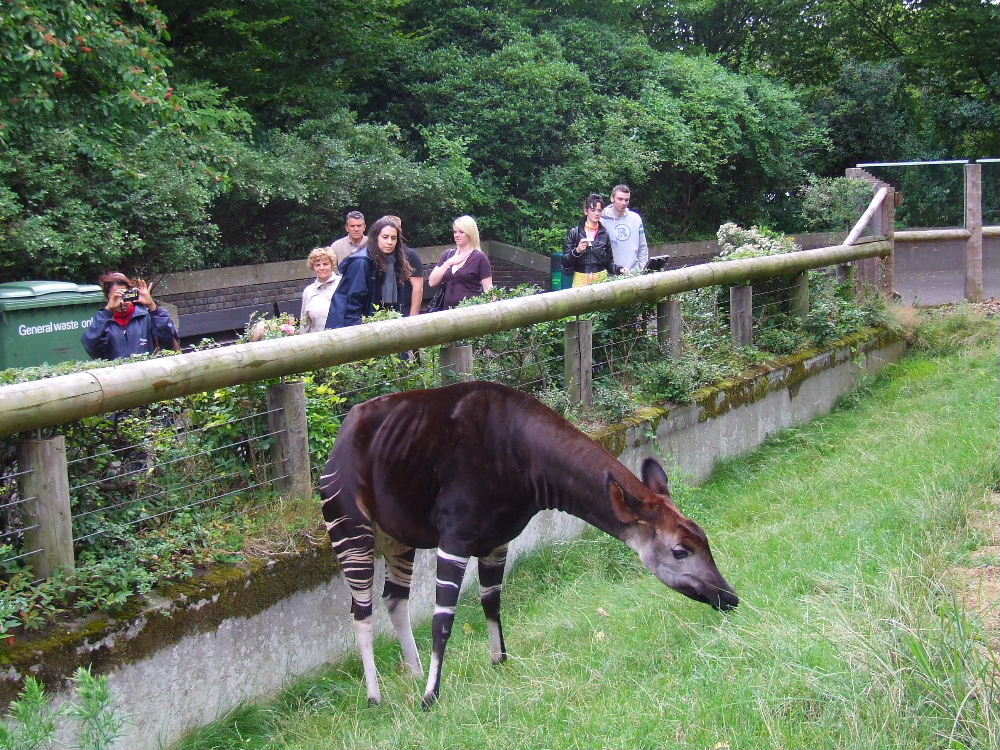
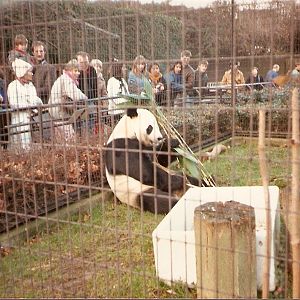
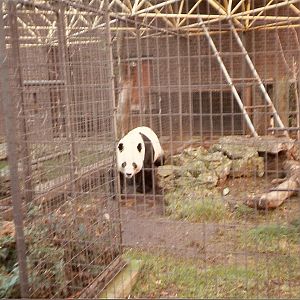
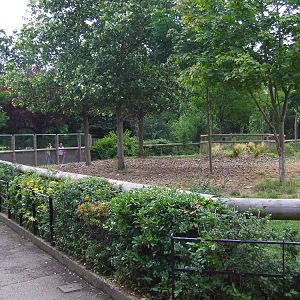
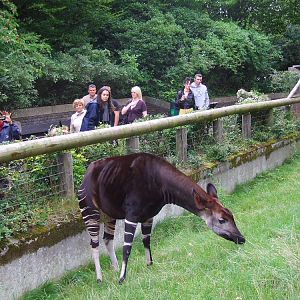
There are several(4?)trees- Acacia etc for shade. The bank where the Okapi is standing eating grass is the filled-in water moat section of the paddock, which as one of the Cotton Terrace paddocks was originally a square flat gravel/sand area.. If you can find any photos in the Gallery of the Gaur(or Bison?)at London, that is what the enclosure was like originally as its the same enclosure. The two young Indian rhino females from Nepal also lived in this same enclosure for a while before going to Whipsnade.
Now the flat part is sandy/woodchip floored but with about four planted trees, while the filled in water moat is now sloping grassy banks and there is also a glass viewing window at the corner(far right in picture). Its a big impovement.
Thats a much better angle, although once chester's trees have established them self's I think it will make a much better enclosure. Although by then they will be in Heart of Africa.
Here's an animal that lives in dense deep forest; so overgrown that their prime survival behavior is to push into thick growth and simply stand still. (One big reason why Western science didn't know anything about them until a bit over a century ago). And yet it is "displayed" as a horse in a paddock. To my mind it is like a pinned butterfly. I don't know what stress such an enclosure puts on the animal (@okapikpr?) but it is presented to visitors as a mere thing rather than a living species that evolved in a specific habitat.