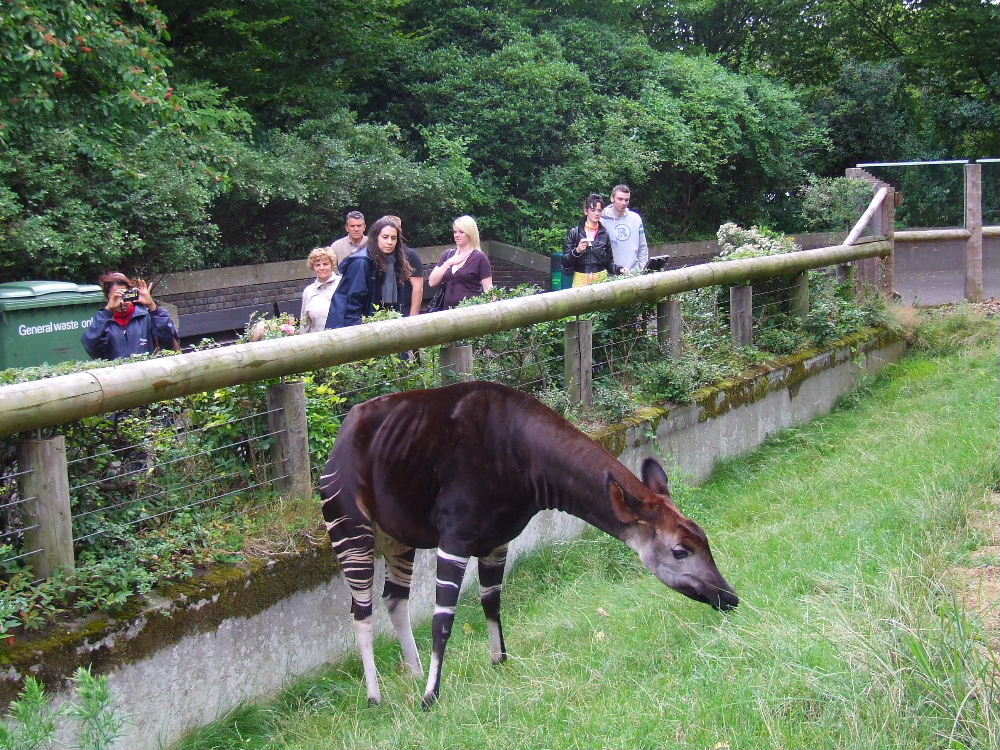
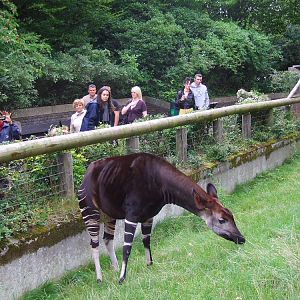
It is not the grass I'm reacting to. It's the presentation of a deep forest animal as a domesticated horse. Like showing an oryx in a swamp.Yes, visitors can get a good clear look at it, but what they are seeing is as wrong as observing Russell Brand as a proper Lord having tea with the Queen. You can see him lift the cup, but it isn't any way to see who he is! (Oh why did I put this image in my head???)
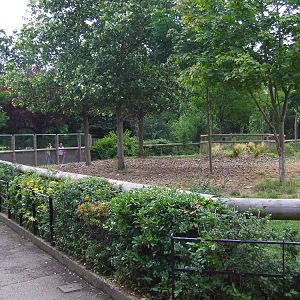
I think there are very few zoos which exhibit Okapi in anything like natural conditions. Its impossible in those urban zoos which lack sufficient trees, anyway. At London there is only grass where the moat used to be, probably to stabilise the bank. the rest of the flooring is woodchip/gravel. The impression from the photo is that the enclosure is completely open, but its not so. Several trees have been deliberately planted for shade and they will grow further. Its not perhaps ideal but attempts have been made to modify the enclosure to suit the animal. Remember this was originally just a bare square of ground before it was given over to Okapis.
I think there are very few zoos which exhibit Okapi in anything like natural conditions. Its impossible in those urban zoos which lack sufficient trees, anyway. At London there is only grass where the moat used to be, probably to stabilise the bank. the rest of the flooring is woodchip/gravel. The impression from the photo is that the enclosure is completely open, but its not so. Several trees have been deliberately planted for shade and they will grow further. Its not perhaps ideal but attempts have been made to modify the enclosure to suit the animal. Remember this was originally just a bare square of ground before it was given over to Okapis.
But it would b so inexpensive and easy to present the okapi in a more appropriate surrounding! Why do we settle for so little? This is the great LZS we're talking about! Not some poor animal farm in western Canada
But it would b so inexpensive and easy to present the okapi in a more appropriate surrounding! Why do we settle for so little? This is the great LZS we're talking about! Not some poor animal farm in western Canada
How would you go about it? As in, what temperate climate-hardy plants would recreate that effect that would not be either poisonous or need to be protected from the okapis? I'm not challenging you - I trust that you know, I would just be interested in your answer.
There are several trees which provide cover in summer over the okapis but all have been browsed when they have grown within reach. So the animals have cover above them but are liable to browse on anything the same height as them or lower.
The trees were actually planted when the bongo arrived (after the bare earth-covered island held Indian Rhino then collared peccaries). They have grown considerably since then and one or two have possibly been added since the exhibit was redeveloped for okapi. Pertinax is right about the moat steps now being covered with grass - unless the concrete was pulled out this may explain why the grass is needed to stop the concrete jutting through.
The bongo paddock at Port Lympne is in deep, mature woodland, and is the nearest thing to a forest ungulate being held in 'dense forest' that I have seen in the UK. However, they are liable to browse away any cover they have access to.
How would you go about it? As in, what temperate climate-hardy plants would recreate that effect that would not be either poisonous or need to be protected from the okapis? I'm not challenging you - I trust that you know, I would just be interested in your answer.
Well the answers to those questions are how I earn my keep and why zoos hire me.
But by way of answering, compare this picture to the pictures of Chester Zoo's okapi exhibit. It's still far from great, but seems SO much better. Or better still, look at the Bronx Zoo's.
I am certainly discovering that zoo practices in UK are different from those in the US and so new UK-appropriate ideas are needed to improve these exhibits. But I am confident it can be done. BTW - there are a number of US zoos with very similar and I say bad okapi enclosures.
e.
But by way of answering, compare this picture to the pictures of Chester Zoo's okapi exhibit. It's still far from great, but seems SO much better. Or better still, look at the Bronx Zoo's.
I've seen both Chester and ZSL enclosures and Chester's does have a little more vegetation but not much. The other two outdoor Okapi enclosures in UK are Bristol's- small, grassy and with just one or two shade trees and Marwell- the largest enclosure of the four but more like an open field with just a few mature oak trees at one end, plus a subsidiary paddock which has nothing in it at all. In order of real attempts to provide a suitable environment I would rate them; Chester-London-Marwell/Bristol(joint 3rd!)
London, Chester and Bristol are all 'urban' zoos where any more cover would have to be planted i.e. there isn't a suitable already wooded area they could build around. And even in a piece of mature woodland, because of the browsing behaviour I think it is hard to provide anything much in the way of 'deep cover' for Okapi, as Johnstoni points out. How do they do things at the Bronx and other 'good' Okapi exhibits in the US?
It isn't rocket science: plant more, much more. Especially around the perimeter as a screen between visitors and animals.
A mature woodland would be nice but is not a requirement. Every forest has to start with something.
I have only seen it through the pictures posted here, so my knowledge is pretty sadly limited.
Okapi are very difficult to create a great landscape for, as they eat most things. But what Chester has accomplished for mandrills and chimpanzees shows some promise for okapi (although there would need to be more open ground for viewing or the okapi would hide in the middle of the shrubbery).
I expect you'll see a better version once Heart of Africa opens
Even here at London, the pictures posted of the anoa exhibit set a better example of what might be done.
None of these examples exactly re-create okapi habitat, of course, but they place the okapi in a dense forest idiom instead of a meadow...and that's essential for understanding these amazing animals, imo.
I have only seen it through the pictures posted here, so my knowledge is pretty sadly limited.
Okapi are very difficult to create a great landscape for, as they eat most things. But what Chester has accomplished for mandrills and chimpanzees shows some promise for okapi (although there would need to be more open ground for viewing or the okapi would hide in the middle of the shrubbery).
I expect you'll see a better version once Heart of Africa opens
Even here at London, the pictures posted of the anoa exhibit set a better example of what might be done.
None of these examples exactly re-create okapi habitat, of course, but they place the okapi in a dense forest idiom instead of a meadow...and that's essential for understanding these amazing animals, imo.
I agree to some extent, all I have to say is that its still maturing and the covervage will get thicker with time and so will all the planting around the perimeter.
I also expect great things from Heart of Africa, I just hope am not disappointed.