Orycteropus

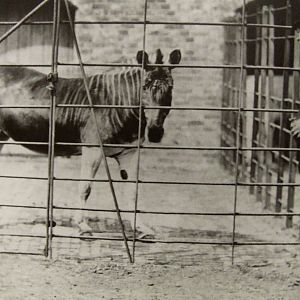
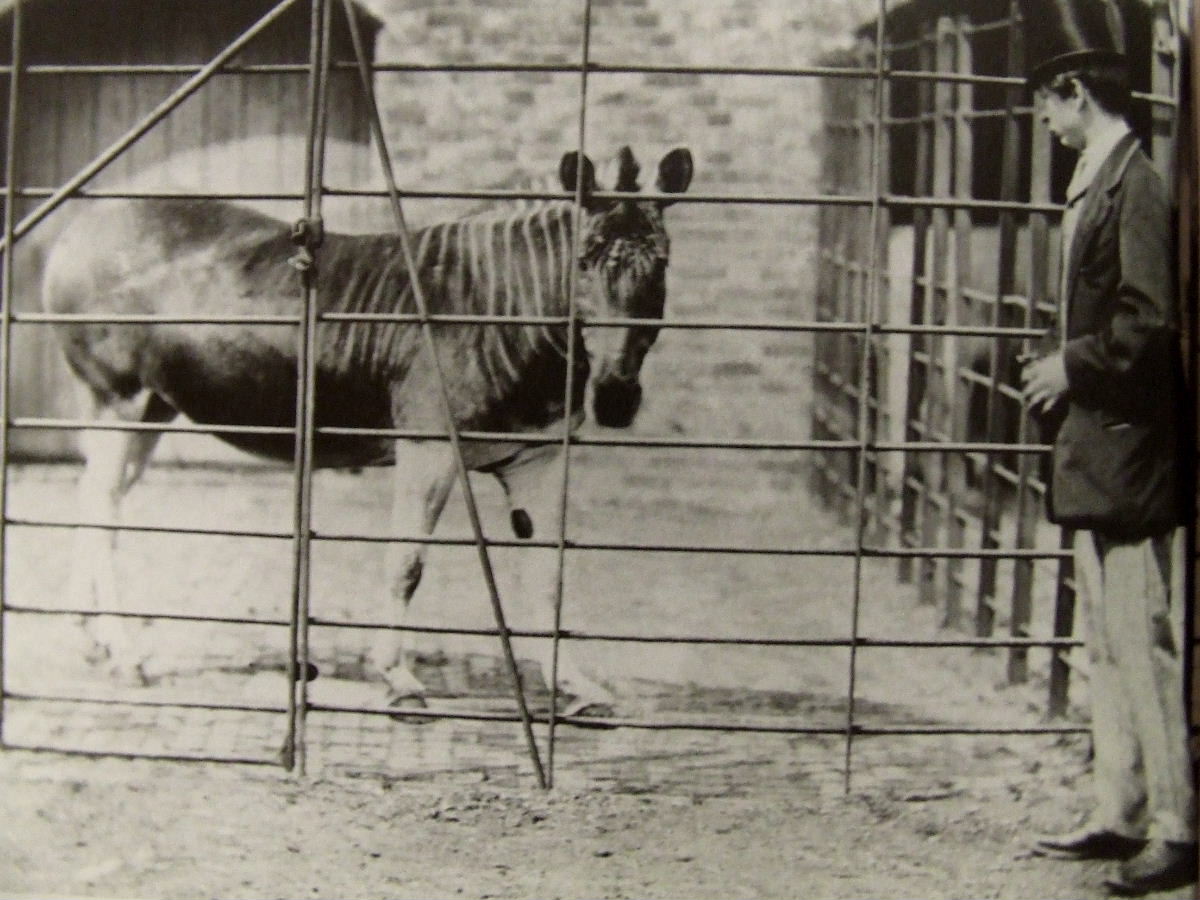
The last Quagga in London Zoo, 1864

Short Quagga history at London Zoo: the Zoo purchased its first specimen in 1831, and after that, in a following decades exhibited three of them. The species became extinct in the wild while the third of these animals was still in the Zoo. This last one died in 1872.

In this picture You can see this last one of three to be seen in the Regent’s Park, photographed in 1864.

The last specimen of the species in the world died in Amsterdam Zoo on 12 August 1883.

Source( photo and partly description): Barrington-Johnson, J. 2005. The ZOO, The story of London Zoo
Having visited the Quagga Project last year and spent many hours studying them, it seems that the Quagga Project is making good headway. I will post a photo of one of last years foals at some point. It is an amazing project and the Quaggas are not infact white but quite a beige colour. As it has now been decided that the Quagga was infact the most southern Plains Zebra and Plains zebras are only different in their coat pattern, it begs the question if we can bring back the coat pattern are they extinct!!! I am sure this question will go on and on.
 
It is an amazing project and the Quaggas are not infact white but quite a beige colour.

My point is that though Quaggas were undoubtedly Plains zebras, their colouration and markings were very different to other plains zebras. Its not just a matter of producing 'reduced striping.' Several of the Project zebras do have a beige ground colour, but only similar to that carried by some of the founder animals. So far they have not been able to produce the darker colour of the originals.
 
As it has now been decided that the Quagga was infact the most southern Plains Zebra and Plains zebras are only different in their coat pattern, it begs the question if we can bring back the coat pattern are they extinct!!! I am sure this question will go on and on.

It will depend on the genome. If the genome for the Quagga is gone, you could recreate it's physical appearance, but if you can't recreate the genome then, yes, the species is extinct.
 
It will depend on the genome. If the genome for the Quagga is gone, you could recreate it's physical appearance, but if you can't recreate the genome then, yes, the species is extinct.

Perhaps that depends on whether quaggas were part of a continous Plains zebra population or not. Some authorities insist that they were, others state they were an isolated or 'relict' population (of plains Zebras) which evolved their own specific and unique colour and markings. If the latter is true, it won't be possible to recreate them.

If you see photos of the (also) extinct Burchell's race of Plains Zebra, it was a classic black/white animal with no stripes on its legs. Many of the zebras bred by the Quagga project already resemble Burchell zebras, so can they be said to have already produced another extinct race?
 
Have you seen the Quagga poster, of all the mounted Quaggas?

The poster doesn't have all the Mounted Quaggas, but it is in colour. Most of the museum specimens are heavily faded, so the background colour is buff or fawn. But the Berlin(?) museum Quagga is better preserved and exhibits the true colour- a dark maroon-chestnut (almost Okapi colour) while the residual striping on the neck consists of narrower white lines rather than the broad bands/stripes as in the extant Zebras.
 
The thoughts of Groves and Bell on Quagga and Burchell's Zebra, courtesy of Wikipedia:-

n 2004, C.P. Groves and C.H. Bell investigated the taxonomy of the zebra genus, Equus, subgenus Hippotigris. They published their research in Mammalian Biology. They revised the subspecies of the plains zebra Equus quagga. Six subspecies are now recognizable. The completely maneless Somali population may represent a seventh subspecies: Equus quagga isabella (Ziccardi, 1958). This subspecies may be valid, but at present there is no evidence that it is.

Quagga, †Equus quagga quagga – Boddaert, 1785
Burchell's zebra, Equus quagga burchellii – Gray, 1824
Grant's zebra, Equus quagga boehmi – Matschie, 1892
Selous' Zebra, Equus quagga borensis – Lönnberg, 1921
Chapman's zebra, Equus quagga chapmani – Layard, 1865
Crawshay's Zebra, Equus quagga crawshayi – De Winton, 1896

The quagga was originally classified as a separate species, Equus quagga, in 1778. Over the next 50 years or so, many other zebras were described by naturalists and explorers. Because of the great variation in coat patterns (no two zebras are alike), taxonomists were left with a great number of described "species", and no easy way to tell which of these were true species, which were subspecies, and which were simply natural variants. The quagga was the first extinct creature to have its DNA studied. Recent genetic research at the Smithsonian Institution has demonstrated that the quagga was in fact not a separate species at all, but diverged from the plains zebra, between 120,000 and 290,000 years ago, and suggests that it should be named Equus burchelli quagga. However, according to the rules of biological nomenclature, where there are two or more alternative names for a single species, the name first used takes priority. As the quagga was described about thirty years earlier than the Burchell's zebra, it appears that the correct terms are E. quagga quagga for the quagga and E. quagga burchelli for the plains zebra, unless "Equus burchelli" is officially declared to be a nomen conservandum.

The Burchell's zebra was thought to have been hunted to extinction. However Groves and Bell concluded in their 2004 publication that "the extinct true Burchell's zebra" is a phantom. Careful study of the original zebra populations in Zululand and Swaziland, and of skins harvested on game farms in Zululand and Natal, has revealed that a certain small proportion shows similarity to what now is regarded as typical "burchellii". The type localities of the subspecies Equus quagga burchellii and Equus quagga antiquorum (Damara zebra) are so close to each other that the two are in fact one, and that therefore the older of the two names should take precedence over the younger. They therefore say that the correct name for the southernmost subspecies must be burchellii not antiquorum. The subspecies Equus quagga burchellii still exists in KwaZulu-Natal and in Etosha.
 
To recap; evidently Burchell's Zebra never became extinct, and a proportion of present day Damara Zebras = Burchells. I think the Quagga Project is creating yet more of these zebras with the reduced striping, though in some cases they have already bred out striping on the body to a greater degree than ever occurs naturally without such selection.

Re the true Quagga, no doubting it was a Plains zebra (it had the same voice) but I believe there are several subtle differences which set it apart from other Plains Zebra, as well as its distinct colouration/striping pattern. If you contrast the photos of the ZSL 'live' Quagga and the better mounted museum specimens with other living plains zebra(such as the ones being used in the Quagga Project) the following are evident;

Quagga had;

1. Longer, heavier body giving more 'pony-like' appearance.

2. Shorter mane/larger ears

3. Distinctive markings on cheeks/face.

I think some of these (mane/ears) have been commented on by early writers who saw the living animals too. Possibly complete isolation from other zebra populations gave rise to these particular characteristics, which is why I believe the Quagga Project can never truly recreate them.
 
Most of the museum specimens are heavily faded, so the background colour is buff or fawn. But the Berlin(?) museum Quagga is better preserved and exhibits the true colour- a dark maroon-chestnut (almost Okapi colour)

I’ve seen the Berlin quagga several times, most recently last September; the Berlin specimen is certainly the darkest, most richly coloured individual of the thirteen or fourteen museum quaggas that I've seen.

Unfortunately, the display case in which it's exhibited makes it really hard to get a good unobstructed photograph of it.
 
TheBerlin specimen is certainly the darkest, most richly coloured individual of the thirteen or fourteen museum quaggas that I've seen.

Unfortunately, the display case in which it's exhibited makes it really hard to get a good unobstructed photograph of it.

There are photos of it on the web where it looks as if it has been put (without the case) outside the front door of the Museum in full daylight. I don't know what their secret is in maintaining its colour, possibly reduced lighting? The next most natural-looking(colourwise) is probably the 'Rau' foal .
 

Media information

Category
ZSL London Zoo
Added by
Orycteropus
Date added
View count
17,073
Comment count
32
Rating
5.00 star(s) 1 ratings

Share this media

Back
Top