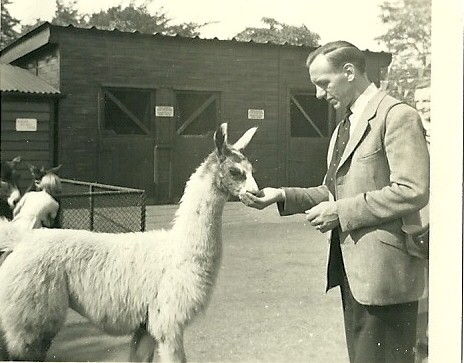
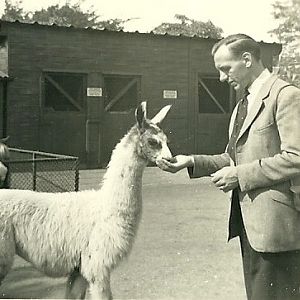
Seeing that we have a llama at my zoo, I have a huge pet peeve (besides the one about having a domestic animal in a zoo). Am I the only person on here who gets annoyed by people mispronouncing the name as starting with a hard L instead of a Y sound? Or do you all pronounce it like an L too?
Hard 'L'. It's a foreign loanword incorporated into English and that's the widely used English pronunciation - while the pedant in me would love it to be otherwise, if you go around (in the UK at least) asking where the 'yamas' are I'm afraid no-one will know what you're talking about!
I've always found it interesting what happens to loanwords in English - some of them stick with at least a degree of their original pronunciation (café, entrepreneur) when others from the same language do not (verdant, for example, would never be pronounced vehr-dangh in English, though admittedly I'd expect that one to have been about in English a lot longer). With animals it's even less predictable - why is duiker almost always dye-ker but nyala almost never 'n-yala?
There's a really interesting (if intermittent) blog from the BBC pronunciation unit (who ensure the most appropriate pronuncations are used in news programmes etc) on these kind of issues - well worth a read if you're interested in this kind of thing - they're always trying to balance comprehensibility with accuracy: BBC NEWS | Magazine Monitor: How to Say
in my opinion, if you're in South America pronounce it "yama"; if you're elsewhere pronounce it "lama". Although I agree with the sentiment: its always a struggle trying to pronounce animal names (and other words) correctly when they are so commonly mispronounced by others that it makes you sound like the one mispronouncing it. In New Zealand my most awkward one is chamois which everyone pronounces "shammy" -- which of course is what you polish your car with!
The thing is, I live in the Southwest quite close to Mexico. Here in Tucson, everyone (and I mean everyone) pronounces other Spanish words correctly. We have three very common words with LL that all locals (no matter how white they are) pronounce as a Y and anyone pronouncing it with an L would be immediately corrected. They are ocotillo (the plant), cholla (the plant), Rillito (the local river/wash). Even with the local animal javelina, everyone uses the Spanish pronunciation of havaleena (no one pronounces the hard J). So it boggles my mind why Southwesterners pronounce all other Spanish LL words correctly but then suddenly switch to a hard L for llama. The other reason it bugs me is because the way they pronounce it to me means lama (not llama), which of course is not an animal but a Buddhist high priest.
May be different in Latin American Spanish, but in 'Spain itself' Spanish, it would be closer to 'lyama' rather than 'yama' in any case (hopefully one of our Spanish members will correct me if I'm wrong).
The other thing here is, didn't the Spanish settlers get the name 'llama' from a Quechua word? Does anyone know how that word would originally have been pronouced?
Ah, now you've entered the Great Domestic Animal Scientific Name Debate.
(why do we have separate scientific names for domestic llamas, alpacas, cows, sheep, goats, horses, donkeys, dogs, cats and guinea pigs, but not for pigs, rabbits, chickens or ducks? If there's a good reason I've never found it out!)
The thing is, I live in the Southwest quite close to Mexico. Here in Tucson, everyone (and I mean everyone) pronounces other Spanish words correctly. We have three very common words with LL that all locals (no matter how white they are) pronounce as a Y and anyone pronouncing it with an L would be immediately corrected. They are ocotillo (the plant), cholla (the plant), Rillito (the local river/wash). Even with the local animal javelina, everyone uses the Spanish pronunciation of havaleena (no one pronounces the hard J). So it boggles my mind why Southwesterners pronounce all other Spanish LL words correctly but then suddenly switch to a hard L for llama. The other reason it bugs me is because the way they pronounce it to me means lama (not llama), which of course is not an animal but a Buddhist high priest.
does that not then suggest to you that llama (pronounced "lama") is now the acceptable English name? The other words you have there would be little known (probably completely unknown) to anybody outside their range areas unless they were botanists/horticulturists and geologists. Javelina is also little-used outside of the Americas; everywhere else it's just the collared peccary.