Interesting point; I was still thinking of white rhinoceros as a single species. (Although I am well aware that, say, Colin Groves & Peter Grubb list the two as distinct species in “Ungulate Taxonomy”.)
Not many places have ever had northern white rhinos but I guess that there would be a few places that had northern white rhino, southern white rhino, black rhino and Indian rhino simultaneously.
Dvur Kralove immediately springs to mind as a possibility but I’ve not had time to check full details. (I think that London Zoo would have come into that category for a short while too.)
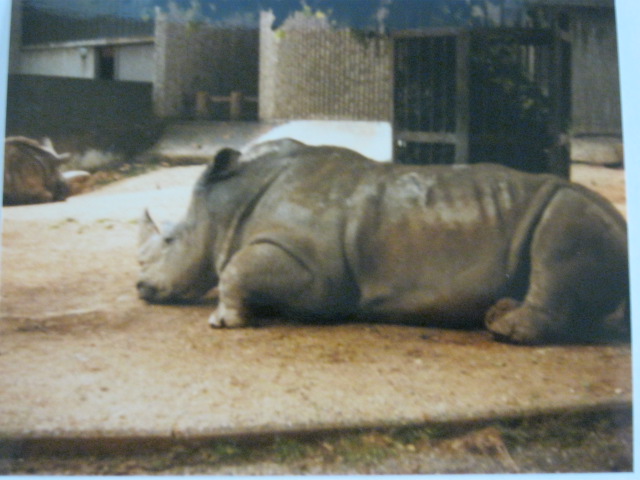
1. F Luana. born 26.11.69. sent to Dublin Zoo 1972. died on ?
2. F. Joanna. born 15.11.72. sent to Paignton Zoo 1973. died 1974.
3. F. Noelle. born 28.11.75. sent to Chester Zoo 1977. died 1978.
4. M. Kes. born 20.9.78, sent to Marwell 1980. Died 1986.
5. F. Esther. born 22.5.82. sent to Chester 1984 . Died on ?.
6. F. Rosie. born (date?) handraised. sent to Chester and later Port Lympne- still alive.
The first two calves were born to the breeding pair 'Paul' and 'June.' After the male died, the male from Whipsnade (Bwana Mkubwa) was transferred to London on several occasions and sired the 4 later calves with 'June', as well as several (3 or 4) at Whipsnade with his other mate 'Mama Kidogo.' ('Bwana' and 'Mama' were later sent to Port Lympne, where Bwana fathered a further four calves, and Mama had two more (1 DNS))
You can see that while London reared all these calves until they were sent away to other zoos(at rather a young age I might add) few survived very long after (with the exceptions of 'Esther' and 'Rosie') It was a similar pattern with the Whipsnade born calves also.
Can someone explain why they are nowadays accorded full species status? Both 'species' look virtually identical in appearance and can obviously interbreed producing fertile offspring if what the current project is attempting is anything to go by.
Aren't they really two geographically split populations of one species?
Can someone explain why they are nowadays accorded full species status? Both 'species' look virtually identical in appearance and can obviously interbreed producing fertile offspring if what the current project is attempting is anything to go by.
Aren't they really two geographically split populations of one species?
Basically, the genetics indicate the two diverged over 1,000,000 years ago, and the two are reliably distinguishable by cranial structure and dentition. That's all a mammal taxonomist's favourite things!
The biological species concept (broadly, that two putative species are different species if they cannot produce viable offspring) is no longer used in its pure form by any taxonomist that I'm aware of. It is untestable, difficult to apply to species that are not sympatric, and not really compatible with modern understandings of speciation.
Not many places have ever had northern white rhinos but I guess that there would be a few places that had northern white rhino, southern white rhino, black rhino and Indian rhino simultaneously.
The San Diego Wild Animal Park currently has all of these rhino species, as of summer 2014. Sadly the last two northern white rhinos there are now senior citizens by rhino standards and have never bred.
There's a summation here:
Basically, the genetics indicate the two diverged over 1,000,000 years ago, and the two are reliably distinguishable by cranial structure and dentition. That's all a mammal taxonomist's favourite things!