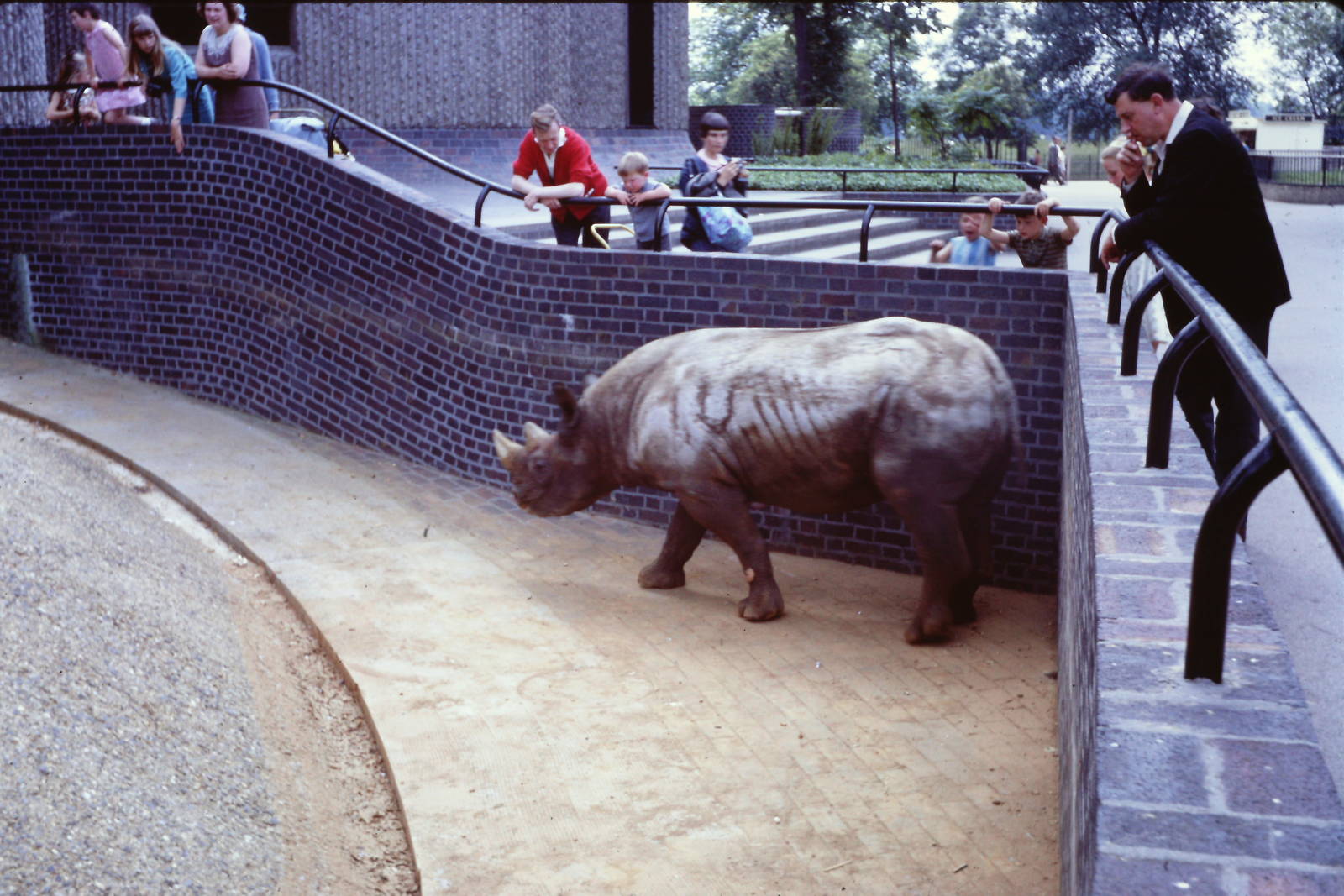
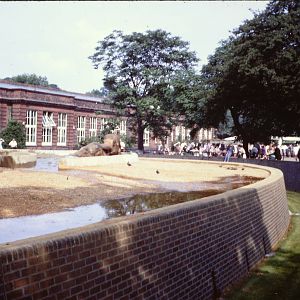
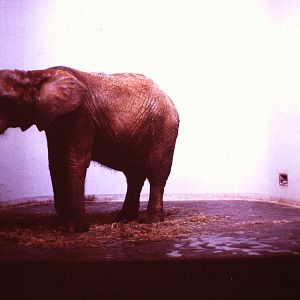
The female Indian rhino ‘Mohini', who was at Whipsnade from 1952 until 1974, spent a couple of years in the Casson Elephant & Rhino Pavilion during the mid 1970s before being sent to Artis (Amsterdam).
(In 1957, 'Mohini' was the mother of the first Indian rhino born at Whipsnade.)
Note the abraded-looking skin on the Rhino- too much contact with concrete/brick walls probably, though I don't remember this particularly from seeing them at the time.
Surprised you let this one pass, Tim! Actually, the rhino did OK here. Three (Colin Groves would argue four!) species were held in the Casson from 1965 to 2003, when Jos left for Port Lympne: Great Indian (as mentioned by Tim), Black (3: 3 adults held in period, of whom one lived (and was living) after a 25 year period, five calves bred), and White (one Northern bull sent to Dvur Kralove in 1985, probably too late for the taxon's benefit and certainly too late for his (he had arrived at London in 1955) ; and one Southern cow, who had started her UK career at Whipsnade in 1961, was sent to London as a companion for the Northern bull, and was finally sent to Glasgow in 1986.
By the standards of the time, the Casson Pavilion's rhino did OK. The three long-term residents (the Black cow "June" and the White animals "Ben" and "Mashobeni" ) all lived there for over 20 years. Only one adult - the original Black bull "Paul" died there. I don't think that the Black calves born in the Casson fared terribly well, but then I don't think that their captive-bred contemporaries at Bristol or Chester fared much better.
I would go further; if (say) in 1976, the elephants had been sent elsewhere, and the Casson split between a pair of Indian (maybe Black) Rhino on the elephant side of the house, and the rhino side split between pairs of Pigmy Hippo and Malay Tapir, I doubt if many would have perceived a welfare issue, then or later.
By the standards of the time, the Casson Pavilion's rhino did OK. The three long-term residents (the Black cow "June" and the White animals "Ben" and "Mashobeni" ) all lived there for over 20 years. Only one adult - the original Black bull "Paul" died there. I don't think that the Black calves born in the Casson fared terribly well, but then I don't think that their captive-bred contemporaries at Bristol or Chester fared much better.
Agree, there were far less issues with the Rhino being kept in this House, than with the Elephants. The main problem was that, having more than a pair, the different animals had to take turns using the outdoor paddock, and the indoor on-show areas were pretty small for animals to spend long periods in. One pair could probably have been kept on longterm without detriment to the animals or overt critisism. If they had stayed with just, say, Black rhino they might even still have them!
As for the (black)calves, the losses were mainly after they had left ZSL and their success rate was pretty much equivalent to Bristol( whose breeding pair had a tiny enclosure) & Chester of the time.