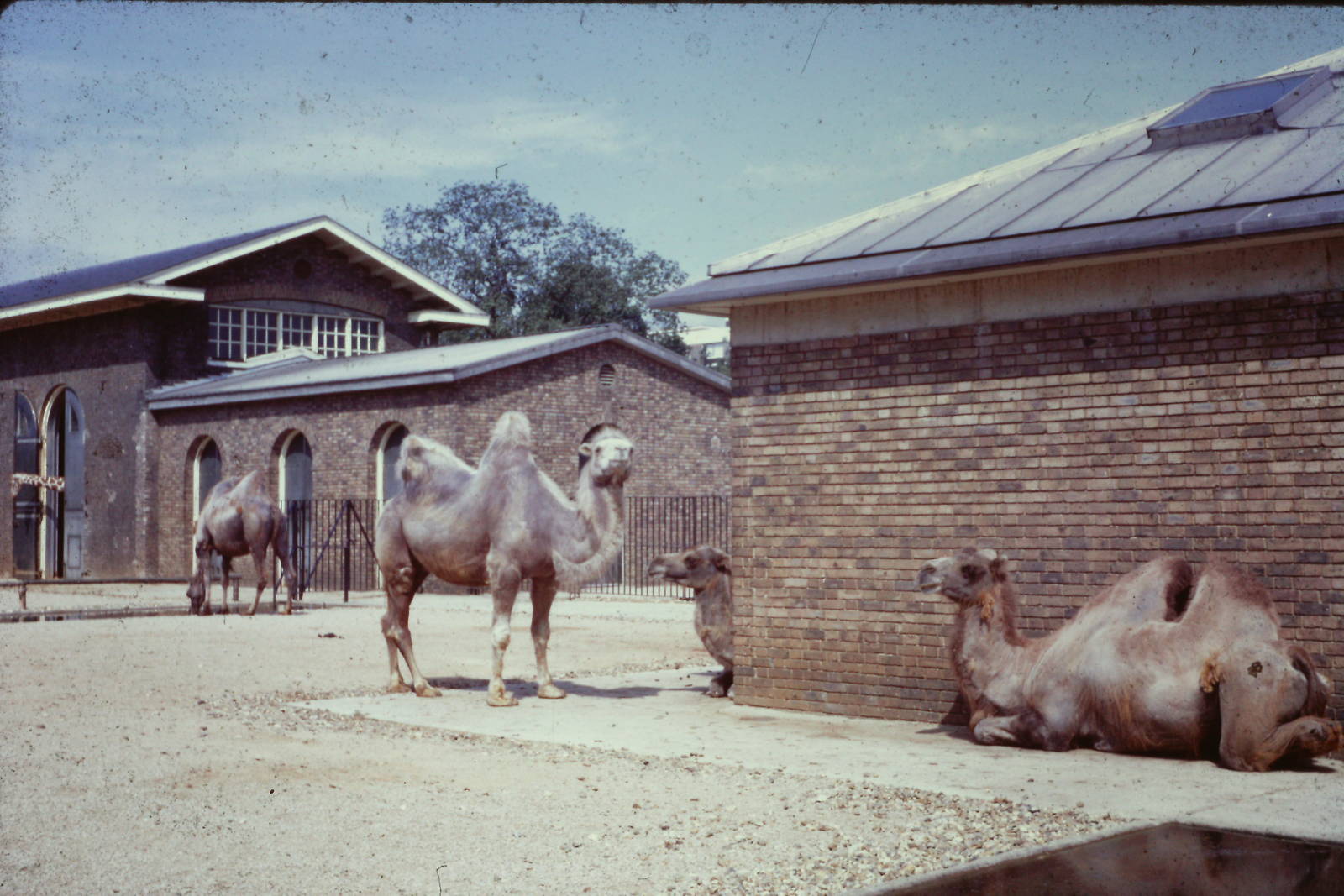
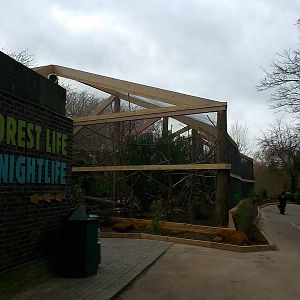
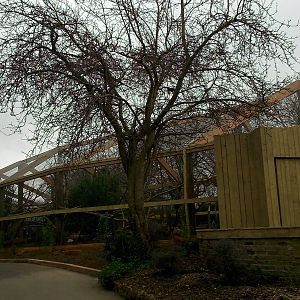
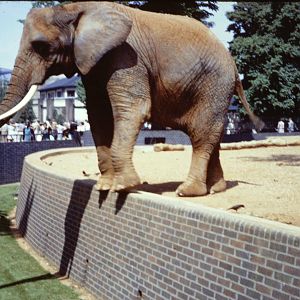
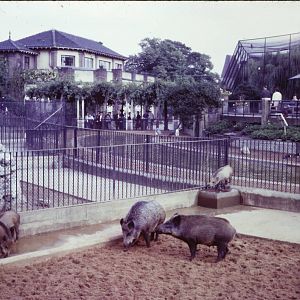
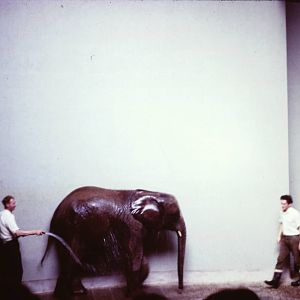
I'm sure most people commenting here already know this, but it's astounding to me how many older photographs of the terraces can make the enclosures look larger than they actually were. The footprint of this enclosure now forms less than a quarter of the current giraffe paddock, with some of it now a planted area underneath the raised platform. It really was a tiny area for one, let alone four, camels. Add to this the fact that these would have been shut in on some days in order to rotate them with the inhabitants of the other indoor stalls that were served by this yard, and you have a system almost unimaginable by today's standards.
As I've said elsewhere, given the giraffe house with it's two extensions is listed, I wish the buildings, paths and moats of the upper Cotton terraces nothing but the bulldozer (before they get listed), and the whole level given over to giraffes.
Does anyone know if the giraffe house itself no longer meets EEP standards for holding a breeding group? I ask this not to speculate on the reason why they don't hold one, but because of its age and the difficulty in modifying the building if indeed this is the case. Just observing the size and layout of many new build houses, this occured to me recently.
An interesting set of observations here. I think that communityzoo's comments illustrate the uncertainty that some feel about London Zoo's place in the modern world; there is no doubt that the Giraffe House yard is by modern standards a small area to be holding what are these days the biggest mammals on the London site.
Incidentally, the story that I was told about the Giraffe House's present usage was that Westminster City Council consider that it's unsafe to hold a bull there. Never mind that a breeding herd (regrettably generic) averaged a calf a year there for thirty years from the modernisation of the house in 1963, I suppose the council was always going to get a pound of flesh from ZSL after the elephants killed a keeper in 2001.
The Cotton Terraces could do a very good job for smaller, or solitary, ungulates. They already hold Okapi and Pygmy Hippo; with the return of Bongo and Red River Hog (neither of whom seem to make much use of the space given to them at Whipsnade) and the acquisition of a pair of duiker (species suggestions on a postcard), the buildings could tell the story of the crisis facing Africa's rainforest mammals, as they are poached towards extinction. The Giraffe House interior - well -lit and with height - might do an excellent job as aviaries.
Personally, I think that the way forward for giraffe is to lobby for the ten acres to the south of the zoo. A breeding herd of Reticulated Giraffe (Whipsnade's proximity to the motorway and Luton Airport would make it an excellent home for a bachelor group), a herd of Lesser Kudu (beautiful animals of conservation importance), a couple of Grevy's Zebra stallions, maybe one or two Eastern Black Rhino, and a lake holding waterfowl and flamingos, with an island holding colobus. What's not to like?
I'm sure most people commenting here already know this, but it's astounding to me how many older photographs of the terraces can make the enclosures look larger than they actually were.
This is the effect of using a wide-angle lens which exaggerates the perspective in images - as is well known to estate agents and their customers. Most of the old 'point and shoot' film cameras had wide-angle lenses.
This was taken with a Kodak "Colorsnap 35". I have just taken it out of the cupboard (still in its original case, but the strap is broken), and the lens is a "Kodak Anaston, Mount 320". It has various settings for distance, close-ups and group views.