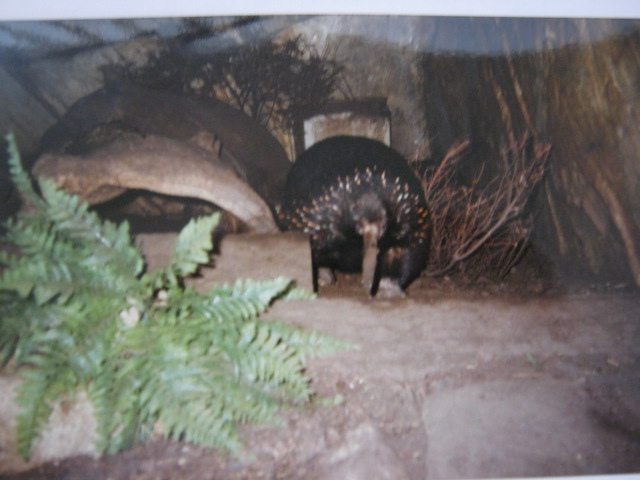
captive short-beaked echidnas have been recorded up to 50 years, and long-beaked over 30 years. (I was trying to find a thing I read ages ago which had specific captive longevity records for each but couldn't).
EDIT: Philadelphia Zoo for the short-beaked echidna: 1903-1953 (almost 50 years, but wild-caught so actually over 50 years)
And from Tim May's post above, the long-beaked echidnas now at Taronga are over 40 years old, possibly almost 50 (depending on which two are the surviving ones).
That useful book “Longevity of Mammals in Captivity; From the Living Collections of the World” (Richard Weigl; 2005) lists three short-beaked echidnas that have lived around half-a-century.
In addition to the Philadelphia Zoo animal, already mentioned by ‘Chlidonias’, the other two are:-
• male lived in Prague Zoo for 48 years 9 months
• male still alive in San Diego Zoo, as at January 2005, after 48 years 5 months
And from Tim May's post above, the long-beaked echidnas now at Taronga are over 40 years old, possibly almost 50 (depending on which two are the surviving ones).
He was the only one on display at that time. I think then they swapped them over, so the female was on display, and if I recall correctly Jabiru96 saw both on show at the same time on one visit. I'm not sure which one or if both are on display currently.
I believe that the male is the one mostly (always?) on show as he is more active than the female, but I think I did see two on one occasion (but only one every other time).
He was the only one on display at that time. I think then they swapped them over, so the female was on display, and if I recall correctly Jabiru96 saw both on show at the same time on one visit. I'm not sure which one or if both are on display currently.
That useful book “Longevity of Mammals in Captivity; From the Living Collections of the World” (Richard Weigl; 2005) lists three short-beaked echidnas that have lived around half-a-century.
In addition to the Philadelphia Zoo animal, already mentioned by ‘Chlidonias’, the other two are:-
• male lived in Prague Zoo for 48 years 9 months
• male still alive in San Diego Zoo, as at January 2005, after 48 years 5 months
The longest-living long-beaked echidnas listed in Weigle’s book are the two ex-London Zoo animals, still alive in Taronga, as at January 2005:
• female that arrived London Zoo in 1965
• male that arrived London Zoo in 1986 after fifteen years in Dallas