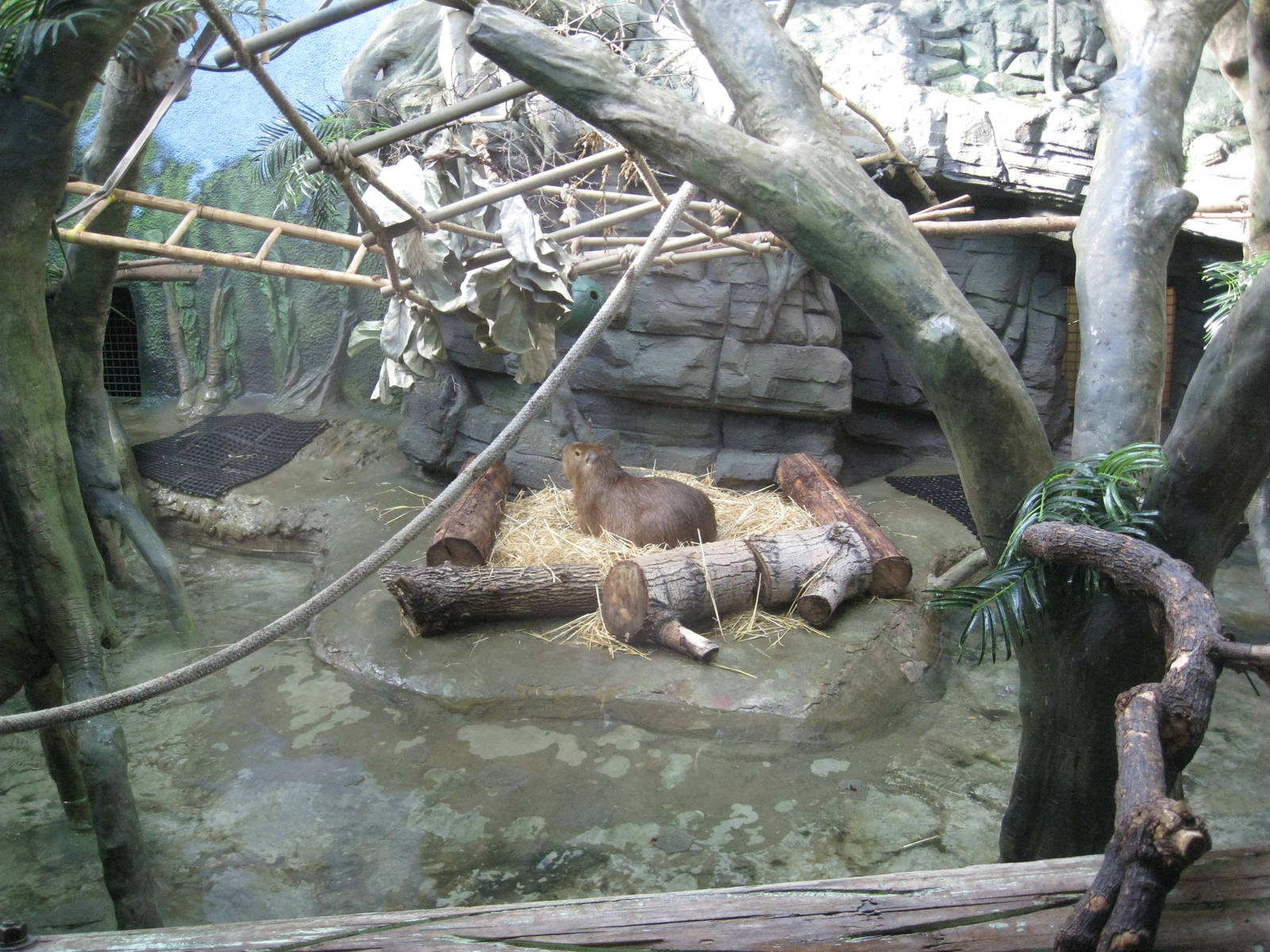
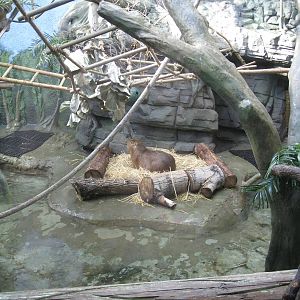
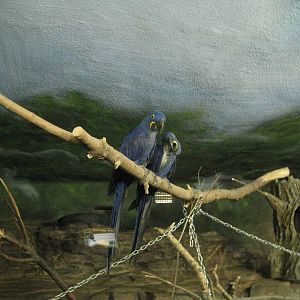
It is a renovation of their outdated primate house. The combination is due to a white-handed gibbon that is still in the collection, but I assume it will not be replaced when it passes.
I've seen far uglier exhibits. And I've never quite understood the extreme reaction to non-geographic mixes on here - Chester mixes wetland Capybara with the largely forest-dwelling Brazilian Tapir and until recently the above-the-treeline Vicuna without anyone commenting just because they're from the same continent.
It's nice when mixed exhibits match up geographically but it's really not the end of the world if they don't - sometimes practicality has to take priority.
I did not see them when i went yesterday, but i know that on my last visit there were two gibbons. An older male and a fairly young female. This may indicate that they plan on having them in the collection for the foreseeable future. This house is in desperate need of renovation, or even better it could be knocked down and a new state of the art south american facility could take its place. The only issue with the would be the De Brazzas guenons and gibbons would be out of a home.
OK - probably not the best example as I was working off the top of my head! (though the range of the species and the habitat are two different issues - the range of the Great Crested Newt and the Mountain Hare overlap but wouldn't make much sense as a mixed exhibit!)
The point is that we (and I include myself) have this arbitrary sense that animals from the same continent are fine in a mix, however disparate the habitat or geographic range within the continent. Nothing particularly wrong with that, except that it leads to scorn being placed onto non-continentally matched mixed exhibits.
Woburn's Monkey Jungle area has Patas, Barbary Macaques, Drills and Bongo - all 'Africa' so 'close enough'. Patas, Drills and Bongo more-or-less overlap, but Barbary Macaques are way out on their own. Travel north again the distance between the range of the Patas and the macaques and you could almost include Arctic Foxes in the exhibit. And within that range have oryx, addax, chamois, brown bears... (albeit not all 'forest animals'). It's entirely arbitrary where we put the cut off.