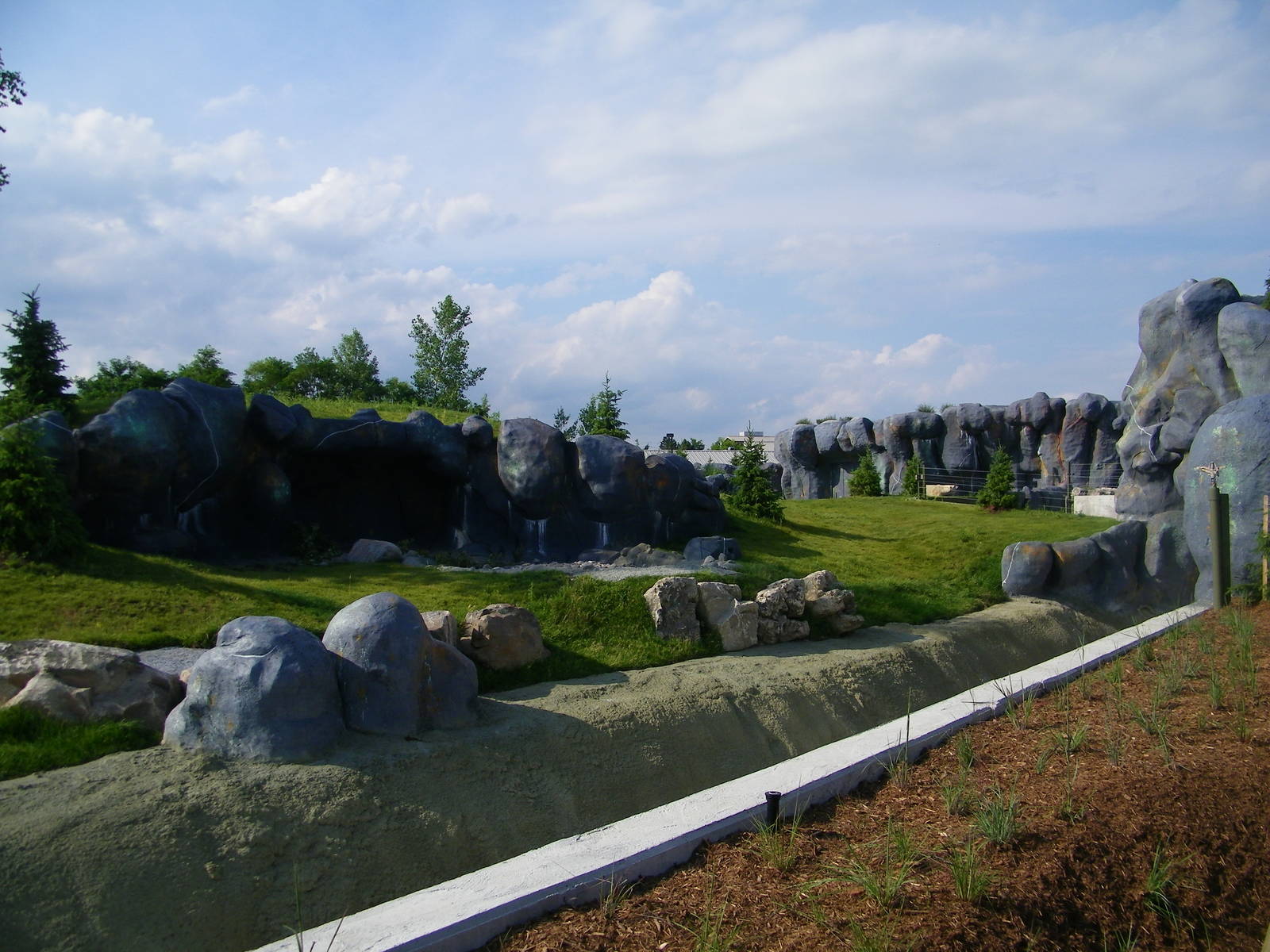
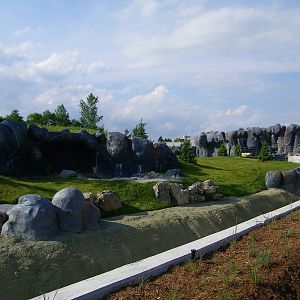
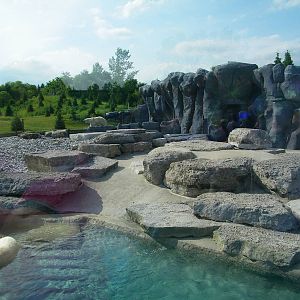
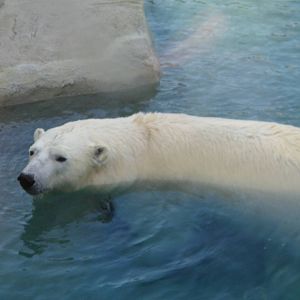
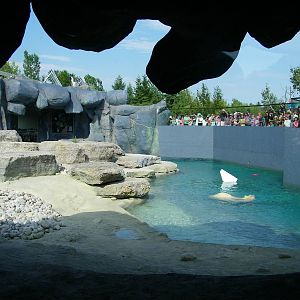
Slightly off-topic, but what the hell? Since the professional zoo landcape designer here at ZooChat - Zooplantman - is reading the thread, I have to take the opportunity to ask a couple of questions.
We both agree that the fake-rock work looks bad. But would you like to take the time and indulge us amatuers a bit more on this subject?
How is fake-rock produced?
From pictures and videos I have gotten the impression that metal framework forms the basis; metal frameworks that express the basic shape wanted is produced and then dirt, grovel etc (?) is used to fill the "empty space" of the metal framework? Then cement (?) is poured all over the frame work and within a rather short time all of the "authentic features" must be created, before the cement "turns to stone" and can no longer be worked with?
Is this a fairly correct description or it is totally wrong?
What about the process of coloring the cement? Complicated or easy, cheap or expensive!
Othe technical aspects that I did not think of?
I would really appreciate a detailed answer if you could take the time, Zooplantman!
Often the interior of artificial rockwork is hollow.
There is a new system using some kind of foam which is carved and then sprayed with successive thin coats of a concrete-glass mix. It cuts out the steelworkers on a job. The new African exhibits at Fort Wayne Children's Zoo use it.
As for that new system, creating "artfiicial rockwork" (I was just going to ask you for the term used by the professionals, as opposed to "fake-rock"), is that used only for creating the "frame"? Is it still just a frame that will be poured over with cement/concrete?
What I am REALLY deep-down intersted in is how the "realistic effect" is achieved. The "effect" that obviously was not achieved in the new rockwork in Toronto. You certainly did not give me any clues there, Zooplantman.
Anyway, I will read the links provided and perhaps (probably) come back with other questions.
As for that new system, creating "artfiicial rockwork" (I was just going to ask you for the term used by the professionals, as opposed to "fake-rock"), is that used only for creating the "frame"? Is it still just a frame that will be poured over with cement/concrete?
What I am REALLY deep-down intersted in is how the "realistic effect" is achieved. The "effect" that obviously was not achieved in the new rockwork in Toronto. You certainly did not give me any clues there, Zooplantman.
Anyway, I will read the links provided and perhaps (probably) come back with other questions.
Ah, realistic is the work of the artists who hand-carve the surface layer and the artists who color/paint effects. There are better artisans and less-skilled ones.
And the concrete slurry is pneumatically "shot" at the steel mesh rather than poured.
Ah, realistic is the work of the artists who hand-carve the surface layer and the artists who color/paint effects. There are better artisans and less-skilled ones.
OK... and this is one of them details that I would love to hear so much more about! Come on Zooplantman, tell us more, please! Go into details! You don´t do a very good job answering my questions!
Given your profession, you could do so much better than this. And I bet that each and every forumster on ZooChat would be interested...
OK... and this is one of them details that I would love to hear so much more about! Come on Zooplantman, tell us more, please! Go into details! You don´t do a very good job answering my questions!
Given your profession, you could do so much better than this. And I bet that each and every forumster on ZooChat would be interested...
@Dan - I am not clear on exactly what you want to know.
Why not start a new thread on rock work and let everyone participate.
I am not a rock work fabricator. I have seen it done hundreds of times, but do not spend time watching them (I have my own work to do). So maybe someone else can give you whatever answer you want.
@Dan - I am not clear on exactly what you want to know.
Why not start a new thread on rock work and let everyone participate.
I am not a rock work fabricator. I have seen it done hundreds of times, but do not spend time watching them (I have my own work to do). So maybe someone else can give you whatever answer you want.
Also, when I read my latest post in this thread I notice that it may have a "whining or discontent tone" about it? If so, that wasn´t my intention at all - I probably should have inserted a -sign here and there in the text....
Yes, the rock work sucks. However, this is still a great exhibit based on the pics imo. Probably the 2nd best in North America.
Most of us are much more critical than your average zoo visitor, but I think some forget that when they say things like this or vairous other exhibits aren't that good of a visitor experience. For the vast majority of people, it very likely is a great visitor experience.
My feeling about zoo exhibits is that we should strive for excellence whenever possible and this means going above and beyond what your average visitor would be happy with.
I don't want to be unnecessarily negative but I find this exhibit disappointing. It looks like a golf course from the Flintstones... OK, that might not be the most constructive criticism but having looked at several pictures of this exhibit I just feel that an opportunity to do something really exceptional was missed here. Hopefully as the exhibit matures it will look better but I'm not convinced.
I like the fact that these polar bears have varied substrate (grass, gravel, rock, sand, concrete, water, etc.) while other fairly good polar bear habitats (Polar Bear Plunge at San Diego) are just limited to rockwork, sand and water with some added concrete
I think once Polar Frontier opens in 2010 at Columbus Zoo, Tundra Trek will become the third best polar bear exhibit in North America (After Arctic Ring of Life and Polar Frontier) with Northwest Passage at Memphis Zoo in 4th and Polar Bear Plunge in 5th
I really don't think that Polar Frontier will be a greater exhibit than Toronto's. But we all have our own opinions. However it will surely be one of the top.