Chlidonias

macrophthalmia of pouched lamprey (Geotria australis)

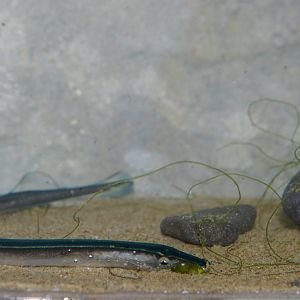
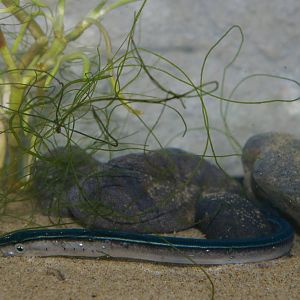
a native lamprey of New Zealand, also found in Australia and southern South America. Lampreys have three stages to their life-cycle. The first stage after hatching is the ammocoete, coloured muddy greyish-brown, which lives burrowed into the substrate in freshwater and is a filter-feeder. The following stage four to five years later is the macrophthalmia (pictured here) which is much more colourful. It migrates downstream to the ocean where it remains for another three or four years, feeding as a blood-sucking parasite on larger fish, before coming back to freshwater to spawn and then die. When they migrate back to freshwater the adults turn from silver and blue to a drab brown.

Photo taken 6 July 2010.

The macrophthalmia in this photo is about 10cm long. Adults grow up to 75cm. Photo of an adult is here: http://www.zoochat.com/399/nz-pouched-lamprey-geotria-australis-30665/
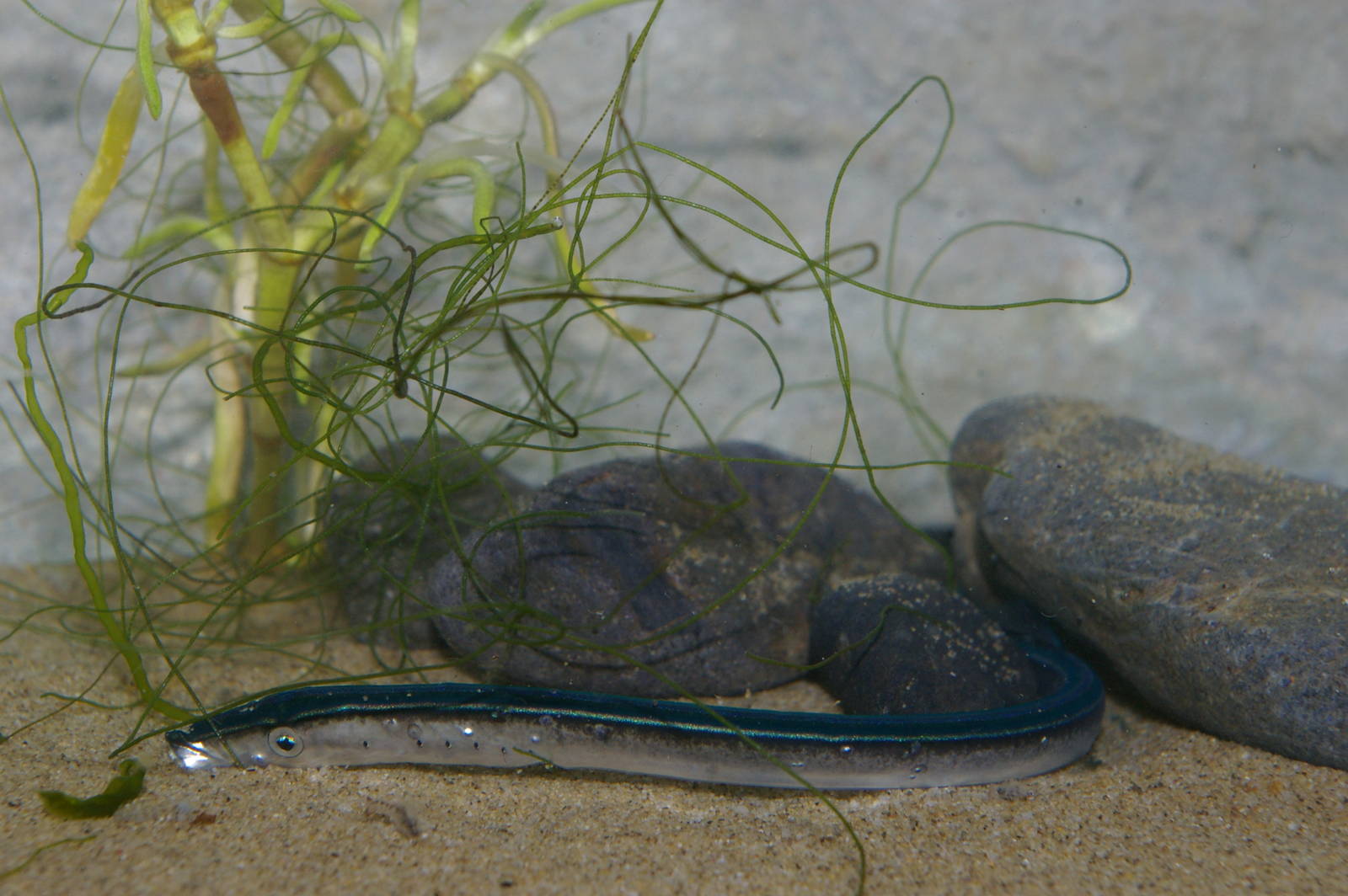
a native lamprey of New Zealand, also found in Australia and southern South America. Lampreys have three stages to their life-cycle. The first stage after hatching is the ammocoete, coloured muddy greyish-brown, which lives burrowed into the substrate in freshwater and is a filter-feeder. The following stage four to five years later is the macrophthalmia (pictured here) which is much more colourful. It migrates downstream to the ocean where it remains for another three or four years, feeding as a blood-sucking parasite on larger fish, before coming back to freshwater to spawn and then die. When they migrate back to freshwater the adults turn from silver and blue to a drab brown.

Photo taken 6 July 2010.

The macrophthalmia in this photo is about 10cm long. Adults grow up to 75cm. Photo of an adult is here: http://www.zoochat.com/399/nz-pouched-lamprey-geotria-australis-30665/
 
Interesting!
I have never seen a lamprey, and I don't know of any displayed in an aquarium - I guess there are practical and ethical issues in keeping and displaying a parasite (particularly a relatively large vertebrate one).

Alan
 
I've never seen an ammocoete but theoretically they would be easy to keep (being filter-feeders) but they wouldn't make good display animals as they are largely burrowers.

The macrophthalmia are non-feeders. After changing from the ammocoete stage they simply migrate down to the sea to find hosts. The ones currently at the Southern Encounter Aquarium will only be on display for a few weeks and then they will be released.

The adults only feed while at sea. Once they return to freshwater to breed they stop feeding entirely. They can (apparently) survive for up to two years in this state. They are thus easily held as non-feeding display animals for a period before being released to spawn.
 
An old question, but I'll reply anyway: Among the three species in captivity in Europe, the brook lamprey Lampetra planeri is completely non-parasitic. The last two, river lamprey L. fluviatilis and sea lamprey Petromyzon marinus, are both parasitic (attack live fish) and non-parasitic (feeding on fish carcasses). Consequently, it is reasonably easy to feed all these in captivity without having to consider the ethics of using live prey. Aqua actually keep river lamprey in a quite large stream habitat with various other fish (perch, roach, gudgeon, brook lamprey, etc), but as far as I can understand they generally can't be bothered trying to attack them when easy prey (fish carcasses) is available on a regular basis.
 
Thank you temp. Very interesting. Although I can't help feeling that seeing a lamprey latched onto a dead fish in a public aquarium would cause some visitors to complain.

Alan
 
An old question, but I'll reply anyway: Among the three species in captivity in Europe, the brook lamprey Lampetra planeri is completely non-parasitic. The last two, river lamprey L. fluviatilis and sea lamprey Petromyzon marinus, are both parasitic (attack live fish) and non-parasitic (feeding on fish carcasses). Consequently, it is reasonably easy to feed all these in captivity without having to consider the ethics of using live prey. Aqua actually keep river lamprey in a quite large stream habitat with various other fish (perch, roach, gudgeon, brook lamprey, etc), but as far as I can understand they generally can't be bothered trying to attack them when easy prey (fish carcasses) is available on a regular basis.
the brook lamprey is also a scavenger? Or does it feed on something else (invertebrates or something)?
 
Thank you temp. Very interesting. Although I can't help feeling that seeing a lamprey latched onto a dead fish in a public aquarium would cause some visitors to complain.
the easy way around that (which I would use if it were me) would be to have a hidden section of the aquarium, e.g. behind rockwork, where the dead fish was placed. Or feed them at night.
 
the brook lamprey is also a scavenger? Or does it feed on something else (invertebrates or something)?

The larvae ammocoete phase, which can last at least 6 years (average believed to be c. 5), is essentially a filter feeder. This is similar to various other lamprey species, except that it lasts longer in the brook. In contrast, the adult stage is very short compared to most lamprey species, lasting half a year or less. In that period they don't feed at at all and they die directly after breeding. It has been speculated that the brook lamprey is a case of paedomorphosis (neoteny) of the closely related river lamprey, essentially staying smaller and following roughly the same pattern in the first part of the life, but extending the larvae stage and then skipping the parasitic stage by going directly to breeding adults. They don't really migrate either and are strictly freshwater throughout their life. The larvae spread out in the streams after hatching, but that's about it.

A few other lamprey species have a lifecycle that resembles that of the brook.
 
@Chlidonias, When I was at the Great Lakes aquarium in Duluth sea lampreys were a large display piece, and lots of crowds were in aw watching the lampreys swim about. In that tank they physically Gave no burrowing room for the lampreys in general, just a big glass box;). So they may be burrowing animals, but seeing some tanks for sea lampreys the aquarium, they really don't offer any room for the animals to hide away from the crowds. They were in a special exhibit, so they must have not lived for very long anyway.
 

Media information

Category
Southern Encounter Aquarium and Kiwi House (Closed)
Added by
Chlidonias
Date added
View count
4,435
Comment count
9
Rating
0.00 star(s) 0 ratings

Share this media

Back
Top