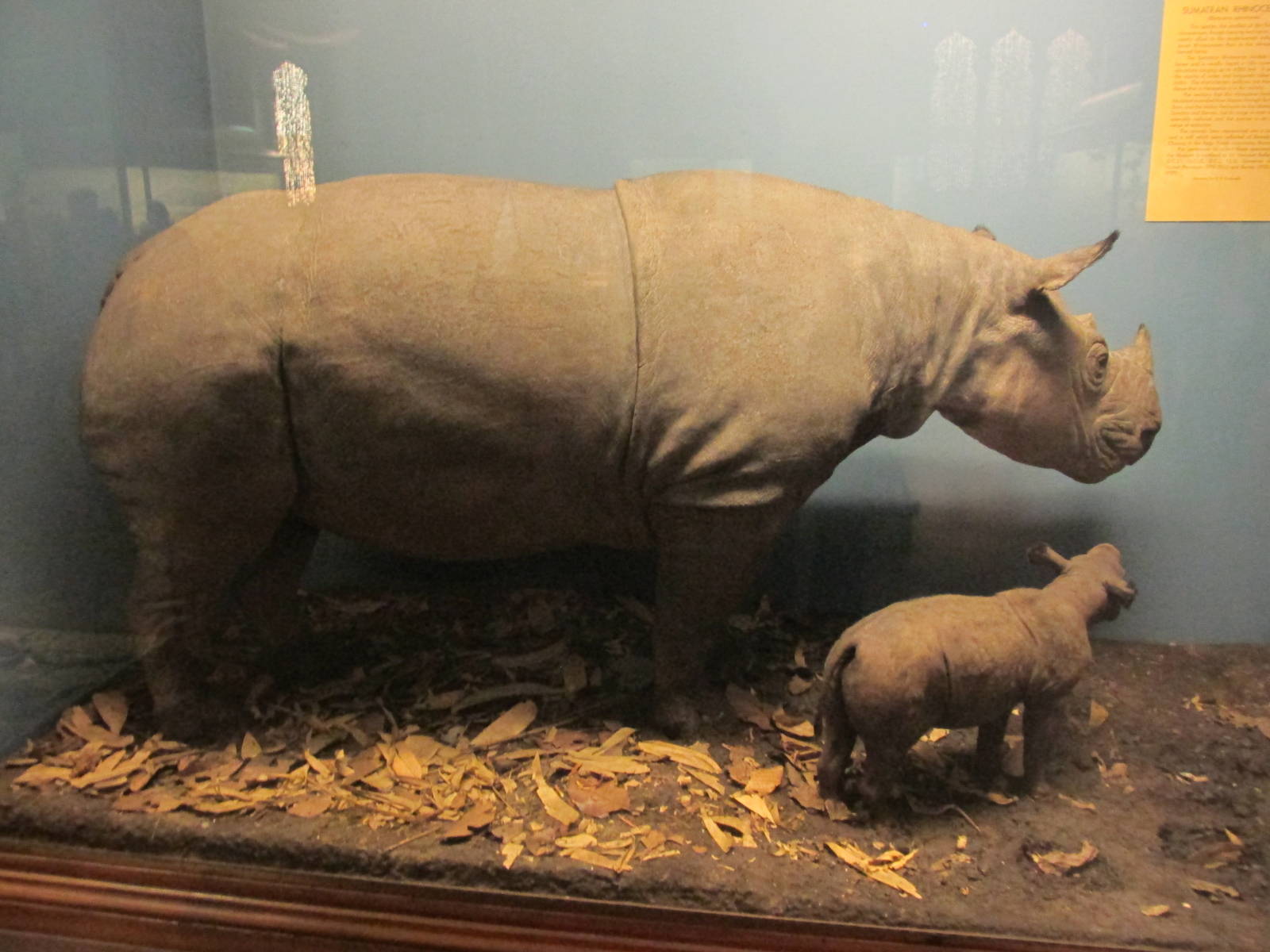
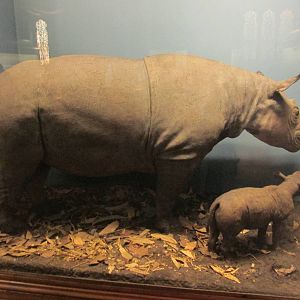
The sign mentions that the female rhino was shot in 1924 in Burma. The juvenile was with her,but was captured and sent to the Rangoon Zoo. It died there afterward and was reunited with its mother at the amnh, both mounted. A true story to warm the heart of elephas maximus,no doubt.
I'm curious as to why only Ipuh was mounted, but apparently neither Emi or Suci. Given their potential value as museum mounts, that seems strange.
Ipuh was definately hairier in life, though it was restricted mainly to his belly and lower legs. The mount makes his skin look a bit too smooth.
The Burmese mother and calf look realistically mounted too, but I'm not sure why both are facing more toward the wall, they might look better facing the visitors. I've noticed the living adult females at e.g. Way Kambas look very 'smooth' compared to a male.
Pertinax is so right again, i also thought why the rhinos are not facing the public? It was hard to photograph this lovely pair on exhibit, which seems to be overlooked with all the treasures at AMNH.
Who cares now? Vets are eager to incinerate everything no matter how rare or interesting the species is. Largest animals are the most vulnerable.
Old times were bad for conservation, but good for preservation - a museum just orders the needed specimen and it gets harvested.
Pertinax is so right again, i also thought why the rhinos are not facing the public? It was hard to photograph this lovely pair on exhibit, which seems to be overlooked with all the treasures at AMNH.
As all three Sumatran Rhinos died in recent years and within a relatively short space of time, I'm still mystified why the 2nd to die (Ipuh) was saved for taxidermy, but apparently not the 1st (Emi) or the 3rd (Suci). Strange decisions somewhere there. Was it anything to do with ownership perhaps?
Re the placing of the mother and calf- I had thought the same thing.
Actually, pachyderms are not so hard to repair, the missing/cracked skin on left side (if there is any) can be resculpted with modern polymers and realistically textured.
However, that would mean repainting the whole mount to blend together with repaired area (which may be undesirable for museum due to specimen's historic value or just not a top priority).
Another explanation is more simple - rhinos were initially positioned this way and the exhibit was sealed once and for all.