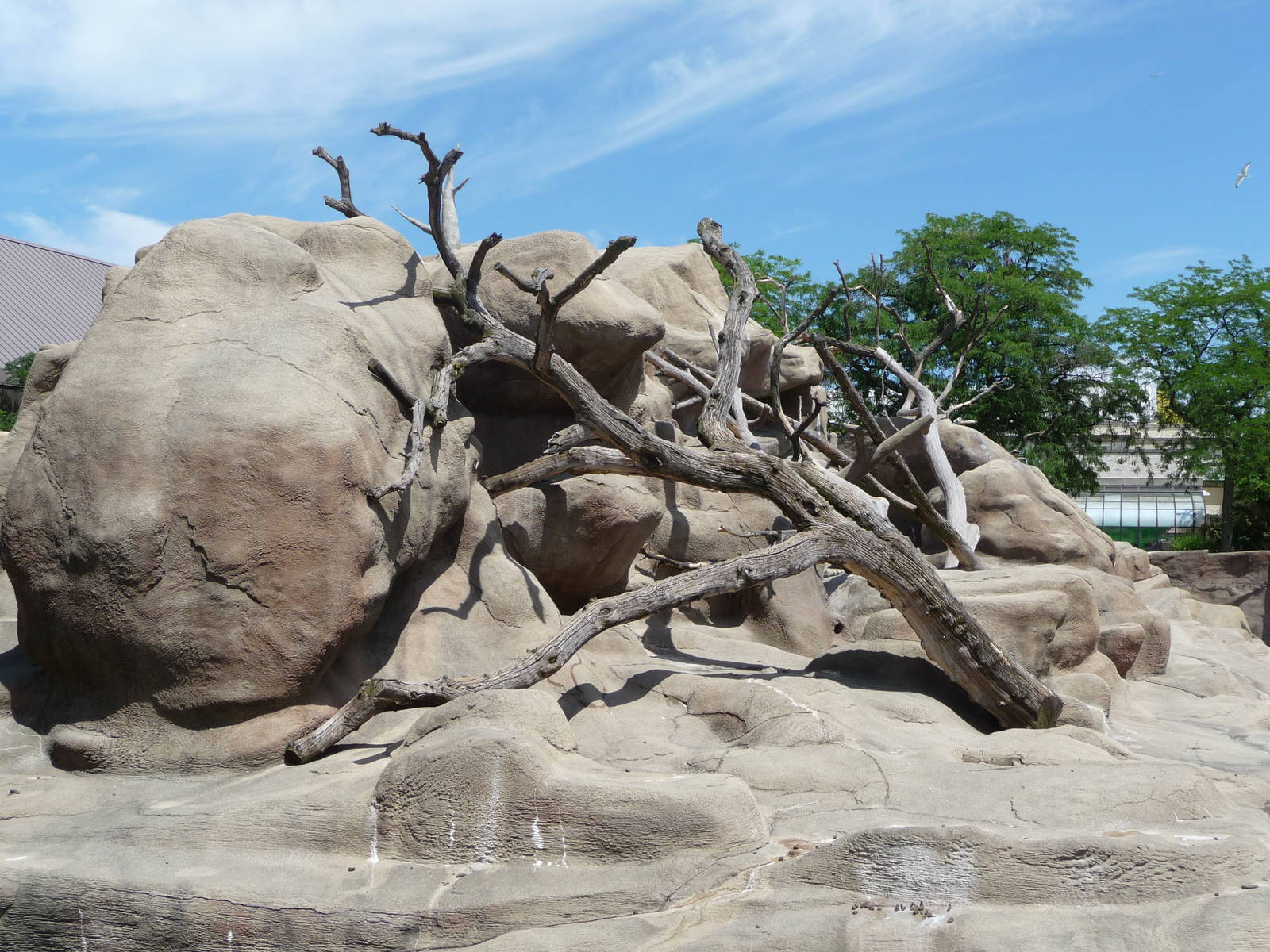
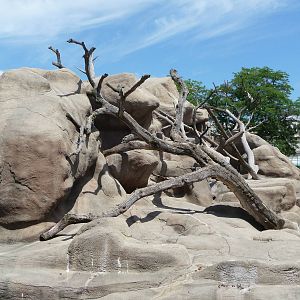
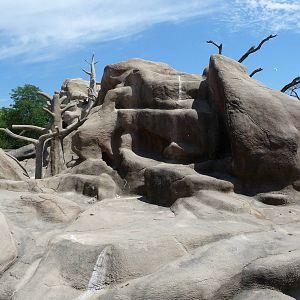
This pile of fake rock opened in 1934 and has barely changed in the last 75 years. To be honest it is huge in size and the baboons have a lot of space in the exhibit.
This massive blob of mock-rock, which is much larger than it appears in the photo, will be demolished in 2014. After almost 80 years of playing host to a plethora of species, and most recently Guinea Baboons, the iconic Chicago landmark will be destroyed. I imagine that the exhibit must have been extremely hot to the touch in the middle of a scorching Illinois summer, and now speculation can begin as to what new habitat will be constructed at this historic zoo.
This massive blob of mock-rock, which is much larger than it appears in the photo, will be demolished in 2014. After almost 80 years of playing host to a plethora of species, and most recently Guinea Baboons, the iconic Chicago landmark will be destroyed. I imagine that the exhibit must have been extremely hot to the touch in the middle of a scorching Illinois summer, and now speculation can begin as to what new habitat will be constructed at this historic zoo.
Baboons have been the big draw and there has been close to 150 Guinea baboons born at the zoo from the time of the opening in the 1930's to the present day. I have two Brookfield Zoo history books and one shows a photo labeled with two species (West African Baboon (obviously the Guinea species) and Dall sheep) while a second photo seems like there is a possibility of an ibex species being present at a later date although it might be an aoudad. It is sometimes difficult to tell with old, black-and-white photos and the Dall sheep could even be questionable as to whether the label is correct. The zoo most definitely had Dall sheep at one time and it seems as if they might have been mixed with the baboons even though they are geographically quite diverse from each other in terms of where they are located in the world.
What is known for sure is that the original occupants were Rhesus macaques, who at one point shared the exhibit with sun bears. There have also been African crested porcupines, aoudads, rock hyrax, meerkats, monitor lizards and rainbow lizards in the enclosure and one summer a few Nile crocodiles were added to the exhibit after they had been confiscated at the airport. There has certainly been quite the menagerie there over the decades! My impression from several press releases is that the exhibit has held Guinea baboons since 1938 and all of the other species have been placed in with the baboons at one time or another to create a unique environment.
In the eighties, siberian ibex were kept at Brookfield zoo on the false mountain which has been torn down. May have been with the baboons sometime. The dall sheep were in northern area near the bears. Brookfield did not have aoudads back then, Lincoln Park zoo had them. Sad to see baboon rock go. Hopefully, the gorillas and orangs will finally get outdoor exhibits, since baboon rock is just outside tropic world.
I spoke with a Keeper at the zoo last Friday who told me the current plan is to demolish the current version of Baboon Island replace it with a similar, large version of Baboon Island with a different species. He also said part of the problem came from the zoo's existing baboon stock dying - they were having too many babies in the 1980's so they began spaying the females to prevent further breeding. Now they are too old
However, the Zoo's 15-year plan at their official website suggests Japanese Macques may be placed there instead - interesting to me, given Lincoln Park Zoo just began construction on such an exhibit.
May have been with the baboons sometime. The dall sheep were in northern area near the bears.
Brookfield did not have aoudads back then, Lincoln Park zoo had them. Sad to see baboon rock go. Hopefully, the gorillas and orangs will finally get outdoor exhibits, since baboon rock is just outside tropic world.