Maguari

Anthony Sheridan Award at Vienna, 14/06/13

  • Media owner Maguari
  • Date added
For Best European Zoological Gardens 2008, 2010 and 2012.

Proudly displayed in the ORANG.erie.

No comment.


Except that I shall be awarding the Ben Gilbert Award very shortly, and I invite you all to join me in awarding random prizes.

(not a dig at the excellent Schoenbrunn, of course!)
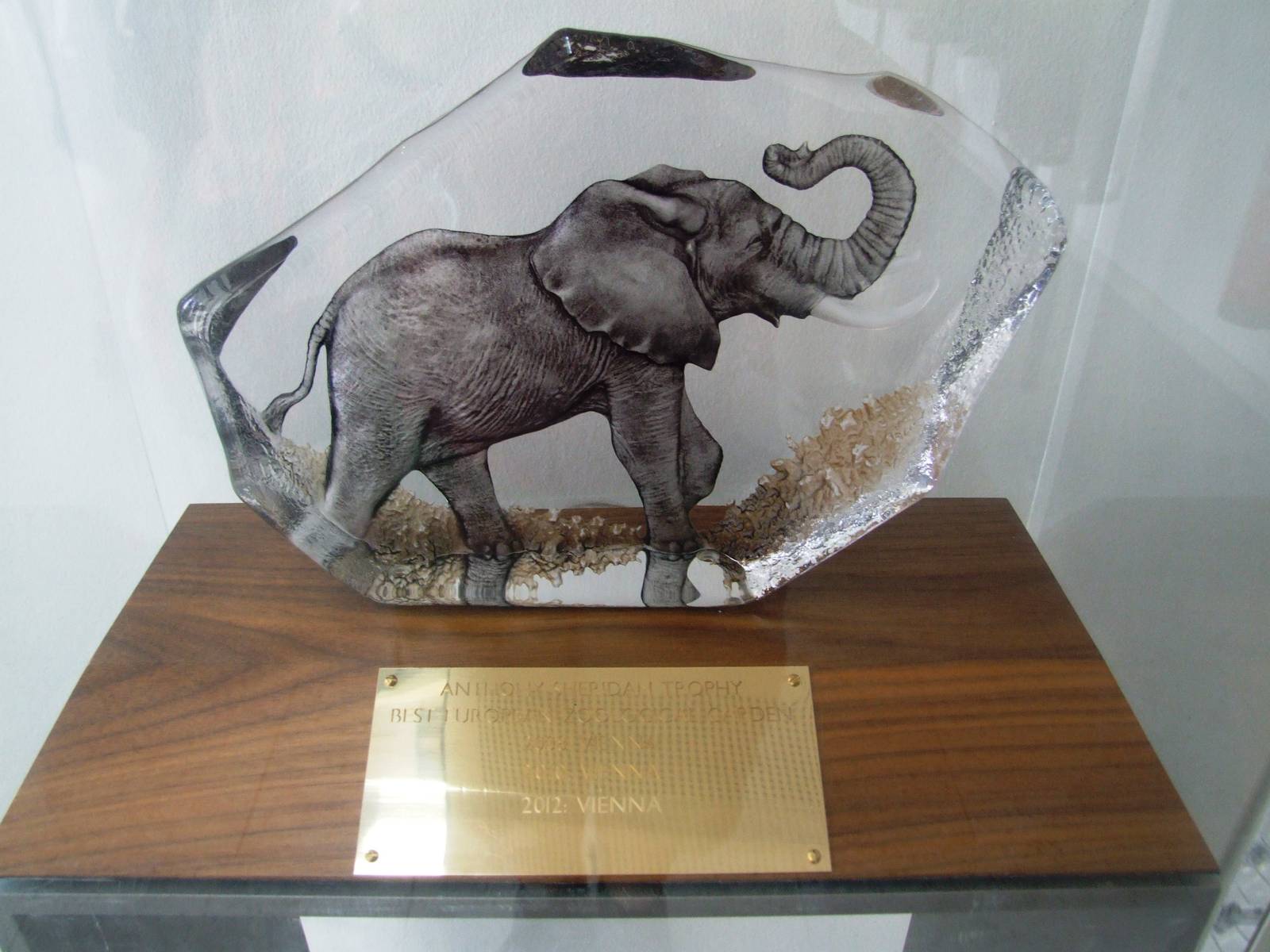
Is it really called "the Anthony Sheridan" award? If so, that is quite simply extraordinary.

I'm afraid it genuinely is - you should just about be able to read the inscrption if you open up the full-size image. Extraordinary is exactly the word!


I'm probably stepping on a metaphorical landmine by asking this based on the comments here, but who is Anthony Sheridan and why is there an award named after him?

Full disclosure: I have never read in full and do not own his book. This is in part because I have some breakable things in my living room, and hurling a book at them could cause damage. But I have looked through it and I have endur- er, enjoyed - Mr. Sheridan's talk about his work on it twice, and have spoken directly with him on a few occasions.

As regards the book, 'arbitrary' and 'credulous' spring to mind. The selection of the zoos is notionally based on visitor numbers (except where he wants it differently), and he slightly gives the impression that the zoos that were more 'welcoming' to him got better write-ups. His attempts to make it seem quantitative rather than qualitative only hurts the book's credibility.

Also, unlike the books of our ZooChat colleagues Mr. Brown and Mr. Nyhuis, Mr. Sheridan does not appear to have actually been to much more than the number of zoos in the book, many of them only for his meetings with senior staff, and sometimes gives the impression in his talks that most of his current experience is based on what the directors of the zoos in his book told him (I wouldn't even like to be sure he actually fully toured the zoos, from the impression I get in his speeches).

Part of the problem is the way he attempts to judge how each zoo will be in the future based on what the directors have told him is planned. Twycross' entry in particular sees him spun some amazing pipedreams by the former management giving a glowing impression of its future that if he were more familiar with the zoo at that time, he would know was incredibly unlikely to happen.

I should say that he has obviously invested a lot of time and effort in the book, and its aim is solid and the book raises money for conservation, which is all good. (And it sells - we saw someone buy the English edition in Schoenbrunn's gift shop)

As to Anthony Sheridan the man, well, I was always told if you can't say anything nice don't say anything at all...
 
Perfect analysis Maguari!

It's a dreadful book in my view. Firstly I hate ranking zoos and exhibits. It's subjective and will always be based on personal preferences and tastes rather than absolutes.

I've been thinking a great deal about what to say about this book. There is no doubt that it's an enjoyable read for any of us lot but it is deeply flawed. The criteria of his ranking and for inclusion in the guide, the sloppy editing, the inclusion of maps which are too small or feature numbers with no key makes it quite frustrating as well as enjoyable to read.

The book is an incredibly pompous and self-indulgent amateur publication; poorly edited - not even in correct English in parts, poorly put together, maps randomly inserted with no thought given to the fact that you can't see them properly in some cases, no key for example.

I would take the award with a pinch of salt, although Vienna is an amazing zoo and one of my favourites.
 
If it's of any interest, here is a review I wrote of this book. I'm sure that much of what I say is a matter of personal opinion - others will, I know, disagree, and I am sure that there are those who will see this book more positively.


What Zoos Can Do by Anthony Sheridan. Published by Schuling Verlag. 388 pages, soft cover. ISBN 978-3865231833. Cost: £24.95. Available from the Independent Zoo Enthusiasts Society

This is a curious and, ultimately, rather unsatisfactory book. It is difficult to understand what it is attempting to do, and at whom it is aimed, and while it has some excellent photographs and some interesting information which has not, as far as I know, been gathered together in this way before, the ultimate sense is of a missed opportunity, of a book which, had it been more coherently thought-through, and better edited, might have been a great deal more successful than is the case.

There are three primary sections to What Zoos Can Do. The first contains a series of essays, wide in range but shallow in depth, looking at a string of zoo-related issues: what does a zoo director do? What is an EEP? How has Colchester Zoo been transformed? Then there are a string of lists: zoos ranked by attendance, by members, by opening hours; in addition, and most contentiously, zoos scored for the quality of their exhibits, and for the quality of their work. Finally, there is a brief catalogue of each of the eighty zoos that Sheridan has decreed to be Europe’s best. Here we can find out whether dogs are allowed in (no at Zlin Lesna and Paignton, yes at Munster), whether there is a guidebook (there is at Heidelberg, there isn’t at Antwerp), how we get to the zoo and how much it will cost us to get there when we get in; there is a wholly subjective list of each zoo’s star exhibits (tamarins at Frankfurt, for example, and Magagascan boas at Mulhouse); and there is a map of each zoo.

A major problem throughout the book is that its execution is not all that it might have been. There are errors that frustrate (and that would have been spotted by a good editor), there are inconsistencies (aviaries are sometimes – but not always – referred to as “volieres”, or, tautologically, as “bird voileres”; we leap from “Ring Tailed Lemurs” to “Ringtail Lemurs”, and European otters are frequently called “fish” otters, in a literal translation of their German name. The book’s design, meanwhile, is utilitarian in the extreme – this is by no means a beautifully put-together volume.

The essays are puzzling. They are, ultimately, lacking in sufficient depth to make them truly worthwhile, but are too detailed, I suspect, to interest the casual reader. Thus like the book as a whole, they leave this reader scratching his head, wondering what it is that that they are for. That piece on Colchester Zoo’s improvements over the past two decades, for example, really doesn’t shine any significant light on how a raggedy collection of animals was transformed into one of Britain’s best zoos, beyond simply saying that it has been. Two pages on in-situ conservation in Kenya have little to do with zoos, and try to encapsulate a massively complex issue into just a few hundred words. A piece on the importance of a zoo director is a masterclass in stating the obvious (such people need, apparently, to be “highly capable, intelligent, dedicated and multi-faceted”).

The ‘lists’ section is both the best and the most frustrating part of Sheridan’s book. It is genuinely interesting to be able to compare the sizes, visitor numbers and animal collections of Europe’s top zoos (although it is not immediately apparent to which year these statistics refer). Less appealing are the league tables that attempt to rank zoos against criteria which are, surely, subjective. How can we, really, say that, for example, Munster’s Zoo is “better” than Berlin’s Tierpark, without acknowledging that this is simply a matter of opinion? That opinion is dressed up as empirical data by pages of tables giving marks out of six to each zoo’s enclosures – Leipzig’s penguins get 3, Valencia’s giraffes get 5, and so on. It’s the sort of thing that a child might do – in fact, it is the sort of thing this child did do, in his pre-teen years, assiduously grading Marwell’s tapir house, and comparing it to London’s Cotton Terraces; it’s the sort of thing, too, that any group of zoo enthusiasts would do when gathered together: have you seen the new rhino house at Magdeburg? Any good? How does it compare to Chester’s? But does such discourse merit publication? I think not – not least because there is a danger to such publication. It’s very nice for Vienna, which finishes top of the list of eighty, but what of Ljubjlana, which comes at the bottom of the pile? How much benefit will it derive from this analysis? And how useful it is to compare Leipzig, with its massive resources, with, say, Bojnice Zoo, which must make do on rather a smaller budget? And why is Odense’s pelican exhibit (a 5, apparently), so much better than that at La Fleche (a mere 2)? None of this is explained. League tables serve football teams well, but they can have no place in the world of zoos.

And then its on to the zoo catalogue, which commences with a few pages in which we are told what each of the top zoos will look like in 2020 (quite interesting, but possibly rather naïve in its assumption that what zoos say they might like to happen will actually come to pass). The catalogues contain the rather esoteric information discussed above. In this era of the internet, it is hard to fathom who might want a book with road directions to Sosto Zoo, in Hungary, and Lisbon Zoo, in Portugal, when such information is so easily available elsewhere, while the time of the penguin feeding and the tiger talk is, again, perhaps not best compiled in a hefty book. There is a short paragraph of prose for each zoo, in which the adjective ‘delightful’ is frequently used, a map (all interesting, but only some of any practical use given the frequent absence of a key, and the small scale on which some of the maps are reproduced), and some very good photos (although these are only partially labelled). I would have really valued fuller essays here – in Allen Nyhuis’s America’s Best Zoos, for example, or Tim Brown’s IZES Guide To British Zoos there are contentious opinions put forward, but these are supported by words rather than numbers, and are thus all the more compelling. We may not agree with Nyhuis, or Brown, but we understand why they think as they do. Here, in contrast, we have just numbers, with little explanation of how those numbers were derived.

General books on zoos are few enough on the ground that when one arrives, it should be welcomed. And for many readers, a volume that contains pictures of Doue la Fontaine’s rhino enclosure, Kronberg Zoo’s giraffe house and the entrance gate at Warsaw Zoo is going to be worth buying. Some of the information, too, is certainly worth having – there is even a strange fascination to knowing which zoos do allow dogs on their premises. But, ultimately, this is a book that, despite its good intentions, does not succeed, that is too diffuse it its aspirations and too careless in its execution.
 
Nice review Sooty, and I actually do agree with a lot of what you stated. I've also heard many opinions about Sheridan himself and I've yet to find a positive one. Still.....

I'll swim against the current here and offer up some praise for the book, as even with its flaws it is arguably the most comprehensive book in regards to European zoos ever produced. There are plenty of publications on specific zoos and one could fill a small library with books about London Zoo, Berlin Zoo or the many fine German and Dutch establishments. However, What Zoos Can Do takes the 80 best European zoos and in a way replicates what America's Best Zoos did with the 60 best American zoos. I am a fond fan of the latter volume as the reviews offer up extremely detailed tours through each facility while in What Zoos Can Do there is scant information on the zoos. Still, as a Canadian who has only visited 2 European collections (Zurich Zoo and Langenberg Wildlife Park in Switzerland) I am enthralled by Anthony Sheridan's book and I open it to look something up perhaps 3 times a week. I have plenty of zoo books in my collection but most of them are read once and then occasionally used to research information while Sheridan has done what no one has ever done before and accumulated data on a vast number of zoos within a single continent. The fact that the book exists at all is worthy of a lot of praise.

Could the book be improved upon? Of course, as certain zoos are missing (Moscow and Attica are most definitely classified as European zoos by many); the chapter on what zoos will look like in 2020 has many plans not set in stone; and the maps in some cases are difficult to read and they lack keys. As someone who owns around 800 maps that was not a major issue for me as I just dug out the corresponding map for each zoo and it helped enormously. For those who do not collect maps then I can empathize with the issue of the lack of keys in the book.

Chapter 11 with "Zoo Facts" is fantastic, with all 80 zoos listed in order in terms of attendance, acreage, date of foundation, membership numbers and collection size. To have all of the information available within a few pages is absolutely brilliant, and I know a handful of zoo nerds that have practically memorized What Zoos Can Do just for that chapter. Fascinating stats like the fact that 61 out of the 80 zoos have elephants can be found nowhere else, or that Cologne has 202 species of birds. We all look up such info on a regular basis but having someone put it all together in a glossy zoo book is something to cherish. Why visit countless zoo website's searching for a needle in a haystack when it can be found in Sheridan's book in seconds? It is like an encyclopedia for zoo nerds!

Naturally the most contentious section is the star rating system for iconic species (4 pages of giving marks to key exhibits) and 9 pages of ranking zoos in a variety of categories. Everyone knows that ranking zoos is a subjective effort, and Sheridan's top 11 zoos would be different from many other ZooChatters. But, if one were to take a poll of perhaps 25 European zoo nerds than would you really come up with a much different list?

Sheridan's top 11 zoos (the last two are tied on points in his rating system):

Vienna
Leipzig
Zurich
Berlin
Basel
Chester
Cologne
Rotterdam
Arnhem
Hamburg
Prague

Sure, Berlin Tierpark fails to crack the top 11 and Basel seems high, but I would have bet money that the rest would have been there or on the edge. It seems to me that Sheridan's ranking of zoos is about what I would have expected. There are folks that love the naturalism of ZOOM with its modern exhibits while others would prefer more traditional enclosures and animal houses (Frankfurt) but those zoos are still well represented. My final point is that even amongst the flaws that are present, such a book on European zoos has never once been published before and if Sheridan ever supplies us with an updated version in the next decade I'm sure that it will be even better.
 
I'm probably stepping on a metaphorical landmine by asking this based on the comments here, but who is Anthony Sheridan and why is there an award named after him?
Excellent question and very well presented,and one that many of us in Europe have been asking for a good few years now!!
 
One book that also offers up a representation of zoos is the 1980 publication Great Zoos of the World. That excellent book has fine reviews of 19 zoos from 5 different continents, as well as mention of many other establishments. However, What Zoos Can Do really is unprecedented in its scope of European facilities.
 
Interesting enough in the guidebook "Schonbrunn Zoo: Myth and Truth" (really more of an actual book, and published in 2012) almost an entire page is devoted to the fact that Anthony Sheridan gave acclaim to Vienna as being the best zoo in Europe. There is mention on page 21 of Vienna "once again being voted the best zoo in Europe for 2010" and was there an actual vote by anyone? Incidentally there is a terrifically concise 25-page history of the zoo in the 112 page book.
 
Thank you, Maguari, Sooty Mangebey, and SnowLeopard for the shout-outs of my book! I really appreciate it.
 
Thank you, Maguari, Sooty Mangebey, and SnowLeopard for the shout-outs of my book! I really appreciate it.
Well its a far better and more accurate read that what Mr Sheridan produced,so your book is worthy of a shout out!!
 

Media information

Category
Tiergarten Schönbrunn
Added by
Maguari
Date added
View count
6,371
Comment count
30
Rating
0.00 star(s) 0 ratings

Share this media

Back
Top