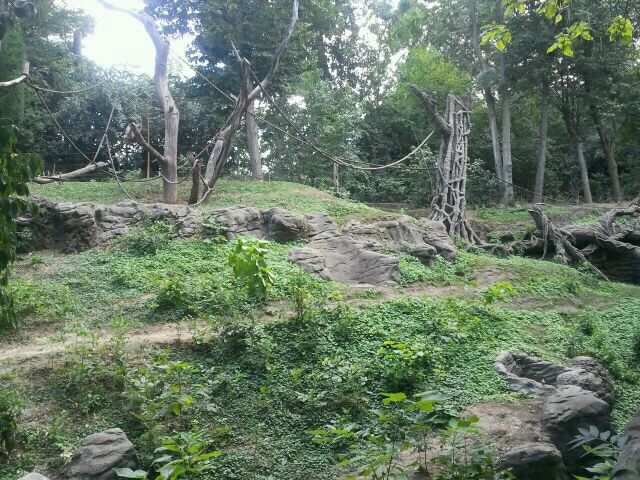
I don't think naturalness has to make a good exhibit, all that matters is that it provides all the needs of an arboreal ape. And if you say that no animal should live an artificial life then you're talking about almost every animal that has lived in captivity.
Though an animals life in captivity cannot compare to ones in its natural habitat, we can give it more than just fake plants, branches, and floor. Orangutans in the wild live in trees not concrete tubes that have been painted to look real. the best we can do, unless we decide to release all of them back into the wild now, is to at least give them as close to their environment as possible. So you think all zoos and every animal in zoos lives an artificial life? How so?
Though an animals life in captivity cannot compare to ones in its natural habitat, we can give it more than just fake plants, branches, and floor. Orangutans in the wild live in trees not concrete tubes that have been painted to look real. the best we can do, unless we decide to release all of them back into the wild now, is to at least give them as close to their environment as possible. So you think all zoos and every animal in zoos lives an artificial life? How so?
I'm sorry but people are saying that they are unsatisfied that the outdoor area doesn't have enough climbing structures yet when it comes to a "bedroom" (something that usually doesn't have a lot of effort put in to it) that has those things they are saying it is too dark, small, and fake. Orangutan and gibbon live in trees, the indoor area doesn't let them touch the ground except for the corners. While I compared it to other indoor exhibits, they did not match it because they have easy access to the ground and not necessarily only the trees. But also honestly tell me, how would the zoo be able to put live trees in the indoor area? Look at the SDZ's orangutan/siamang exhibit, it has just poles but I still like it because when I see them (in the animal cam) they are always usually brachiating.
Pacarana: Every animal is surrounded by a barrier that was man-made, and with-in that barrier could be fake rock, man-made pond or pool, and placed on grass. As for primates, most zoos build fake trees or objects to substitute trees.
I'm sorry but people are saying that they are unsatisfied that the outdoor area doesn't have enough climbing structures yet when it comes to a "bedroom" (something that usually doesn't have a lot of effort put in to it) that has those things they are saying it is too dark, small, and fake. Orangutan and gibbon live in trees, the indoor area doesn't let them touch the ground except for the corners. While I compared it to other indoor exhibits, they did not match it because they have easy access to the ground and not necessarily only the trees. But also honestly tell me, how would the zoo be able to put live trees in the indoor area? Look at the SDZ's orangutan/siamang exhibit, it has just poles but I still like it because when I see them (in the animal cam) they are always usually brachiating.
I would have no way of knowing how to plant live trees in an indoor exhibit....I don't see how this is relevant?
[/QUOTE]Pacarana: Every animal is surrounded by a barrier that was man-made, and with-in that barrier could be fake rock, man-made pond or pool, and placed on grass. As for primates, most zoos build fake trees or objects to substitute trees.[/QUOTE] This is defiantly true, i do feel as though you are missing my point. Zoos have no option but to "cage" there animals in by a man made barrier, Tell me one zoo that hasn't?If a zoo wants a rock barrier, fake rock is the only way to go. Theres no way a zoo could place giant boulders to enclose their stock. Again, man-made pools and ponds are the only way to go-I have seen natural but a zoo can't assure every exhibit will get a natural flowing stream or pond. We have to be realistic here. What zoos can do is provide animals with natural objects that are possible. Branches, in this case, can be provided, which Denver has perfectly shown.
I understand that Cincinnati has an indoor exhibit for their orangs, where they can't touch the ground but the fact that those branches are fake cancels it out. My whole point is, though Denver does have ground access for their orangs, their branches are real. Wouldn't this be more natural than an exhibit where they show natural behavior in a completely artificial surroundings?
Quote: I would have no way of knowing how to plant live trees in an indoor exhibit....I don't see how this is relevant?
Its relevant because you were saying that no animal should live an artificial life, well what do you suppose the zoo does, have a giant tree somehow planted into the ground of the indoor exhibit?
Quote: Wouldn't this be more natural than an exhibit where they show natural behavior in a completely artificial surroundings?
Quote: I would have no way of knowing how to plant live trees in an indoor exhibit....I don't see how this is relevant?
Its relevant because you were saying that no animal should live an artificial life, well what do you suppose the zoo does, have a giant tree somehow planted into the ground of the indoor exhibit?
Quote: Wouldn't this be more natural than an exhibit where they show natural behavior in a completely artificial surroundings?
Not necessarily, I don't think zoos can do that actually. I would suggest building a "jungle gym" type structure made out of real wood, branches that were once on a tree. Many zoos have done this and its a natural as it can get.
It seems now we are just at odds with it but just to go deeper, why wouldn't it in this case? How is this one any different from any other cases that have the same defect?
Not necessarily, I don't think zoos can do that actually. I would suggest building a "jungle gym" type structure made out of real wood, branches that were once on a tree. Many zoos have done this and its a natural as it can get.
It seems now we are just at odds with it but just to go deeper, why wouldn't it in this case? How is this one any different from any other cases that have the same defect?
To answer the original question it's because (in this case-Denver/Cincinnati) it seems that it is easier for the apes to show natural behaviors in Cincinnati's exhibit because the trees are so close together that they can brachiate. Denver's yes does have natural "trees" but it is open-spaced and it doesn't look like a place for an orangutan that can brachiate as well as in Cincy's. I think I'm blabbering now because my mind is going in circles with this conversation
I see that you replied to my question about putting a tree in the indoor exhibit. I said that because the ground is shotcrete and would be very difficult. I still am puzzled on why people say its not great, its a massive "bedroom". Bedrooms are typically not as great as the outdoor areas but in this case it almost is. I took a 3rd look at Toronto's and am still not a fan at all of it.
Edit: And to point out that that is Toronto's only exhibit.
I haven't read through this entire arguement, but if one is discussing the value of gibbons indoors with live tres, then one ought to think hard about Bronx Zoo's JungleWorld.
And we cannot ignore that the feel, the bounce, etc. of a branch cut from a real tree is a very different thing than a shotcrete branch. To what extent does a gibbon or orang care? We can't know without some sort of behavioral study. Anyone know of such a study?