I've seen Chimps and tigers at the LA zoo catch a squirrels before. Every time I see that I leave the exhibit immediately because it can get quite bloody and kind of disgusting.
I think it is Munich that has a mechanical flying fox runing through the enclosure. Hanging a carcass on this and watching the animals run must be amazing!
Mechanical flying fox?? In Munich??? Someone seems to have pulled your leg there...There is sort of a cable railway in Tierpark Hellabrunn where meat is attached to so that the African Hunting Dogs hunt after it-more or less successfully. A similar, older version of this idea can be, among others, found in Duisburg Zoo.
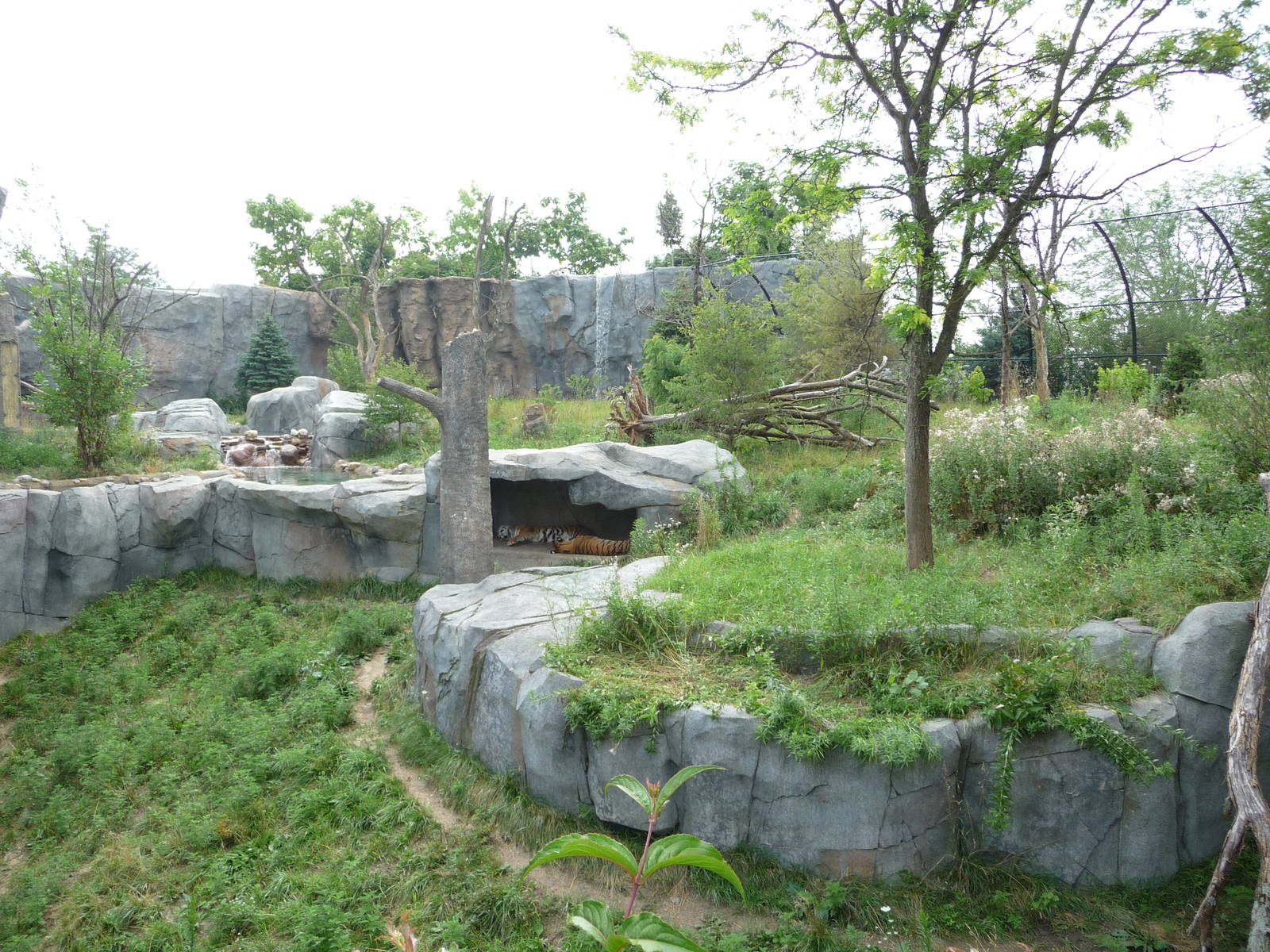
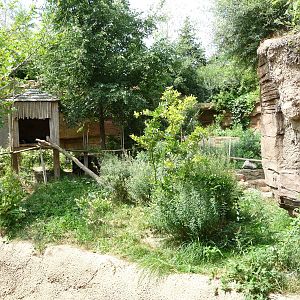
About the exhibit above: I'm not a great fan of fake rocks-and that enclosure has more than plenty of that...
@mstickmanp: That's part of their natural behaviour...
There has been ongoing debates about the feeling of pain in fish; most experts assume now that fish can and do feel pain. In general, I act on the assumption that all animals are equally sensitive to pain (with certain "exceptions" like Naked Mole Rats)...and thus don't "discriminate" here in regard to the aptness of live prey.
I was under the impression that all vertabrates could feel pain as well as squid, octopus and cuttlefish. I heard this from a zookeeper so have always just taken it as fact and never gave it a second thought but I don't know how well it can be proved (proven?).
@PAT: When it comes to pain in animals, a lot is still "taken as a fact", but usually lacks a scientific, factual basis due to lack of research. We can assume that the ability to feel pain in one way or another in general is present in all animals-but to what extant? And what kind of pain in general and in detail-nociceptive, neuropathic or even psychogenic? What kind of nociceptors, if at all, are present? Etc. etc.
Mechanical flying fox?? In Munich??? Someone seems to have pulled your leg there...There is sort of a cable railway in Tierpark Hellabrunn where meat is attached to so that the African Hunting Dogs hunt after it-more or less successfully. A similar, older version of this idea can be, among others, found in Duisburg Zoo.
@zooman: "SW"? "Seperate"? What are you talking about? Tierpark Hellabrunn is just the official title for Zoo Munich that I happened to use in the third sentence of mine...
While revisiting this photo I was struck by the massive size of the fairly new Amur tiger exhibit. There are two large cats clearly visible in their exposed den, but the enclosure is not even completely shown in this particular photo. There are several densely planted areas, and a winding stream and a nice pool for the inhabitants outside of what can be seen here. Off of the top of my head I'd say that only the Minnesota and Bronx zoos have more impressive tiger habitats in all of North America, although there are several other strong contenders.
I'd be a bigger fan of this exhibit if the back rock face didn't look so fake, and the wire fencing on the right isn't visible. I haven't seen anything but photos of this exhibit, but overall it is pretty nice.
@Ituri: I agree with your assessment, as it is always nice when fences and rock walls can be hidden from view via the planting of dense foliage. A handful of thick bushes along the back fence (hotwired if necessary) would not affect the tigers and also obscure the perimeter of the enclosure. It is still one of the very best tiger exhibits in North America, even with the Columbus Zoo's fairly recent reliance on prominent mock-rock formations.