The same way any of the hundreds of free flight bird shows at zoos around the world do. The birds are so used to their routine that they do not want to fly away. Theoretically, they could if they wanted to. (I think they may have some type of radio-trackable antenna on their body in the unlikely event this does happen).
The same way any of the hundreds of free flight bird shows at zoos around the world do. The birds are so used to their routine that they do not want to fly away. Theoretically, they could if they wanted to. (I think they may have some type of radio-trackable antenna on their body in the unlikely event this does happen).
I have seen at least 2 birds of prey shows where the bird has decided to disappear during the show. I remember once at Cotswolds the bird flew into some trees and just kept getting further away everytime the handler decided to get closer. (Possibly a peregrine falcon!)
I have seen at least 2 birds of prey shows where the bird has decided to disappear during the show. I remember once at Cotswolds the bird flew into some trees and just kept getting further away everytime the handler decided to get closer. (Possibly a peregrine falcon!)
I remember seeing the same thing happen at the Cotswold Falconry Centre with a Great Grey Owl. Maybe it's something to do with the area..
Arizona Docent, I'm intrigued by this method of managing cranes. You sound as if it's not the first time you've seen it done - how often have you seen it ?
If cranes, storks, flamingos, waterfowl and pelicans COULD be trained to stay onsite then they'd make a magnificent spectacle, and their breeding results would probably improve enormously.
If cranes, storks, flamingos, waterfowl and pelicans COULD be trained to stay onsite then they'd make a magnificent spectacle, and their breeding results would probably improve enormously.
Basel have an unclipped flamingo flock in an open enclosure. I'm not sure how it works but I know there is something to do with psycological barriers and foliage which stops them getting the momentum to fly away.
Arizona Docent, I'm intrigued by this method of managing cranes. You sound as if it's not the first time you've seen it done - how often have you seen it ?
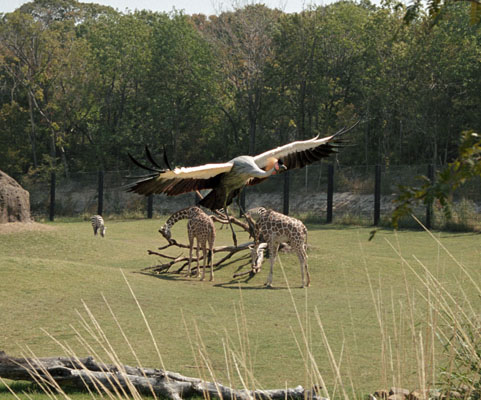
The bird show at the Los Angeles Zoo (which I have seen twice) opens with two crowned cranes flying in from "out of nowhere" and landing on the stage, then walking through the opening to backstage. This is done before there is even a trainer on the stage - they just know to walk back on their own.
The same way any of the hundreds of free flight bird shows at zoos around the world do. The birds are so used to their routine that they do not want to fly away. Theoretically, they could if they wanted to. (I think they may have some type of radio-trackable antenna on their body in the unlikely event this does happen).
Yes, there's a transmitter that, depending on the specie, you can use to track the bird in case he flies off.
I've flown (and still do) cranes, storks, ibis, hornbills and also a wide variety of raptors, and we always use telemetry just to be safe.