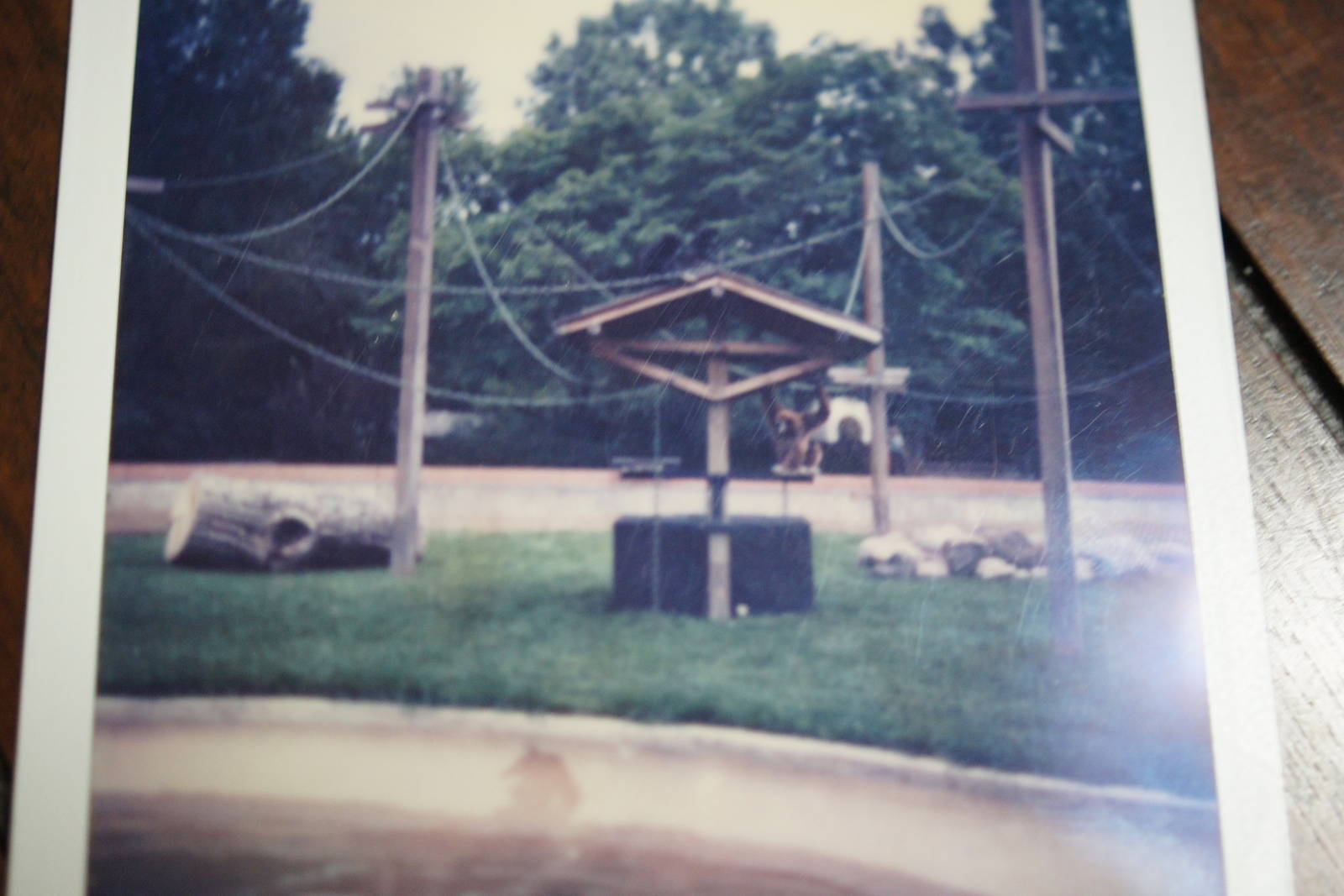
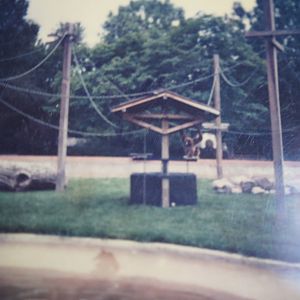
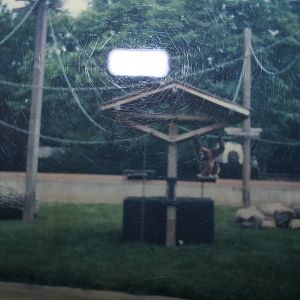
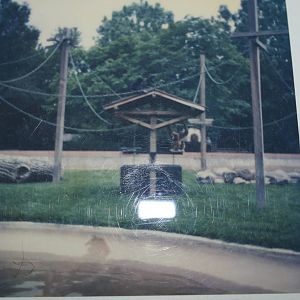
Are you sure this is a Proboscis Monkey? Outdoors in Colorado? I can just about make out an animal on the island on the photo and I would have guessed some kind of a gibbon rather than a treasure such as a Proboscis Monkey.
Look at this website. It clearly states that Colorado reported 1 Proboscis Monkey in 1975. The family photo was taken in 1982. Then if you read further it states that in 1997 it reported none.
I am sure that the small pueblo zoo could not contain this species neither can CMZ. I am 100% sure that Denver Had a proboscis and now I have two marks of evidence. Male Proboscis are large and have orangish fur. This one is large and has orangish fur. Males have large noses and they are a monkey so they have tails. On this one you can see a spot of light hitting the noise. You can also see the tail that is coming down from the backside.
I can also state that if this was CMZ's ( second largest zoo in CO after Denver ) landscape is always curving and upright. There's not a lot of flat parts in Colorado Springs. I have also noticed that CMZ tree's are mostly evergreens and pines. The trees in the back are defiantly not pines.
If you would like to know a bit more or are still on the edge of your seat about it. I would be happy to contact all three Colorado zoos and even pull out an old document that I have lost in my bookmarks that says, Denver documented a Proboscis Monkey instead of saying Colorado.
Thank you for commenting. I always like answering your questions and please ask if you have any more. I have known for a while but I guess it is more exciting to say that Denver had one.
Look at this website. It clearly states that Colorado reported 1 Proboscis Monkey in 1975. The family photo was taken in 1982. Then if you read further it states that in 1997 it reported none.
I am sure that the small pueblo zoo could not contain this species neither can CMZ. I am 100% sure that Denver Had a proboscis and now I have two marks of evidence. Male Proboscis are large and have orangish fur. This one is large and has orangish fur. Males have large noses and they are a monkey so they have tails. On this one you can see a spot of light hitting the noise. You can also see the tail that is coming down from the backside.
I can also state that if this was CMZ's ( second largest zoo in CO after Denver ) landscape is always curving and upright. There's not a lot of flat parts in Colorado Springs. I have also noticed that CMZ tree's are mostly evergreens and pines. The trees in the back are defiantly not pines.
If you would like to know a bit more or are still on the edge of your seat about it. I would be happy to contact all three Colorado zoos and even pull out an old document that I have lost in my bookmarks that says, Denver documented a Proboscis Monkey instead of saying Colorado.
Thank you for commenting. I always like answering your questions and please ask if you have any more. I have known for a while but I guess it is more exciting to say that Denver had one.
I understand you are excited about that you may have seen a Proboscic Monkey as a child; they always were rare, not to mention nowadays when only Singapore Zoo and the odd Indonesia zoo has them. I was excited to see and photograph Singapore's breeding group back in 2008.
But I have to tell you that there is just not the slightest chance of this being a Proboscic Monkey. I'm sorry but you have to accept it.
The collection in question would have been Denver without a question so let us forget Colorado Springs and Pueblo from the beginning.
I wouldn't put too much confidence in that website; it seems to be run by amateurs who clearly love these primates but have little interest in their captive history, or at least to research it properly. The data is moreover over a decade old and based on a single article.
This species was always short-lived in captivity. If we assume that the Colorado animal was not an error, it would never have lived 30 years so reporting that some collection in Colorado had a single specimen in 1975 but NOT 22 years later is just absurd. The animal would never have lived that long and it goes without saying that without company of the opposite sex it would not have reproduced (not that they often did in captivity) so it might have died well before this photo was taken.
Another thing is that these primates were always housed indoors in the US and Europe, such as at Jungle World at the Bronx Zoo, due to the climate. This one is on an island which is like millions of others for Gibbons that you see in zoos around the world.
Male Proboscic Monkeys are indeed large and orange but this primate is dark brown. The way it holds the bar or rope above its head suggests a Gibbon no doubt.
And you have the original photo so you can see all the details you use to argue with. Those of us who see this blurred online version (which includes your living room table for some reason) do not.
Actually, now I realise that this is not a proboscis monkey, because as Baldur said, the way it is holding the bar looks like a gibbon's body structure and you can see that it has very long arms. I also thought it was too hairy to be a proboscis as they have rather thin coats and I also thought the colour was too dark to be a proboscis, and the face is too rounded.
Im sorry to say but I think this is not a proboscic monkey. Are you sure you didn't label this picture wrongly and you have another that is a proboscis monkey. And in no way am I saying you did not see one but this is almost certainly not a proboscis.
EDIT: That "tail" I think is just a climbing frame