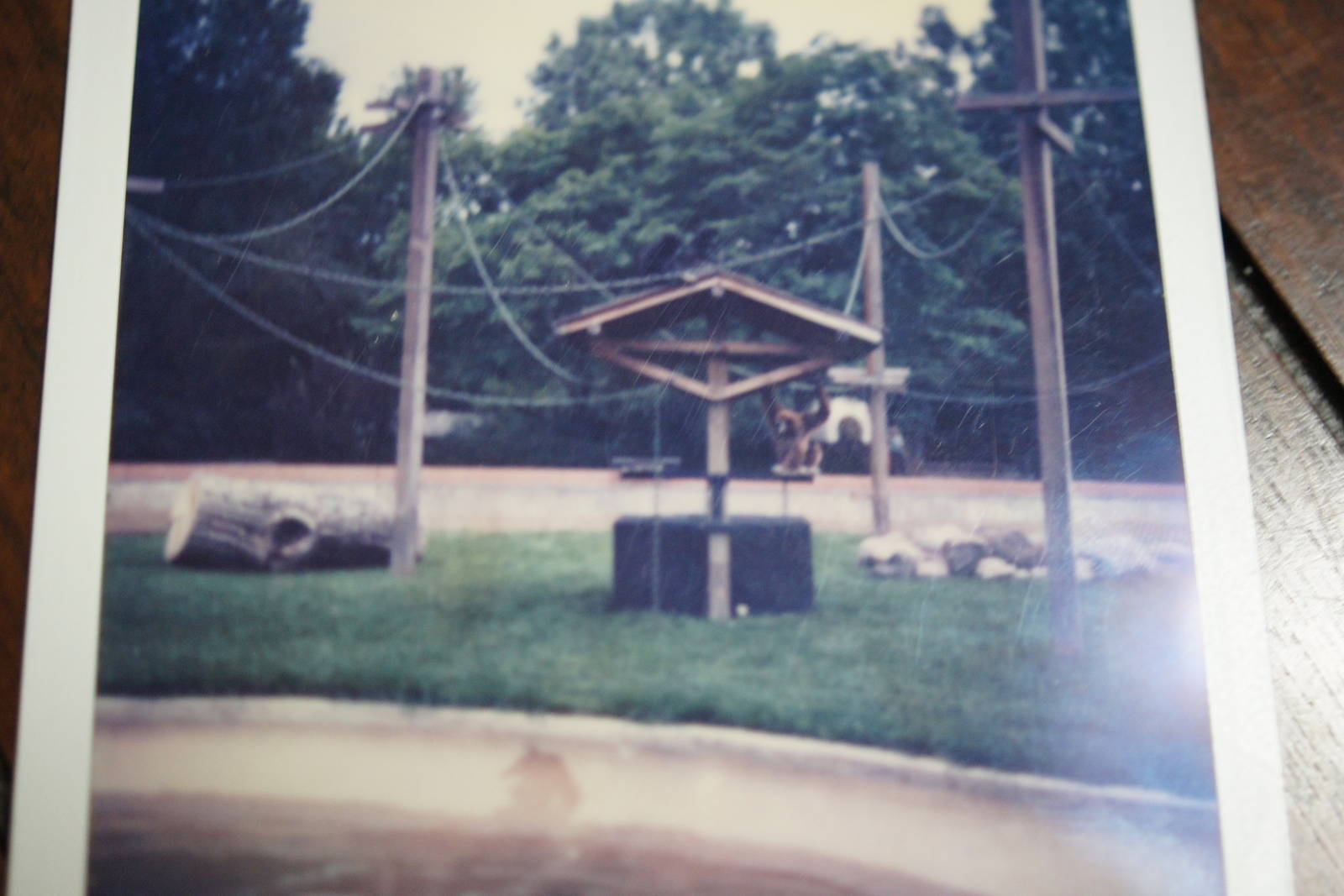
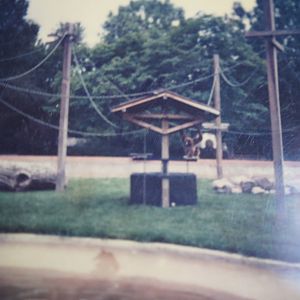
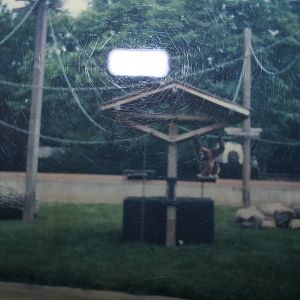
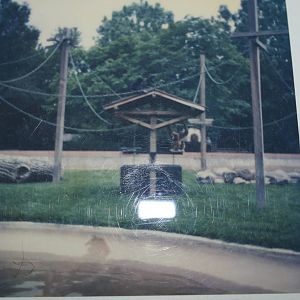
sorry Fossa Dude, but this is absolutely a gibbon and NOT a proboscis monkey. The "tail" is actually a vertical pole or chain directly equivalent to one on the other side of the shelter (i.e. there is one on each side of the shelter). The legs and arms are completely wrong for proboscis monkey but perfect for a gibbon. The "nose" catching the light appears to be the face overexposed and out of focus. The colouration is also totally wrong for proboscis monkey.
EDIT: just saw the other two photos, and it is obvious from those, especially this one (http://www.zoochat.com/561/denver-zoo-1982-a-189811/), that the "tail" is a chain and the "nose" is the white face ring of a lar gibbon (its head is turned to the side)
Ok. First off I don't want to get in a fight with anyone and I hope there hasn't been one yet. This could be a proboscis or it could not be a proboscis. What I don't understand is why no one can believe anything they see on here. I could understand kinda, because you really want to know the facts but why can't you just have a little fun and say yah I can see that it could be. They are all the same photo. I will contact Denver Zoo to see if this was the proboscis monkey and its enclosure.
Ok. First off I don't want to get in a fight with anyone and I hope there hasn't been one yet. This could be a proboscis or it could not be a proboscis. What I don't understand is why no one can believe anything they see on here. I could understand kinda, because you really want to know the facts but why can't you just have a little fun and say yah I can see that it could be. They are all the same photo. I will contact Denver Zoo to see if this was the proboscis monkey and its enclosure.
No one is here to fight (at least not me) but we're here for another word starting with 'F' and that word is 'Facts'. The fact here is that this animal cannot have been a Proboscis Monkey. Even if the photo is blurred, I can see enough to know that it is a Gibbon. And if we are just to have fun with this photo, we might call it a Thylacine. How about that for fun?
The design of the exhibit matches Gibbon exhibits you see all over the world for a start. The way it holds the bar or rope over his head suggests a Gibbon. The color suggests a Gibbon. You don't have to have seen a Proboscis Monkey, it is enough to have seen a Gibbon, even just once, and you must have seen one or two in your life as I have.
If obtaining a Proboscis Monkey would have been the ultimate definition of luck, housing it in this exhibit would have been the ultimate definition of dumbness, even in the 1970s when we knew less than today about animal needs. I would have given a Proboscis Monkey a week in this exhibit, not a day more.
I never said the Denver Zoo didn't have a Proboscis Monkey; many zoos had them at different times. And it may well have been alive when you visited in 1982. But it would have been indoors in the Monkey House that they had at the time, there is just no doubt about it.
If I haven't managed to convince you with this post, my second one, then so be it I'm afraid.
Hey guys did a wee bit of digging .
Berlin zoo had a troop of 6 proboscis monkeys imported in the mid 70s that would have been contemporys of the one at colorado. Theres all seemed to have died with in the space of 4 years. So I doubt this is a proboscis because it would be 7 years old, housed outside and on its own makes me doubt that this is the monkey in question
For all of the evidence cited by others, the photo clearly shows a gibbon, not a proboscis monkey. Also, I remember this exhibit, which was part of the "new" Primate Building (the island was located just outside) that opened in the late 1960s at Denver. It exhibited gibbons. The interior of the Primate Building (which was renovated in the early 90s as part of Primate Panorama) featured the then-typical tile-walled, glass-fronted cages. If Denver ever had a Proboscis Monkey (which I highly doubt), they would almost certainly have kept it in one of those indoor spaces with all the other "delicate" primates they housed there. I believe the island still exists, but was greatly modifed (i.e. planted) and is now a lemur habitat.
It simply doesn't look like the posture, form or habit of a Proboscis to me. I was fortunate to see them for many years at the Bronx Zoo and this fellow doesn't appear much like them even considering the old blurry photo.
Still a cool primate and perhaps after all these years you have an i.d. for it!