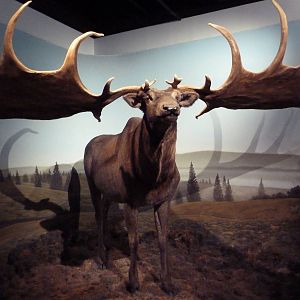
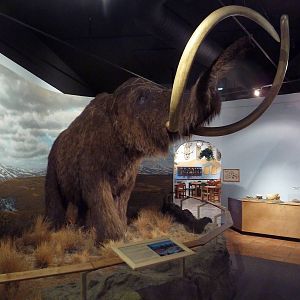
yes KCZooFan, it is a reconstruction of Megaloceros giganteus
here's a photo I took of a skeleton of a giant deer a couple of weeks ago in the Christchurch Museum (NZ); the animal to the right of the giant deer skeleton is a Javan rhino (you might need to turn your head to the side....)
Common fallow deer (Dama dama) and Persian fallow deer (Dama mesopotamica) are actually the closest living relatives of Irish elk (Megaloceros giganteus)
Irish elk (Megaloceros giganteus) were actually not the largest Cervid that ever lived, that was actually the Broad fronted moose (Cervalces latifrons), like Irish elk (Megaloceros giganteus), Broad fronted moose (Cervalces latifrons) lived in the holarctic regions of Eurasia during the Pleistocene. Unlike Irish elk (Megaloceros giganteus), the broad fronted moose (Cervalces latifrons) belonged to the subfamily Capreolinae whereas Irish elk (Megaloceros giganteus) like their modern day counterparts, belonged to the subfamily Cervinae, besides Broad fronted moose (Cervalces latifrons), other species that belonged to the genus Cervalces included Cervalces scotti, Cervalces carnutorum, and Cervalces gallicus
Megaloceros was not a monotypic genus either, the genus Megaloceros consisted of 9 species, considering that Irish elk were surprisingly good runners, and that they were more evolutionarily advanced than Common fallow deer and Persian fallow deer, it is said that man may have been the cause of the extinction of Megaloceros giganteus (probably a similar situation with Wooly mammoth Mammuthus primigenius)
Common fallow deer (Dama dama) and Persian fallow deer (Dama mesopotamica) are actually the closest living relatives of Irish elk (Megaloceros giganteus)
Irish elk (Megaloceros giganteus) were actually not the largest Cervid that ever lived, that was actually the Broad fronted moose (Cervalces latifrons), like Irish elk (Megaloceros giganteus), Broad fronted moose (Cervalces latifrons) lived in the holarctic regions of Eurasia during the Pleistocene. Unlike Irish elk (Megaloceros giganteus), the broad fronted moose (Cervalces latifrons) belonged to the subfamily Capreolinae whereas Irish elk (Megaloceros giganteus) like their modern day counterparts, belonged to the subfamily Cervinae, besides Broad fronted moose (Cervalces latifrons), other species that belonged to the genus Cervalces included Cervalces scotti, Cervalces carnutorum, and Cervalces gallicus
Megaloceros was not a monotypic genus either, the genus Megaloceros consisted of 9 species, considering that Irish elk were surprisingly good runners, and that they were more evolutionarily advanced than Common fallow deer and Persian fallow deer, it is said that man may have been the cause of the extinction of Megaloceros giganteus (probably a similar situation with Wooly mammoth Mammuthus primigenius)
Another interesting thing I found out about Irish elk (Megaloceros giganteus) is that the hump just behind their neck was used to store food (similar to that of of old world camelids)