I reviewed the zoo a few months ago, and hope you dont mind if I just post the Africa portion of that review.
"Africa is huge exhibit, bigger than many zoos. There are several subtle immersion elements, but it is not overboard or cartoonish, creating a realistic environment. It is set in an open valley, surrounded by hilly forests. One section, the Congolese forest, is set in this forest. At one end of the exhibit is a large lagoon. The path goes through Botswana, stops in the Nairobi market, and travels in a loop through Kenya, Tanzania, and Uganda. A side path leads visitors across a bridge into the Congolese Forest. I shall have spate paragraphs for each of the five countries represented.
Botswana has one exhibit. This is the African elephant exhibit. A long path (.25 miles) follows the length of the 4.5 exhibit. It is long and dusty, and has an obstructive cable fence. However, they can be viewed from across a moat at one end. Also at this end is a large pool for them to swim in. There is also an overlook into their small yard. A tram transports visitors from near the entrance down to Nairobi market, going through this exhibit.
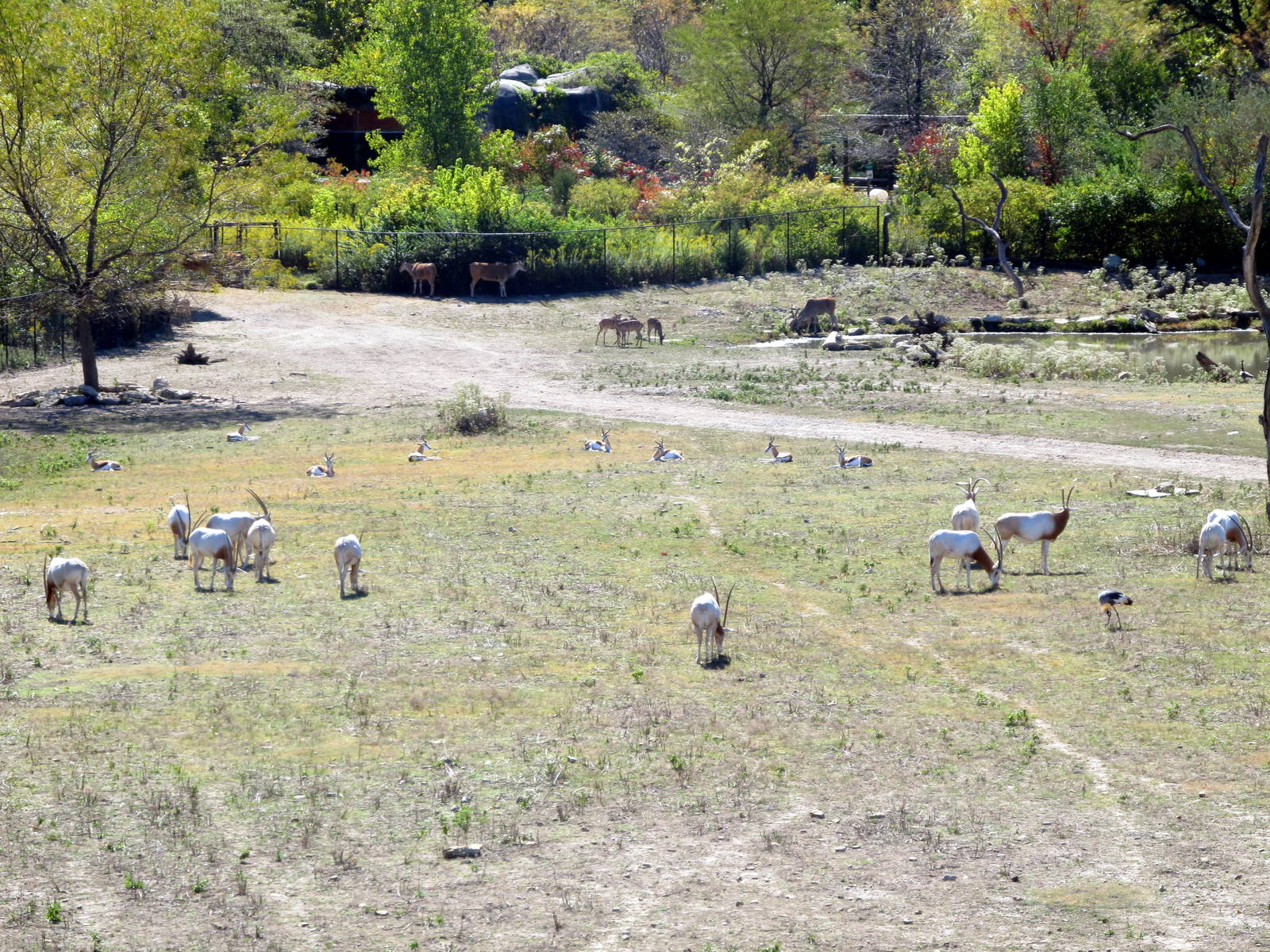
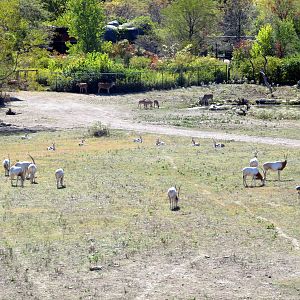
The first part of Kenya is Nairobi market. You reach here from Botswana from across a very large bridge over the Blue River. Buildings here include a restaurant, gift shop, snack stand and restrooms. Also here is the tram station, and boat house, and Skyfari station but more on that later. All the buildings are built to look like something you would find in Kenya, including many signs about the country. Toward the back of the market is an overlook onto the 17 acre African savannah exhibit. It is filled with grass and fake termite mounds. Going through part of it is a small river that connects to the larger lagoon. It is very shallow, and the animals can easily cross it. Species in this exhibit are: common eland, scimitar-horned oryx, lesser kudu, springbok, and gray crowned crane. The other exhibit in the market is lush mesh aviary for masked lovebird and white-cheeked turaco. The first exhibit on the loop is a raised one for cheetahs. They can be viewed from a boardwalk, of behind glass in a viewing cave. The exhibit is very long and large, and is set on a hill, giving the cheetahs a good view of the antelope. Up ahead is a sunken warthog exhibit. It is muddy and has water running through it. Behind it is part of the cheetah exhibit, allowing for an interesting predator prey exhibit. After this is another viewing deck of the African savannah. Also here is a bridge to the Congolese forest, but more on this later. A boardwalk passes over water, allowing views into the antelope exhibit on one side, and a nice, wetlands saddle-billed stork exhibit. Up next is a Bomas village area. There is a round hut that people can go in, as well as several more in the background disguising holding areas. There are three fenced yards, and two mesh aviarys. In the three yards are Aldabra giant tortoise/African spurred tortoise, blue duiker, and red-flanked/blue duiker. In the mesh aviaries are lappet-faced vultures and Bateleur eagles. After this is a large, walk-through aviary. There are several trees and a few small pools for the birds in here. Species are: Superb starling, white-headed buffalo weaver, lilac-breasted roller, cattle egret, bare-faced go-away-bird, hottentot teal, marbled teal, white-faced whistling duck, as well as Kirk’s dik-dik. Seen from the entrance to this aviary is a nice exhibit for red ruffed lemurs. Next to this is an aviary for silvery-cheeked hornbill, but it can only be seen from inside the aviary, providing better views. After this is another antelope viewing deck and a nice, large exhibit for southern ground hornbills.
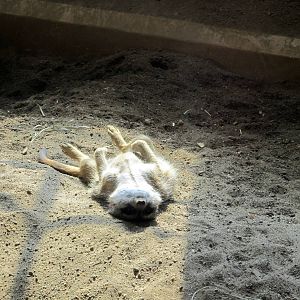
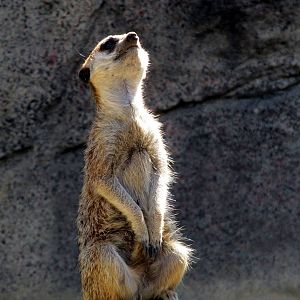
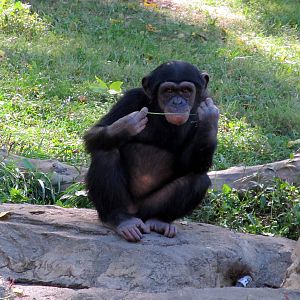
The first part of Tanzania is a kopje exhibit. Most of the exhibits are smallish, but dicely detailed, they are all (with one exception) carved into the rock. Meerkats is habit two large, exhibits, with plenty of rocks for them to climb on. Northern greater galagos and black-footed cats have small exhibits carved into the boulders. The galagos live behind poor, reflective glass, and the cats live behind wire.. Bat-eared foxes, and black-throated monitors have glass-fronted, rocky exhibits. Servals have a nice, but smallish exhibit behind mesh. However, this exhibits has two things going for it though. The first is that the serval can climb up on rock, probably ten feet high. The other is that they have a very good view of the lions. There is also a large aviary for rock hyraxes and masked lovebirds with plenty of climbing spaces for the hyraxes. The main exhibit here is an enormous lion exhibit. This can be seen from across a moat in several locations, or inside a building through glass. It is the best lion exhibit I’ve ever seen, and offers views of the antelope for the lions. It can be viewed behind mesh and across a moat, behind glass in a cave, and from across a moat. The exhibit is actually pretty large and offers the lions enough room for plenty of exercise. A long, wooded bridge leads you to the other side of Africa. The first exhibit visible is a very large, muddy exhibit for black rhinos. This is below the visitor path level, so people are looking down on the animals. Next to this is a mixed species savannah for Masai giraffes, scimitar-horned oryxes, and ostriches. It is separated from the rhinos by a pool. Though much smaller and less grassy than the other savannah, it is still a good exhibit. Between this and the other savannah is a very lush exhibit for Grant’s zebras. This can only be seen from the Skyfari. A side trail leads over the Gombe stream to what may be Kansas City’s best exhibit; a three acre chimpanzee exhibit. 17 chimps are free to roam a great hillside exhibit, complete with tons of trees to climb. The exhibit goes back beyond vision into the forest. They can be seen from across a moat, or inside a building from behind glass. Near the chimp exhibit is the second Skyfari station; a chairlift that travels over the savannah exhibits. Back on the main loop, the path passes by large exhibits for gray crowned cranes (viewing is quite poor), secretary bird/kori bustard, and leopard tortoises. A small building has underwater views of an average slender-snouted crocodile exhibit. Further on is a hippopotamus exhibit. The pool and land are both of average size, but nothing great. A bridge leads over the path into their indoor holding area. Here is a boardwalk out onto the lagoon allowing visitors to access the boat, which travels back to Nairobi market.
Uganda is home to two exhibits. It is set partly in a forest. An African theater and boardwalk overlook of the giraffe exhibit and lagoon is set here. The first exhibit is an average African wild dog (formerly black-backed jackals [formerly African crested porcupines]) exhibit. It is actually very shaded by all the trees. The main attraction here is a 1.5 acre guinea baboon exhibit. It is covered in grass, and has some foliage for privacy in the back. There are many ills located throughout the exhibit, adding to the beauty. The large family group of baboons can often be seen playing is this amazing exhibit, from across a water moat, or behind glass. A long bridge leads from here to an island in the lagoon, and another one leads back to the Nairobi market.
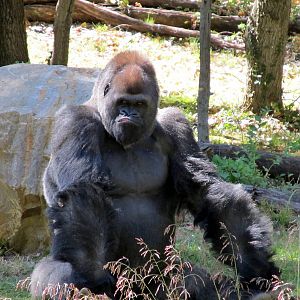
The Congolese Forest is located deep in the Missouri forest, giving the somewhat feel of a rainforest. You can reach it from a very large, nearly 100 year old swinging bridge. The first exhibit here is a tall cage for black mangabeys. It is nice for them, with plenty of vertical space, but viewing is rather poor. Right after this is a leopard exhibit. It is a cage that extends over the path, allowing the leopards to access both sides of the exhibit. It is decent, but not nearly as good as the lion of cheetah exhibits. After this is a boardwalk exhibit. On the outside are three exhibits; a tall cage for red-capped magabey, and two yards for red river hog and yellow-backed duiker. In the center is a large, muddy exhibit for bongo and gray crowned crane. All the exhibits are very well shaded due to the large amount of trees. The best exhibit in this area is a multiple acre one for gorillas. This exhibit is very grassy and naturalistic, with plenty of trees for them to climb. It can be viewed from across a moat, or from behind glass. The only complaint I have about this section is the long walk out."
In the kopje exhibits, I think they should make them bigger and have more vegetation. I also think that they should get Cape Buffalo and wildebeest in the Plains area, and that they should take down the fences separating the animals to make it look like Africa. Also they should get maybe a rock python and more animals in the Congolese rainforest area.