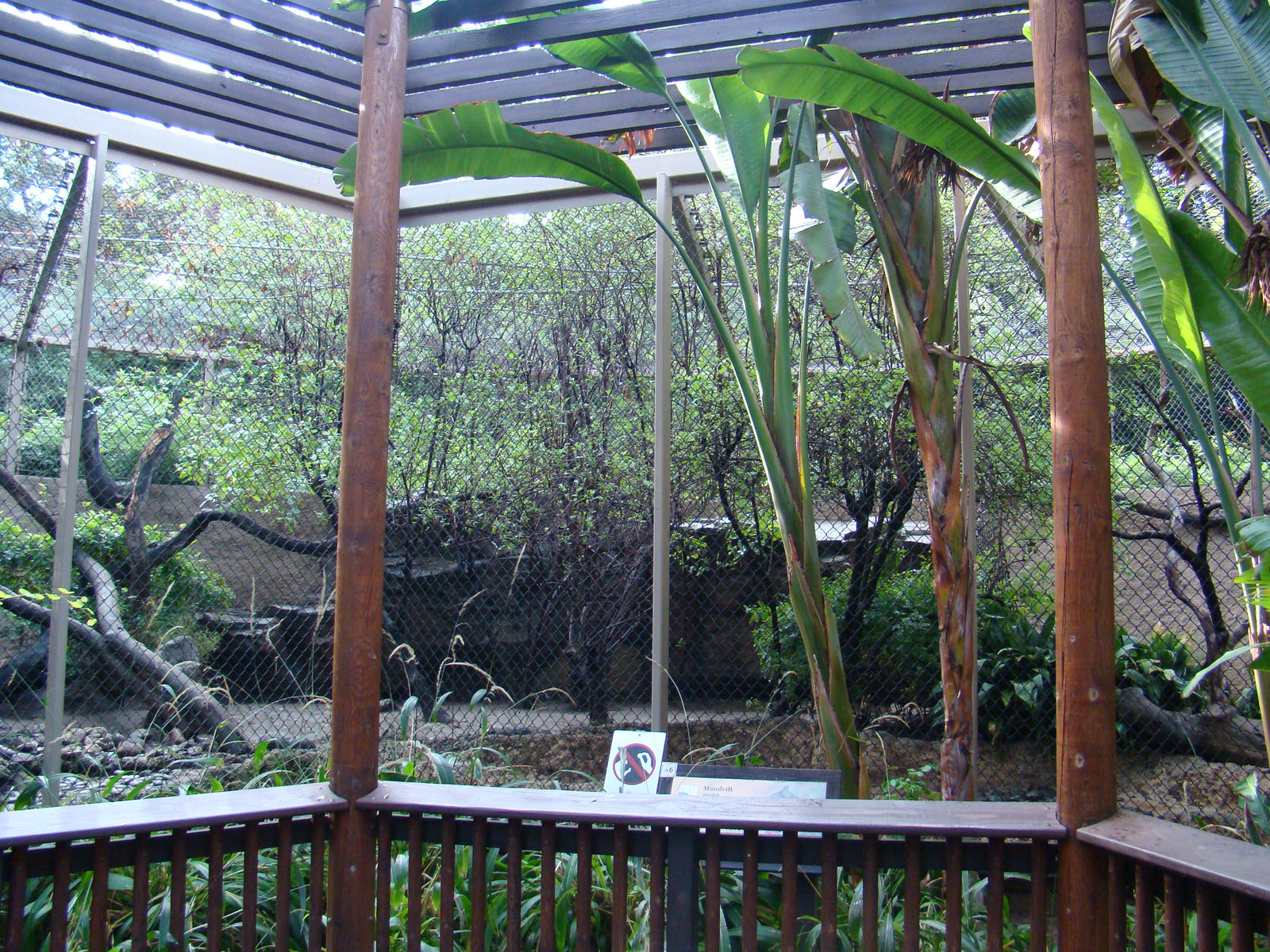
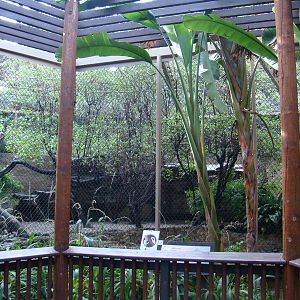
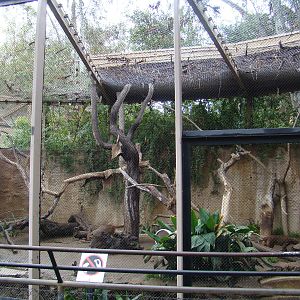
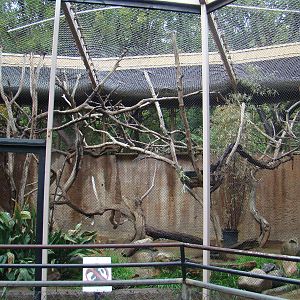
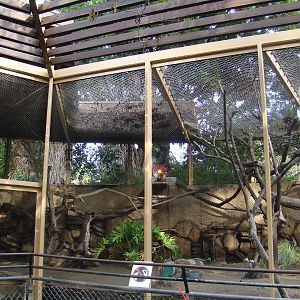
January 2009-This C-shaped house is for the troop of mandrills at the zoo. The zoo allows the 4 mandrills (1.3) to go between both exhibits in the round house.
January 2009-This C-shaped house is for the troop of mandrills at the zoo. The zoo allows the 4 mandrills (1.3) to go between both exhibits in the round house.
I still think that the C-shaped exhibits that are found at the L.A. Zoo (and nowhere else in North America) are too small for large animals such as mandrills. I've seen the enclosure in this photo and it is perhaps only ten feet wide, and the overall exhibit it simply not big enough for 4 mandrills.
I know the C-shaped exhibits are not the best, but they do their job. All of the C-shaped exhibits are lush giving the animals hiding places, especially this mandrill enclosures. None of the exhibits have hard floors and each have enrichment items.
It may be of interest to zoochatters, that all of the roundhouse exhibits are the result of budget problems when the zoo was built. Since they all are almost the same, it was cheaper to build them than individual exhibits as originaly planned. When the zoo first opened, they had nothing but maybe a rock and or log. The rear of the exhibit had a drainage area that allowed the keeper to hose debris into it and run it to a common drain it the keeper area. One keeper could clean many roundhouses in a day. Many years later, walls were built and soil and plants were added along with live trees and perching. As the zoo was originaly in a continent theme, one roundhouse in each area was glass fronted. The current snow leopard, duiker, Island fox and squirrel monkey roundhouses were all glass. Eventually all of the glass was removed due to cracking and it was very difficult to keep clean(zoo water left calcium buildup on the glass).
I still think that the C-shaped exhibits that are found at the L.A. Zoo (and nowhere else in North America) are too small for large animals such as mandrills. I've seen the enclosure in this photo and it is perhaps only ten feet wide, and the overall exhibit it simply not big enough for 4 mandrills.
This is one of the few C-shaped exhibits that are too small for their inhabitants. Most enclosures would be applauded or at least thought of as decent if they had a more pleasing exterior design.
The photo is deceiving, the animals actually have the entire roundhouse. This allows the animals to get away from the others if needed. The entire exhibit for them is approximately 20 by 50 with plenty of room for 4 animals. In fact, it is sometimes difficult to see them. There is also a fairly large area attached to the rear of the exhibit that can be used to hold an animal/s if needed for cleaning or medical procedures.
mweb: San Diego has a mandrill exhibit that is taller than this and maybe a bit larger, but otherwise seems comparable. Is there a great mandrilll exhibit that you have seen anywhere that you would consider a model exhibit?
Mandrills are primarily ground living, so I wonder if height really matters that much to them? I'd be curious to hear from animal care experts on that.
San Francisco actually has quite a good mandrill exhibit with lots of space, more than San Diego and Los Angeles. I think that LA and San Diego have roughly the same amount of ground space.