RetiredToTheZoo

Fishing Cat

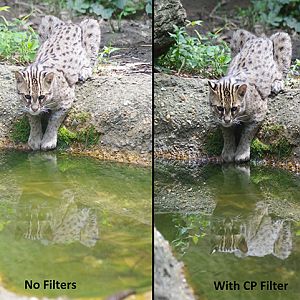
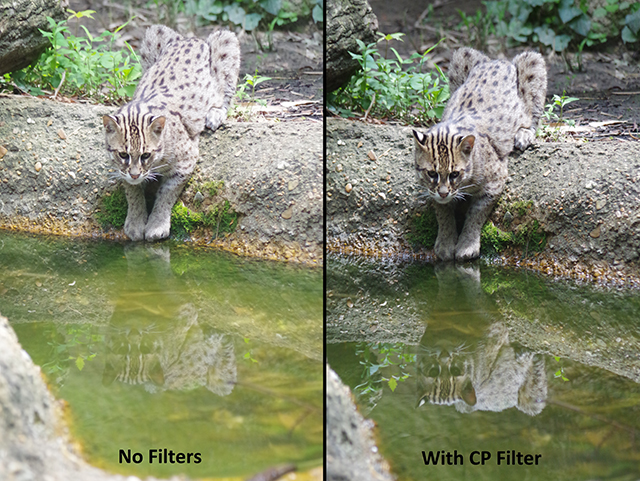
I created this composite image from two photos I recently took of a Fishing Cat at the Memphis Zoo to show the difference between using a circular polarizing filter and no filter at all. Both photos were taken within one minute of each other with the same camera and lens, in a shaded area, with a lightly overcast sky. Both photos are jpegs straight from the camera shot in apeture priority mode. The only post processing I did was to combine them into a composite, add text, and resize the entire image.
  • Like
Reactions: PAT
I created this composite image from two photos I recently took of a Fishing Cat at the Memphis Zoo to show the difference between using a circular polarizing filter and no filter at all. Both photos were taken within one minute of each other with the same camera and lens, in a shaded area, with a lightly overcast sky. Both photos are jpegs straight from the camera shot in apeture priority mode. The only post processing I did was to combine them into a composite, add text, and resize the entire image.

 
This is a great comparison! I have posted a similar photo on ZooChat (exhibit windows at Arizona Sonora Desert Museum), but mine was to show how a CP can reduce glass glare. They also can reduce or eliminate reflections on water, but surprisingly your reflection is still clear with the filter (which is of course desired in this instance).

I worked for two decades at a photo lab (recently changed careers) and also taught photo classes. I would often advise clients that with a digital camera, the only filter you need is a circular polarizer.

I also love this shot because I am a cat fanatic. A friend of mine from India (but now living most of the year in Tucson) co-founded the Fishing Cat Conservancy. They would love to use this shot if you are willing to donate it for conservation purposes. If you are, send me a Private Message for details.
 
Thank you for your kind comments. I think the reason why the cat's reflection was preserved is because it consisted of light rays reflected straight at me. Whereas, the polarizing filter greatly reduced all the extraneous light rays being reflected in all different directions, off the various surfaces including the water, rocks, foliage, and even the cat itself. If I recall when I turned the filter a 1/4 turn the cat's reflection disappeared, but all the glare was still there. I'm just thankful the Fishing Cat held this position for a good 3-4 minutes allowing me time to experiment.

I agree with you about a circular polarizing filter being the only one I really need. However, I found myself in a situation where I could have used a neutral density filter. I was trying to photograph a waterfall, and with ISO set as low as possible and the aperture set as small as possible (f22), the slowest shutter speed I could get was about 1/4 sec. I was trying to get about 2 sec to get that silky smooth water flow.
 

Media information

Category
Memphis Zoo
Added by
RetiredToTheZoo
Date added
View count
925
Comment count
3
Rating
0.00 star(s) 0 ratings

Share this media

Back
Top