As written by former director Warren Thomas in an edition of the International Zoo Yearbook:
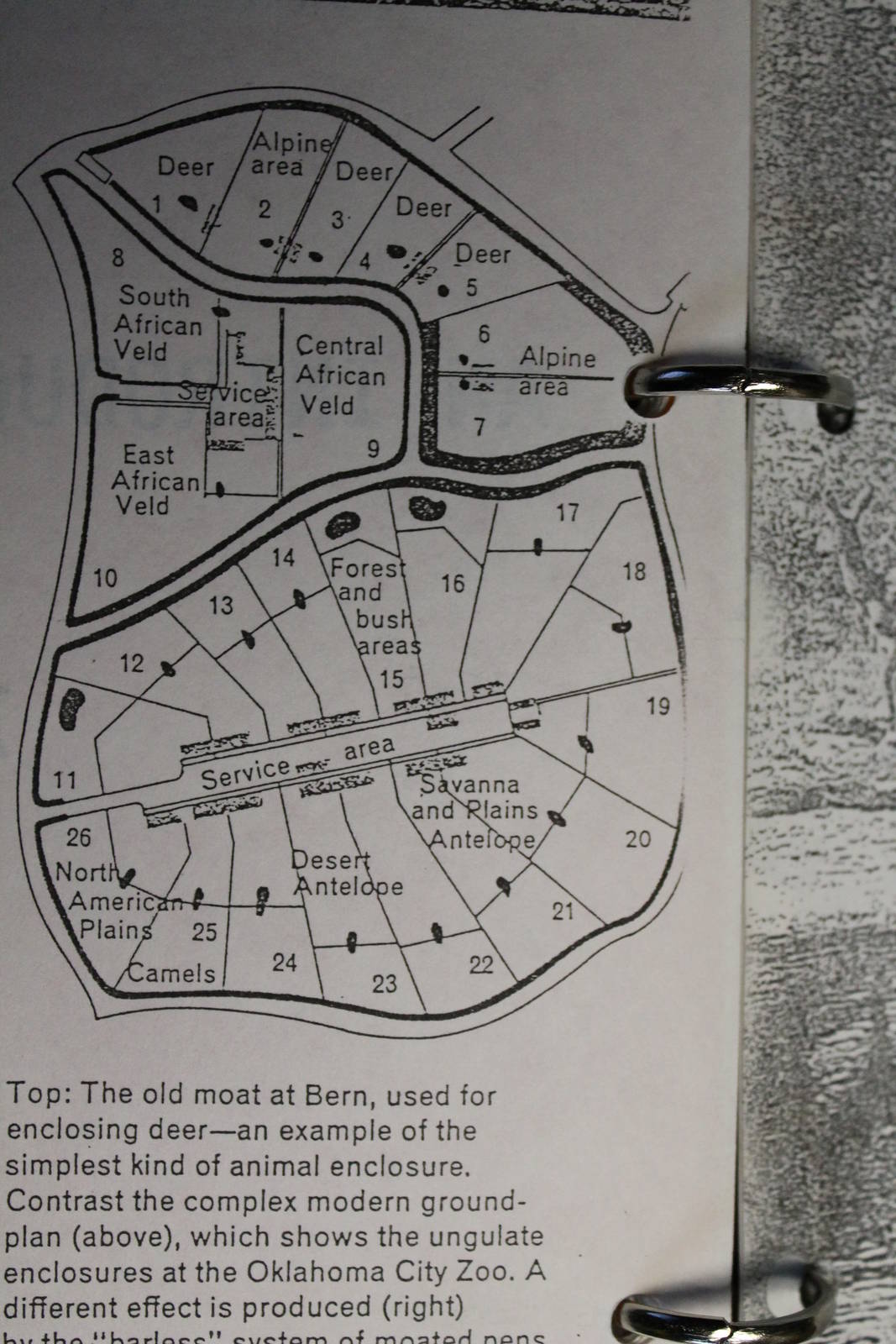
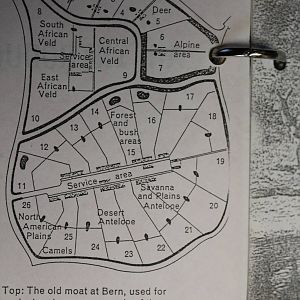
The new ungulate section is divided into twenty-six areas. We have tried to retain the natural aspect of the land and as much natural vegetation as possible. Our aim has been to fit the exhibit into the existing terrain, rather than vice versa. The whole section is divided into five different area: plains, savannah and desert, forest and bush, mountain, veldt and temperate. The whole section covers about forty-six acres. The size of the individual exhibits ranges from three quarters of an acre to three acres. Shelters have been designed to be unobstrusive and, where possible, they have been partially hidden. Where we have not been able to hide them, we have made no attempt to disguise them but have built them in a style of rustic, rugged simplicity. More of the enclosures have pools large enough for waterfowl to live on them. Peafowl and turkeys, which are allowed to range freely throughout the zoo, have already started to move to the new areas.
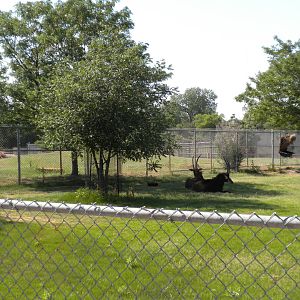
Wherever possible, the exhibits have been designed so that they can be viewed from more than one level or from more than one angle. Where we have not been able to do this, the enclosure has a cross-fence so that it can be arranged for at least some of the animals to be close to the public where they can be easily seen and appreciated. All the displays have been designed to accommodate the animals on a herd basis. Enough space has been provided in each enclosure to keep as many as twenty or more large animals such as Sable antelope, Hippotragus niger, or Gemsbok, Oryx g. gazelle, without crowding or discomfort. With smaller species the groups can be much larger.
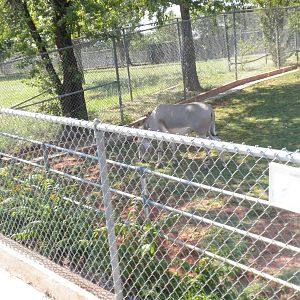
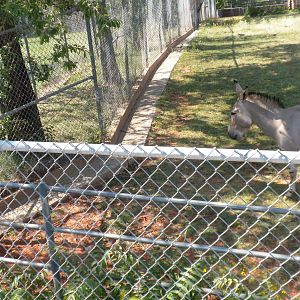
Enclosures adjacent to each other are separated by double fences, leaving a six-foot space between the fences. This discourages the animals in adjoining enclosures from fighting each other through the fence. At the same time, the space between the fences can be planted and landscaped to create a barrier of natural vegetation so that each area stands on its own and gives the visitor a sense of surprise. As the result, it is not possible to stand at one end of a row of adjoining enclosures and see all the way to the end. Most of the enclosures are covered with a thin layer of soil and bedrock closely underlies all of them.
Each area has a group of shelters behind it and these can accommodate all the animals exhibited in the area served by the shelters. With the exception of the giraffe house, all are of a fairly standard design. The floors are fairly rough concrete, there are galvanized steel feeding troughs and infra-red heaters are suspended from the ceiling. Running water is provided. The space within the shelters is divided into three parts: maternity stabling, stabling for bulls and the ordinary stabling. The doors have been arranged so that the bulls can be shifted or rotated without their coming into contact with each other. (We plan to keep at least two bulls per species.) Shelters connect, by means of ‘chutes’ or corridors with each other and with another area equipped with various restraining facilities. In this way it will not be necessary for an animal to be handled in order to catch it up or move it.
Plains, Savannah and Desert Area contains seven enclosures (Nos. 20-26). The ground is fairly flat or gently rolling. Vegetation within the enclosures is sparse. Displays are arranged as follows:
Display No. 20 Topi, Damaliscus korrigum topi
21 Cape Hartebeest, Alcelaphus buselaphus selbornei
22 Gemsbok, Oryx g. gazelle
23 Scimitar-horned oryx, Oryx tao
24 Addax, Addax nasomaculatus
25 Arabian camels, Camelus dromedaries
26 Bison, Bison bison, Pronghorn antelope, Antilocapra americana, and Texas Longhorn cattle, Bos Taurus.
Forest and Bush Area contains nine enclosures (Nos. 11-19). The terrain is rolling and heavily wooded. Displays are arranged as follows:
Display No. 11 Cape buffalo, Syncerus caffer
12 White-eared kob antelope, Kobus kob leucotis
13 Harnessed antelope, Tragelaphus scriptus
14 Nyala, Tragelaphus angasi
15 Defassa waterbuck, Kobus defassa
16 Sitatunga, Tragelaphus spekei
17 Gaur, Bos gaurus, and blackbuck, Antilope cervicapra
18 Greater Kudu antelope, Tragelaphus strepsiceros
19 Roan antelope, Hippotragus equines
Enclosures in both the above areas (11-26) are serviced from the same service section.
Veldt Area consists of three exhibits (8-10). They are large, each covering several acres. No. 9 has very sparse vegetation, while Nos. 8 and 10 are planted with large trees. African animals from various parts of the continent are exhibited here. No. 8 is for South African animals and includes Sable Antelope, Hippotragus niger, and springbok, Antidorcas marsupialis. No. 9 is Central African for the exhibit of giraffes, Giraffa camelopardalis, Grant’s Zebra, Equus burchelli boehmi, and ostriches, Struthio camelus. No. 10 is for East African animals and Grevy’s Zebra, Equus grevyi, and Grant’s gazelles, Gazelle granti, are exhibited here. The three exhibits radiate from a central service section with the same facilities as the other areas.
Mountain Area consists of three fairly large enclosures (Nos. 2, 6 and 7). The terrain is very rugged. No. 2 has a deep, rocky depression in its centre. Nos. 6 and 7 are level with the public on their western boundaries but extremely precipitous on their eastern boundaries. No. 2 can be viewed from two sides, both looking down. Nos. 6 and 7 can be viewed from two and three sides, respectively – up, across, and down – depending on where the visitor is standing. No. 2 is devoted to African mountain animals, the Nubian ibex, Capra ibex nubiana, and the Barbary sheep, Ammotragus lervia. No. 7 contains Asiatic mountain animals including Siberian argali, Ovis ammon. No. 6 has been assigned to markhor, Capra falconeri.
Temperate Area consists of four enclosures (Nos. 1, 3, 4 and 5). They are heavily wooded with sharply changing terrain. Several have out-crops of natural rock. Displays are arranged as follows:
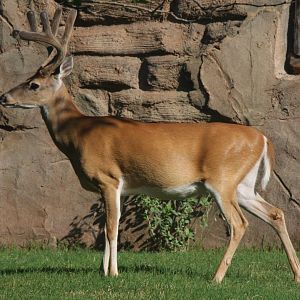
Display No. 1 North American deer, including Mule deer, Odocoileus hemionus, White-tailed deer, O. virginianus, and prong-horn, Antilocapra americana.
3 Asiatic deer, including Sika deer, Cervus nippon, barasingha, C. duvauceli, and Axis deer, Axis axis
4 White and normal-coloured wapiti, Cervus canadensis, and Spotted fallow deer, Dama dama
5 Pere David’s deer, Elaphurus davidianus, and muntjac, Muntiacus muntjak.
The basic idea underlying the planning of the new ungulate enclosures is to attempt to display the animals in large, spacious natural settings as well as to make every effort to propagate these animals by keeping them in breeding groups. We hope that it will fulfill two important functions: that of an impressive and educational display area and that of an animal breeding centre.
The project has been built with more funds made available from a general bond issue, while the animals have been bought by the Oklahoma Zoological Society.
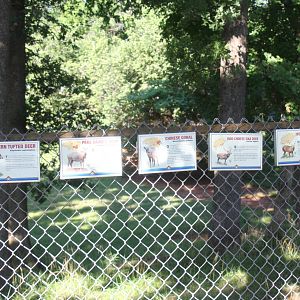
The veldt areas are still there. 1-4 are now a single enclosure for Asian deer (IMO the best exhibit at the zoo). 11-18 are now Oklahoma Trails. 19-26 still existed on my last visit but will become the new Asian area.
If you read the text, that piece was written at the time the exhibits were built - apart from a few typos ('Camelus dromedaries' and 'Hippotragus equines' seem like modern auto-correct artefacts!) they are more 'out-of-date' than 'not accurate'.