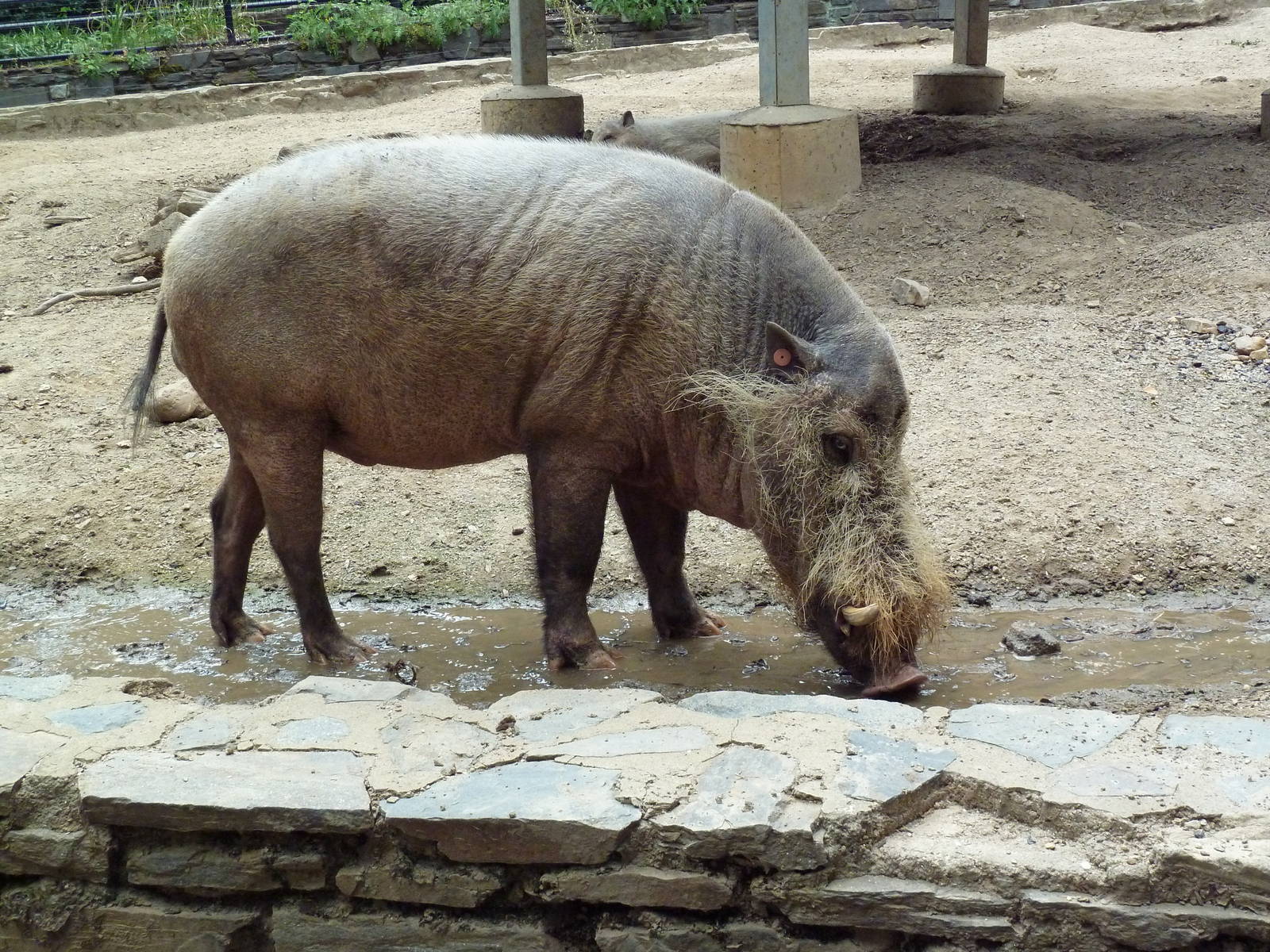
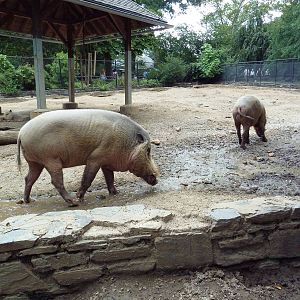
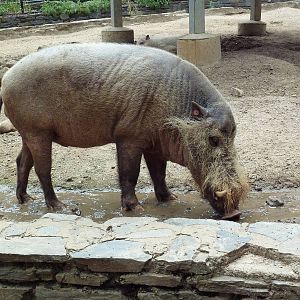
I’m not sure where these guys went to exactly, though Southwick’s Zoo in Massachusetts recently got some new ones in, so I'm strongly assuming that they're them. I can't believe they were replaced with common red river hogs. Thank you, AZA, for purging another of many wonderful species from your ranks for no good reason. There's over 100 red river hogs already in US collections, and less than 30 bearded pigs (which are more endangered in the wild too I might add). Typical asinine AZA over-regulations led to the loss of this rare species in all AZA facilities except for Gladys Porter Zoo and possibly a pair off display in Lowry Park and San Diego (can’t confirm that, may or may not be true). Thankfully non-AZA facilities have taken up the mantle. Southwick’s Zoo, Shadow Nursery, and Tennessee Safari Park definitely still have Bornean bearded pigs, and possibly a couple more places in the private sector.
I’m not sure where these guys went to exactly, though Southwick’s Zoo in Massachusetts recently got some new ones in, so I'm strongly assuming that they're them. I can't believe they were replaced with common red river hogs. Thank you, AZA, for purging another of many wonderful species from your ranks for no good reason. There's over 100 red river hogs already in US collections, and less than 30 bearded pigs (which are more endangered in the wild too I might add). Typical asinine AZA over-regulations led to the loss of this rare species in all AZA facilities except for Gladys Porter Zoo and possibly a pair off display in Lowry Park and San Diego (can’t confirm that, may or may not be true). Thankfully non-AZA facilities have taken up the mantle. Southwick’s Zoo, Shadow Nursery, and Tennessee Safari Park definitely still have Bornean bearded pigs, and possibly a couple more places in the private sector.
WhiteTiger, you are bringing up very good points, I totally agree with you, it is not a good idea to phase out Bornean bearded pigs in favor of Red river hogs, on top of Bornean bearded pigs being more endangered, their population is also decreasing, sorry to take the thread further off topic but another thing I'd like to mention is that Beisa oryxes and Fringe eared oryxes are being phased out in favor of Gemsboks, and if you were to combine the numbers of the populations of Beisa and Fringe eared oryxes, it would still be more endangered then Gemsboks, another thing is Mishmi takins being phased out in favor of Sichuan takins when Mishmi takins are more endangered. I am not really sure these decisions made by the taxonomic advisory groups really have anything InSitu, ExSitu, strong EEP etc. I could go on and on about this...
Another sad thing is that when I went to San Diego Zoo as a high school sophomore in 2009 I was standing in the middle of Monkey Trails and I asked a zoo staff member (probably in a high position) what happened to the Bearded pigs ?, he litteraly said "We sent them to a guy in tennessee, they are ugly and boring and we didn't want them anymore" yes he literally said those exact words, that really makes me sad
That's really sad. I have a contact who said they may have a pair still kept off display, but couldn't confirm it. Yeah the AZA and the utterly ridiculous TAGs have ravaged US institution collections in recent years, particularly with hoofstock but pretty much in all fields. I have been a very staunch, vehemently opposed critic of their practices way before they started phasing out everything for ridiculous or no reasons (if you can't tell my by screen name, I've been at outright war with them over the white tiger issue since the late 90s. But that's another matter). Now it's gotten unbelievably worse. Idiocy & ignorance (with obsession of genetic diversity trumping species diversity), over-regulation, and environmentalist ideals run amuck are doing terrible things to the zoos here. I grew up in Europe where diversity in collections is still quite strong, so it's very upsetting to see these things happen here. I've been a firm supporter of private zoos and entities (like Shadow Nursery in Tennessee) since the early 2000's because of this.
At San Diego, the loss of Horn and Hoof Mesa was because of the new AZA regulations. The complete overhaul of elephant husbandry rules demanding whatever the absurd increase in space is, was coupled with the demand that the zoo axe out a lot of its hoofstock species for whatever reasons (often because they were rare). My contact at the zoo said they tried to hold as many as they could in off-display exhibits, but they would've gotten in trouble for breeding many of them anymore (something about AZA rules for space allotment for designated species and some other blah blah crap). So, they sent most of their now controversial equids, swine, deer, and cattle to Shadow Nursery and sheep, goats, and antelope to Iron Mountain Ranch in western Texas. Both places have large spaces for herds of animals where they can live and continue to breed, which is good. But still, the fact that this is all happening at all nationwide is ridiculous and upsetting. I'm hoping it's just a bad phase...
1. You all have no one to blame but the USDA and the agriculture lobbies for changes to U.S. zoo collection planning.
2. AZA wants to move towards sustainable collection planning because of #1 and to reduce/eliminate boom & bust population cycles that all captive populations have historically gone through.