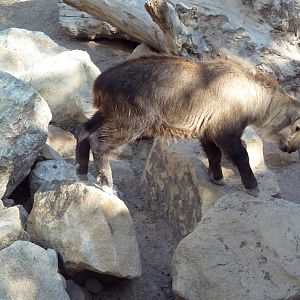
Which I'm quite aware of reduakari, having been a regular visitor there since 1966. And even prior, while the old Griffith Park Zoo was still open as a youngster. But I don't think LA is unique in that regard, as evidenced here, and on my visit to the Phoenix Zoo last year, where Andean Condors were displayed in an aviary for North American species.
Which I'm quite aware of reduakari, having been a regular visitor there since 1966. And even prior, while the old Griffith Park Zoo was still open as a youngster. But I don't think LA is unique in that regard, as evidenced here, and on my visit to the Phoenix Zoo last year, where Andean Condors were displayed in an aviary for North American species.
It's one of my pet peeves. I've heard many people argue that arranging zoos zoogeographically "doesn't work, becuause visitors don't get it, or care". But how could they when nearly every zoo fails to stick with its geographic system. LA has been a perpetual offender, and Miami has a lot of African hoof stock and carnivores in "Asia.". And then there are all of those lemurs displayed in various "Africas."
Small zoogeographic groups of exhibits tend to work quite well. For the most part, when a zoo tries to give over a quarter of its area to a zone it invites problems because it's hard to maintain that level of consistency.
I think lemurs in 'Africa' is tolerable - after all, no-one would object to Bornean species in an Asian zone.
It's one of my pet peeves. I've heard many people argue that arranging zoos zoogeographically "doesn't work, becuause visitors don't get it, or care". But how could they when nearly every zoo fails to stick with its geographic system. LA has been a perpetual offender, and Miami has a lot of African hoof stock and carnivores in "Asia.". And then there are all of those lemurs displayed in various "Africas."
I agree with all that you say - except for the last point about Madagascan animals. If not in Africa, in which continental grouping should they be found?
When animals are displayed zoogeographically, that is excellent (but it's not the only way, of course - and some of my favourite zoos are those which have a mixture of different themes running through their collection). But, as you suggest, what is not excellent is the sort of lazy, short-term view that results in zoogeography becoming corrupted. I don't understand how collection planning can be so poor as to suddenly result in Asian species, say, being needed to be put in the African area. Does the local art museum suddenly find that it's got to put a Damian Hirst in the impressionist gallery, because that's the only place where there is room to do so?
I agree with all that you say - except for the last point about Madagascan animals. If not in Africa, in which continental grouping should they be found?
When animals are displayed zoogeographically, that is excellent (but it's not the only way, of course - and some of my favourite zoos are those which have a mixture of different themes running through their collection). But, as you suggest, what is not excellent is the sort of lazy, short-term view that results in zoogeography becoming corrupted. I don't understand how collection planning can be so poor as to suddenly result in Asian species, say, being needed to be put in the African area. Does the local art museum suddenly find that it's got to put a Damian Hirst in the impressionist gallery, because that's the only place where there is room to do so?
Well, some islands like Borneo are so close to the mainland or were relatively recently connected by land bridges to have lots of zoological "overlap." Madagascar, on the other hand, has such long-isolated and unique endemic fauna and flora, it is just not "Africa."
As far as lazy collection planning, just remember that most curators are not zoo designers, and vica versa.
And when exhibit zones are so generic and un-themed as they originally were in both Miami and LA, it is easy to slip in animals from other continents essentially unnoticed.
Well, some islands like Borneo are so close to the mainland or were relatively recently connected by land bridges to have lots of zoological "overlap." Madagascar, on the other hand, has such long-isolated and unique endemic fauna and flora, it is just not "Africa."
...but they should be thinking of such matters! I've no - real - objection to, say, a Sri Lankan leopard popping up in an African area, but why, at the curious Faunia in Madrid, does what might have been a really fantastic African aviary have in it a silver pheasant, various European gulls, black-throated magpie jays (and a couple of species of lemur too)? It's that sort of thing that drives me bonkers.