geomorph

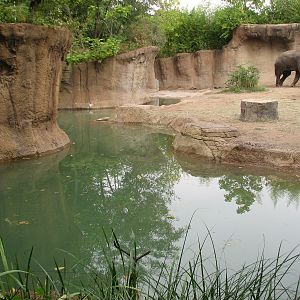
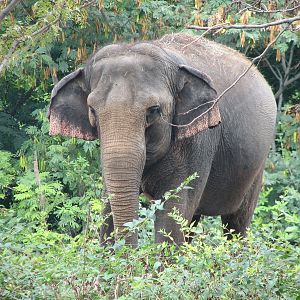
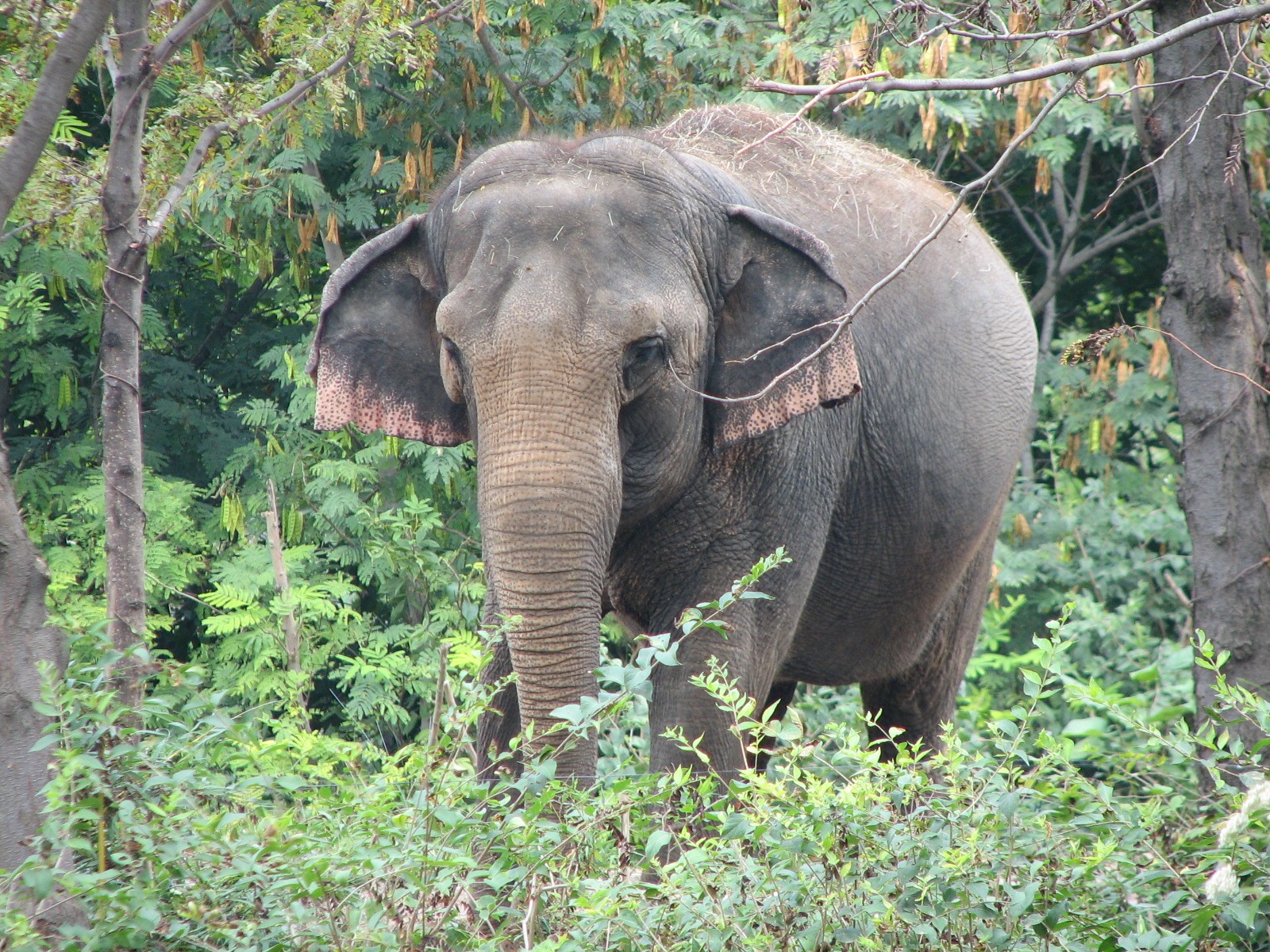
River's Edge - Asian Elephant

  • Media owner geomorph
  • Date added
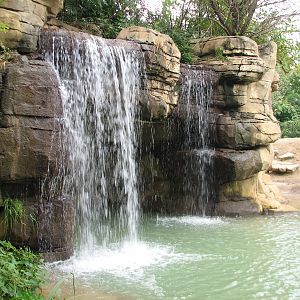
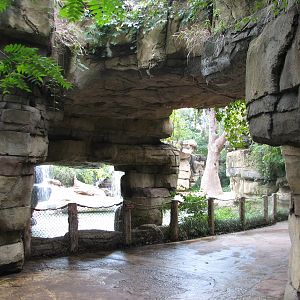
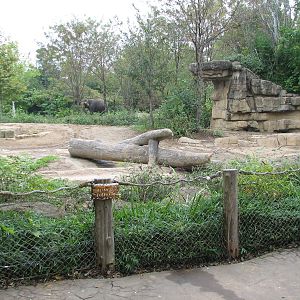
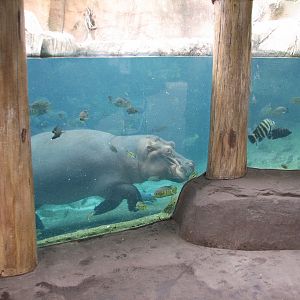
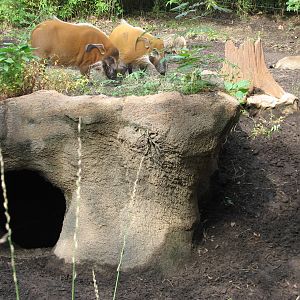
This excellent area is a lushly planted meandering loop trail which has a common thread of water features that form waterfalls, streams, moats, swimming pools, and even an aquarium. The trail interprets four geographic areas with representative exhibits for each, mostly mammals. The four areas are South America, Africa, Asia, and Missouri.
  • Like
Reactions: Austin the Sengi
@BlackRhino: I most definitely judge elephant exhibits based on their size, as well as the enrichment items on offer for the world's largest land mammal. There are literally hundreds of zoo elephants all over the world that have serious issues with their joints due to small paddocks that often have large concrete sections. I remember talking with a keeper at Zoo Atlanta who was working with a co-worker to encourage their elephants to stride back and forth across their enclosure for tiny bits of food so that the pachyderms would get some exercise, and yet the Atlanta exhibit is not what you would consider tremendously small.

Elephants need daily foot care in all zoos, as they don't walk anywhere near the kilometers that they do in the wild and thus they suffer terrible foot ailments and joint disorders in captivity. Elephants need SPACE, and if they can be encouraged to walk all day searching for hidden treats in zoo enclosures then that is fantastic for all concerned.

Within the next 5 years or so there will be 25 elephant exhibits just in the United States that are 3 acres in size or larger, and so 1-acre paddocks in my mind are totally unacceptable due to the extensive needs of elephants. In some cases all the elephants at a particular zoo DO NOT share the same exhibit space, as for example at the Oregon Zoo (and many others) the bulls are separated from the cows and thus are rotated through what amount to tiny areas of land. Sad but true.;) Don't forget that many northern zoos (Valley Zoo in Edmonton, Calgary Zoo, Toronto Zoo just to name 3 Canadian zoos) have their elephants in tiny, cramped areas for months in the winter where they can only turn around twice before hitting iron bars.

I completely agree with this but, to answer blackrhino's question, human's are sociable and yet we still need time alone. In the same way, elephants in the wild do not spend their entire lives together and will often spread across the savanna whilst feeding, for example. A 1.2 acre exhibit would not allow eight elephants privacy and would not give them the opportunity to escape eachother in the same way it would if there were only three elephants in that area. As such, like with any species, the no. of animals to space provided ratio is very important.
 
I completely agree with this but, to answer blackrhino's question, human's are sociable and yet we still need time alone. In the same way, elephants in the wild do not spend their entire lives together and will often spread across the savanna whilst feeding, for example. A 1.2 acre exhibit would not allow eight elephants privacy and would not give them the opportunity to escape eachother in the same way it would if there were only three elephants in that area. As such, like with any species, the no. of animals to space provided ratio is very important.

Well then you eliminate the family element from an elephants life. Elephants need to be around other elephants, which is why I think that the number of elephants is more important that the number of acres. The more elephants you have, the more socializing that occurs, and forming bonds with other herd member is one of the most important aspect to an elephant's life.

@scott: I hate to break it to you, but most of those exhibits are not going to be 3 acres. Maybe if you include the indoor facilities, but not the outdoor yards. Most are going to be somewhere around 2 acres. You seem strongly influenced by the IDA's elephant campaign, and I must point out that not all elephants in captivity have joint disorders. Its actually less than half. Even Lucky, the lone female Asian Elephant at the San Antonio Zoo, who lives in a bare cramped paddock less than a half acre and is 49 years old, doesn't have joint disorder. As far as I know, none of our elephants at Cleveland Zoo (who are living at the Columbus Zoo) have joint disorders either, and one of our elephants is around 44 years old
 
@redpanda: I'm glad that you agree, and I too feel that zoos with 1.2 acre elephant exhibits should perhaps only have a few of the pachyderms rather than jamming 7-8 into what is essentially a tiny space for such large, wide-ranging mammals.

@BlackRhino: if you are happy with elephants being in large groups in 1-acre exhibits then you must be relatively pleased with hundreds of enclosures around the world. I would love to see healthy, large herds in zoos provided that there is the space to house such numbers of elephants. I am much more demanding in what I see in zoos than many other ZooChatters (who seem to be content with the status quo), and in a perfect world I'd see massive, multi-acre paddocks for elephants in every single zoo that has that species of animal. The era of small enclosures is fading fast, as already during the past 20 years there are exhibits that used to be regarded as fantastic but are now deemed unacceptable. Over 40 zoos just in North America have increased the size of their elephant enclosures this decade, and there will be more on the way.:)
 
Well then you eliminate the family element from an elephants life. Elephants need to be around other elephants, which is why I think that the number of elephants is more important that the number of acres. The more elephants you have, the more socializing that occurs, and forming bonds with other herd member is one of the most important aspect to an elephant's life.

I am not suggesting you eliminate the family element from an elephant's life, from previous discussions you will know that I think elephants should be given more than 1.2 acres, that was an example you gave. In my opinion, we should give them enclosures of 3+ acres and have large herds. My point was that it is much easier for elephants to escape one another when there is a lower elephant to space ratio and, therefore, three elephants would get more privacy on an area of 1.2 acres than eight elephants would.
 
You might also consider that one good outcome of low animal numbers to acreage is the possibility of grass and other plants. As you exceed 1 elephant per acre the space becomes increasingly barren (depending on the exact location, length of growing season, soil mix, any other animals kept there, etc.,). At a rate of 1 elephant/.5 acre I'd have little hope for grass
 
You might also consider that one good outcome of low animal numbers to acreage is the possibility of grass and other plants. As you exceed 1 elephant per acre the space becomes increasingly barren (depending on the exact location, length of growing season, soil mix, any other animals kept there, etc.,). At a rate of 1 elephant/.5 acre I'd have little hope for grass

I have to disagree with you for once as I almost always agree with you. At the Miami Metrozoo they have three elephants on one acre and the exhibit is so grassy that in the summertime with the frequent thunderstorms they actually have to mow the grass. The St. Louis exhibit isn't exactly barren either as you can see from the picture. Even in Cleveland, with our old enclosure there were spots that were pretty grassy, and that enclosure was less than a half acre. At that rate, if enclosures start turning barren at 1 elephant/acre than I would assume from that that there are no grassy 2 acre exhibits out there since most 2 acre elephant exhibits have more than 2 elephants. This is not the case at all as Indianapolis which has 7 elephants on 2 acres is very grassy, as well as Columbus which has 5 elephants on 2 acres. Both exhibits are very green. I honestly can't think of any exhibit that is 2 acres or more that doesn't have grass besides San Diego (which wasn't planted to begin with) and Oakland. Even Seattle which has 3 elephants on 1.5 acres, has a pretty green paddock and is over 20 years old.
 
I have to disagree with you for once as I almost always agree with you. At the Miami Metrozoo they have three elephants on one acre and the exhibit is so grassy that in the summertime with the frequent thunderstorms they actually have to mow the grass. The St. Louis exhibit isn't exactly barren either as you can see from the picture. Even in Cleveland, with our old enclosure there were spots that were pretty grassy, and that enclosure was less than a half acre. At that rate, if enclosures start turning barren at 1 elephant/acre than I would assume from that that there are no grassy 2 acre exhibits out there since most 2 acre elephant exhibits have more than 2 elephants. This is not the case at all as Indianapolis which has 7 elephants on 2 acres is very grassy, as well as Columbus which has 5 elephants on 2 acres. Both exhibits are very green. I honestly can't think of any exhibit that is 2 acres or more that doesn't have grass besides San Diego (which wasn't planted to begin with) and Oakland. Even Seattle which has 3 elephants on 1.5 acres, has a pretty green paddock and is over 20 years old.

Your observation at Miami MetroZoo underscores my point about the role of "length of growing season." Many of the Florida zoos are able to accomplish a level of greenery that more northerly or even western US zoos cannot hope for in similar animal space ratio situations.

Cleveland - and Seattle - is perhaps a different matter. I was thinking of uniformly grassy, lush exhibits (like Nashville), not pockets of surviving grass. My memory of these two is that they have substantial bare areas.

To my mind, this picture of Columbus proves my point: http://www.zoochat.com/558/columbus-zoo-asian-elephant-paddock-41867/
Indianapolis is more difficult for me to explain
 
Your observation at Miami MetroZoo underscores my point about the role of "length of growing season." Many of the Florida zoos are able to accomplish a level of greenery that more northerly or even western US zoos cannot hope for in similar animal space ratio situations.

Cleveland - and Seattle - is perhaps a different matter. I was thinking of uniformly grassy, lush exhibits (like Nashville), not pockets of surviving grass. My memory of these two is that they have substantial bare areas.
I don't remember your other examples well enough but would love to learn more!

But Nashville had 3 elephants up until a few weeks ago therefore they had 1 elephant/acre which according to you is when exhibit starts to turn very barren. Nashville's exhibit is obviously not barren at all.

I also think it is possible for zoos to keep exhibits lush if they have the ability to divide up the elephant yards, that way when one enclosure does become barren they can grow back grass without having the elephants off exhibit.

I would also like to point out that the Miami's exhibit is green year round and Florida can be extremely dry in the winter time going weeks without any rain.

One thing that I think helps with keeping exhibits lush is not giving the elephants access to the exhibit 24 hours a day. If they are brought in for the night or put in an off exhibit yard, the enclosure isn't constantly being trampled on by elephants which certainly must help.
 
Good points, absolutely.
Perhaps I was being simplistic in my original post.

Two notes:
1. Nashville's elephant space approaches 2.75 acres (so close enough for my 1 ele/acre generalization)
2. Irrigation or regular rain is a requirement. (I know Nashville is irrigated. I do not know whether Miami is)

But exactly what is the minimum space (for lush grass, folks, that's all I'm talking about :D ).... again it depends on many factors.
 
Good points, absolutely.
Perhaps I was being simplistic in my original post.

Two notes:
1. Nashville's elephant space approaches 2.75 acres (so close enough for my 1 ele/acre generalization)
2. Irrigation or regular rain is a requirement. (I know Nashville is irrigated. I do not know whether Miami is)

But exactly what is the minimum space (for lush grass, folks, that's all I'm talking about :D ).... again it depends on many factors.

Didn't you say that elephant exhibits become barren at 1 elephant/acre? Nashville's exhibit is perhaps the most lush elephant exhibit in the United States and they had 1 elephant/acre for 5 years.

I am almost positive that Miami's exhibit is not irrigated.
 

Media information

Category
Saint Louis Zoo
Added by
geomorph
Date added
View count
7,771
Comment count
22
Rating
0.00 star(s) 0 ratings

Share this media

Back
Top