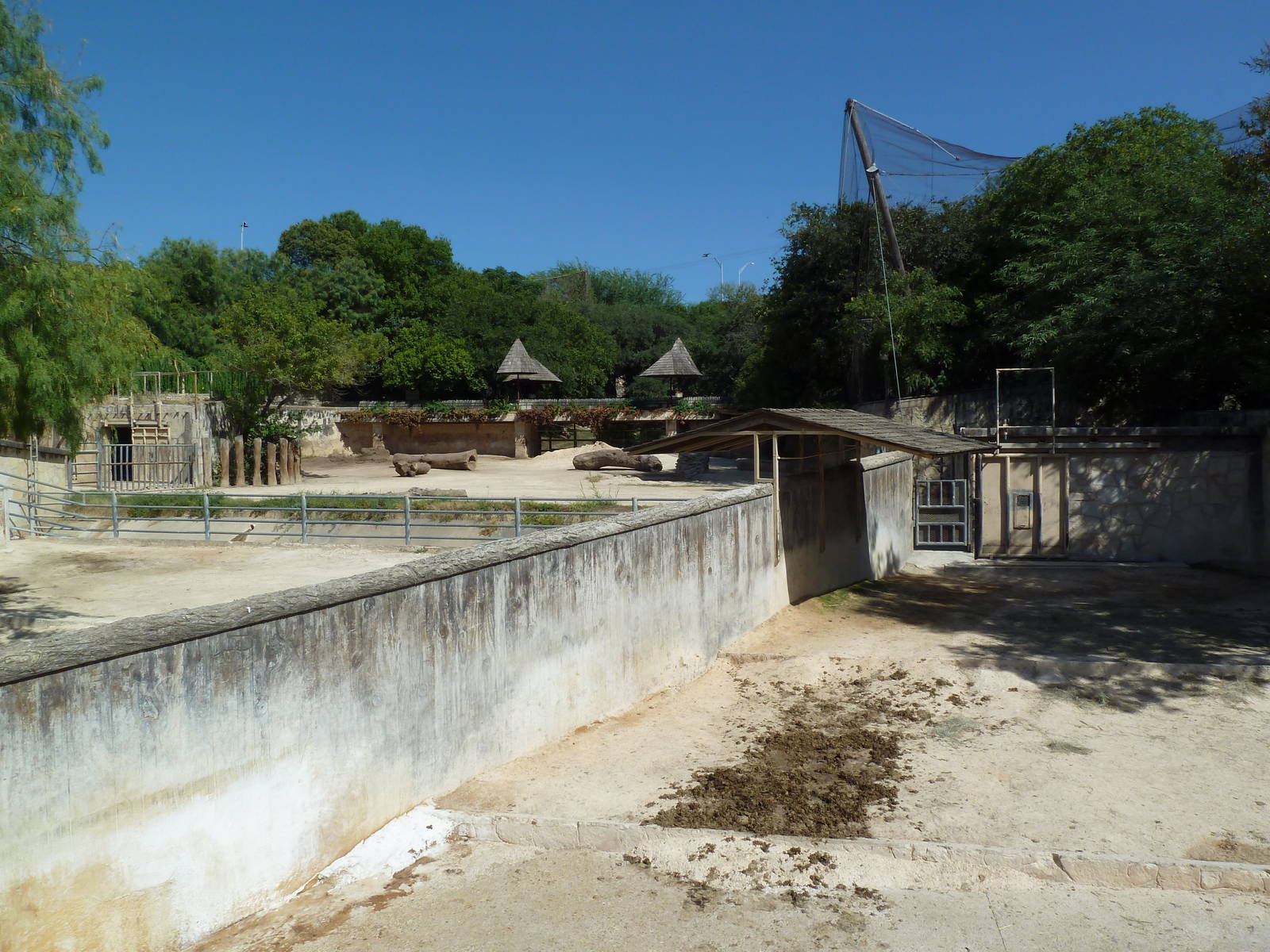
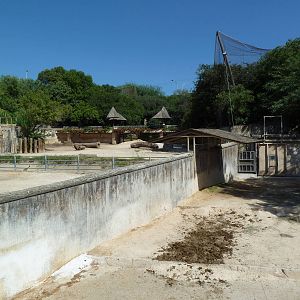
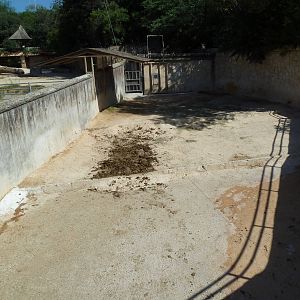
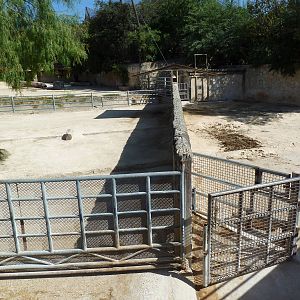
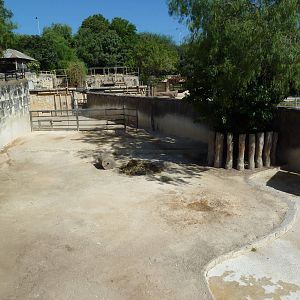
Is there any truth to the rumor that San Antonio Zoo will eventually overhaul its rhino paddocks? At the moment visitors look down on the animals, with huge cement walls separating the enclosures. The complex showcases America's ugliest rhino yards, and even the indoor accommodation resembles something that could be seen in WWII:
The white rhino exhibit, which is the far half in this photo and not very prominent from this angle, is the only one currently being used. The bottom half, more prominent in this photo, is the old black rhino exhibit which currently has a small bulldozer in it. The wall in the middle is completely gone as are the black rhino night houses. The aviary (netting showing in back) is also gone.
That is from my visit two weeks ago. My previous visit was spring 2012 and on the day I was there was the very day they started demolition of the black rhino buildings. I was surprised over a year later to still see construction equipment in that yard (with no apparent new work).
I had assumed they would combine the two yards for a larger white rhino exhibit, but I have no definite information.
Surely, this is a sign of the meagre budget the San Antonio Zoo has for renovations and/or new exhibitry in the zoo. I cannot but hope rather sooner than later the new phase of the African Savannah may come up within the zoo grounds and bringing back the black rhino in a much improved exhibit.
Having said that: it needs underlining that the San Antonio Zoo has bred both black and white rhinos for a good number of years in history in these very exhibits. It may look unpresentable to the general public, but was this also the perception of the animals meant to live in them? I sure do not think so! I suppose it suited them (which ain't saying I would not see room for improvement for better rhino exhibits in future).
A new exhibit is only as good as the last one built. The first 10 years is brand new, the second tenure of 10 presentable, the third tenure of 10 it is out-of-date / over the hill! That is the natural cycle of animal exhibits in a zoo perception-wise for the general public / zoo management (ideas get copied and benefit from what has gone before and improve upon them ... et cetera et cetera).
Having said all that: again I wish for better financial more buttered times for the San Antonio Zoo - a zoo with tradition and very respectable breeding results in many departments.
It was mentioned on another San Antonio thread about it being a philanthropy poor city and a hard place to raise money. This may or may not be true - having only passed through as a tourist, I cannot say.
What I can say is that the well known Riverwalk in downtown San Antonio (only a few miles from zoo) is doing VERY, VERY WELL. I go there to walk and eat dinner on all my trips and it is always jam packed with tourists and conventioners - even on weeknights. It is filled with dozens of somewhat expensive restaurants and many of them have long waits to get in. The riverwalk is raking in the money - people are throwing out tens of thousands (if not hundreds of thousands) of dollars every single night there. So someone in San Antonio must have some money.
San Antonio has a strong military presence—it is home to Fort Sam Houston, Lackland Air Force Base, Randolph Air Force Base (which constitute Joint Base San Antonio), Lackland AFB/Kelly Field Annex and Brooks City-Base, with Camp Bullis and Camp Stanley outside the city. Kelly Air Force Base operated out of San Antonio until 2001, when the airfield was transferred over to Lackland AFB and the remaining portions of the base became Port San Antonio, an industrial/business park. San Antonio is home to five Fortune 500 companies and the South Texas Medical Center, the only medical research and care provider in the South Texas region.