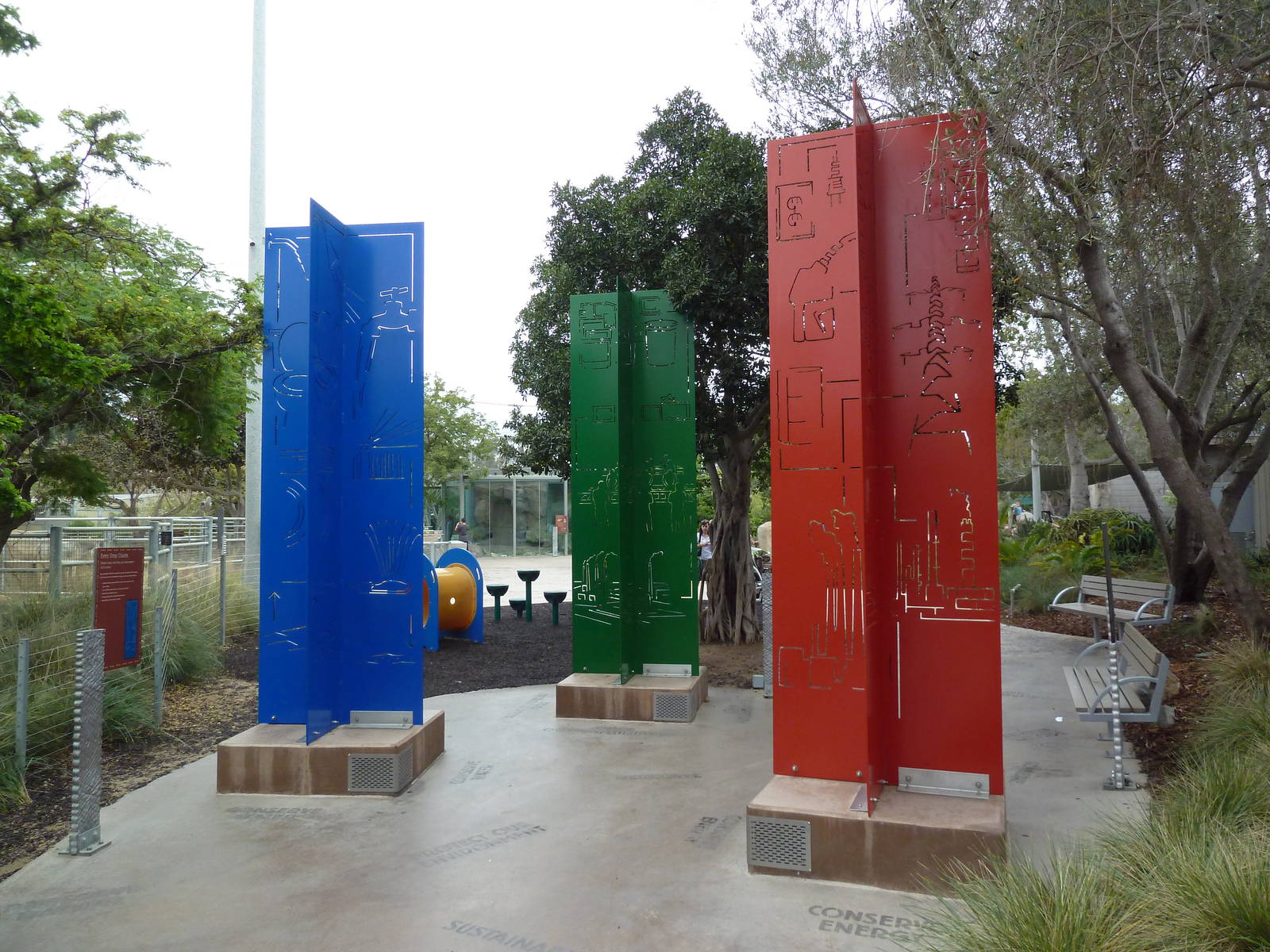
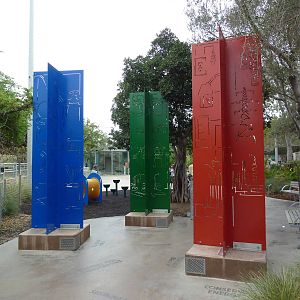
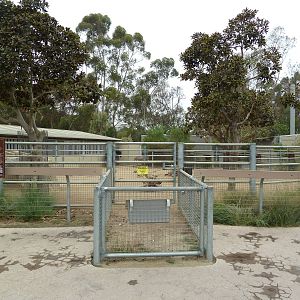
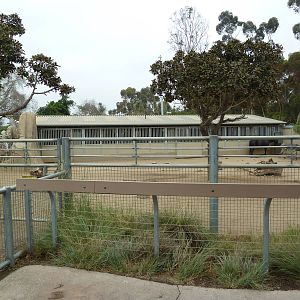
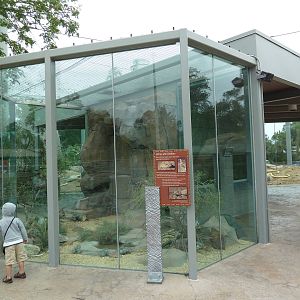
There is a conservation message on the 3 large panels but they are bizarrely placed and I didn't notice anyone actually reading the small signs near the "towers".
Then the SDZ failed in delivering a message. If it doesn't get used, its wasted. All the signage in EO is boring and doesn't grab you're attention. While this one does catch your eye, there isn't any clear message being shown.
Then the SDZ failed in delivering a message. If it doesn't get used, its wasted. All the signage in EO is boring and doesn't grab you're attention. While this one does catch your eye, there isn't any clear message being shown.
I'm curious if people here think that Elephant Odyssey successfully delivers any relevant conservation message to zoo visitors.
It seems like the big picture message is "megafauna used to live all over the world including California; most of them went extinct recently (in evolutionary time) and we'd better get to work if we don't want to lose elephants and lions".
I'm not sure how well this message gets delivered, and ultimately I would argue the only justification for keeping these animals in captivity and spending the tens of millions of dollars to build this exhibit is to deliver a relevant conservation message.
Is this exhibit a success or failure using the metric of effectiveness of conservation message?
I'm not sure how well this message gets delivered, and ultimately I would argue the only justification for keeping these animals in captivity and spending the tens of millions of dollars to build this exhibit is to deliver a relevant conservation message.
Is this exhibit a success or failure using the metric of effectiveness of conservation message?
I would dispute the bit I've bold-ed. What about education about (and study of) the actual animals themselves? The 'zoology' of 'zoological gardens'? This is just as important in my book (not least because in at least some visitors it should help to foster an appreciation of the importance of conservation by the 'back door'). No-one will care about, say, Arabian Oryx if they've no idea what it is or why it is special - too many zoo education displays now are just about how rare animals are and nothing else. I wish they'd give the visitors more of a reason to care about conservation rather than just saying it's important (which it is, of course, don't get me wrong!).
But even leaving aside conservation, zoological education is a fine endeavour in itself.
Regardless of how the execution played out, the idea of using modern relatives to produce an exhibit educating the public about prehistoric California is a very good one. Whether San Diego pulled it off (or whether it's even possible to pull this off) in reality is a different question, of course!
I would dispute the bit I've bold-ed. What about education about (and study of) the actual animals themselves? The 'zoology' of 'zoological gardens'? This is just as important in my book (not least because in at least some visitors it should help to foster an appreciation of the importance of conservation by the 'back door'). No-one will care about, say, Arabian Oryx if they've no idea what it is or why it is special - too many zoo education displays now are just about how rare animals are and nothing else. I wish they'd give the visitors more of a reason to care about conservation rather than just saying it's important (which it is, of course, don't get me wrong!).
But even leaving aside conservation, zoological education is a fine endeavour in itself.
Regardless of how the execution played out, the idea of using modern relatives to produce an exhibit educating the public about prehistoric California is a very good one. Whether San Diego pulled it off (or whether it's even possible to pull this off) in reality is a different question, of course!
You raise an excellent point about education and raising awareness of the basic existence of the animal, but as you point out this is also an essential step in conservation. I think maybe we are talking about the same thing from slightly different perspectives (or maybe not even that different).
Zoos do a service far beyond being a marketing arm of the conservation movement:
Natural science education is being largely dropped from American curricula and zoos may become among the few places where a child might encounter such things. The study of zoology and animal behavior, as well as general biology, habitats, even history are all worthwhile aside from their contribution to or being tied to a direct conservation "pitch."
Zoos do a service far beyond being a marketing arm of the conservation movement:
Natural science education is being largely dropped from American curricula and zoos may become among the few places where a child might encounter such things. The study of zoology and animal behavior, as well as general biology, habitats, even history are all worthwhile aside from their contribution to or being tied to a direct conservation "pitch."
I think that zoos go way beyond being the marketing arm of the conservation movement and actually ARE a major part of the conservation movement, or could be anyway.
I agree that zoos can play an essential role in natural history education...seeing a live gorilla, giraffe, elephant, etc. provides an educational experience that can go way beyond, or greatly enhance, watching a video or reading a book. However, I would still maintain that the primary mission of the modern zoo should be educating with the aim to make people aware of the existence and conservation challenges facing the animals and habitats portrayed in the zoo.
... and ultimately I would argue the only justification for keeping these animals in captivity and spending the tens of millions of dollars to build this exhibit is to deliver a relevant conservation message.
However, I would still maintain that the primary mission of the modern zoo should be educating with the aim to make people aware of the existence and conservation challenges facing the animals and habitats portrayed in the zoo.
I'm not sure whether these statements are the same or different in intent.
I do agree that if this message is not delivered or poorly delivered it is a vitally important opportunity lost.
My point was that it is not the only justification for zoos.