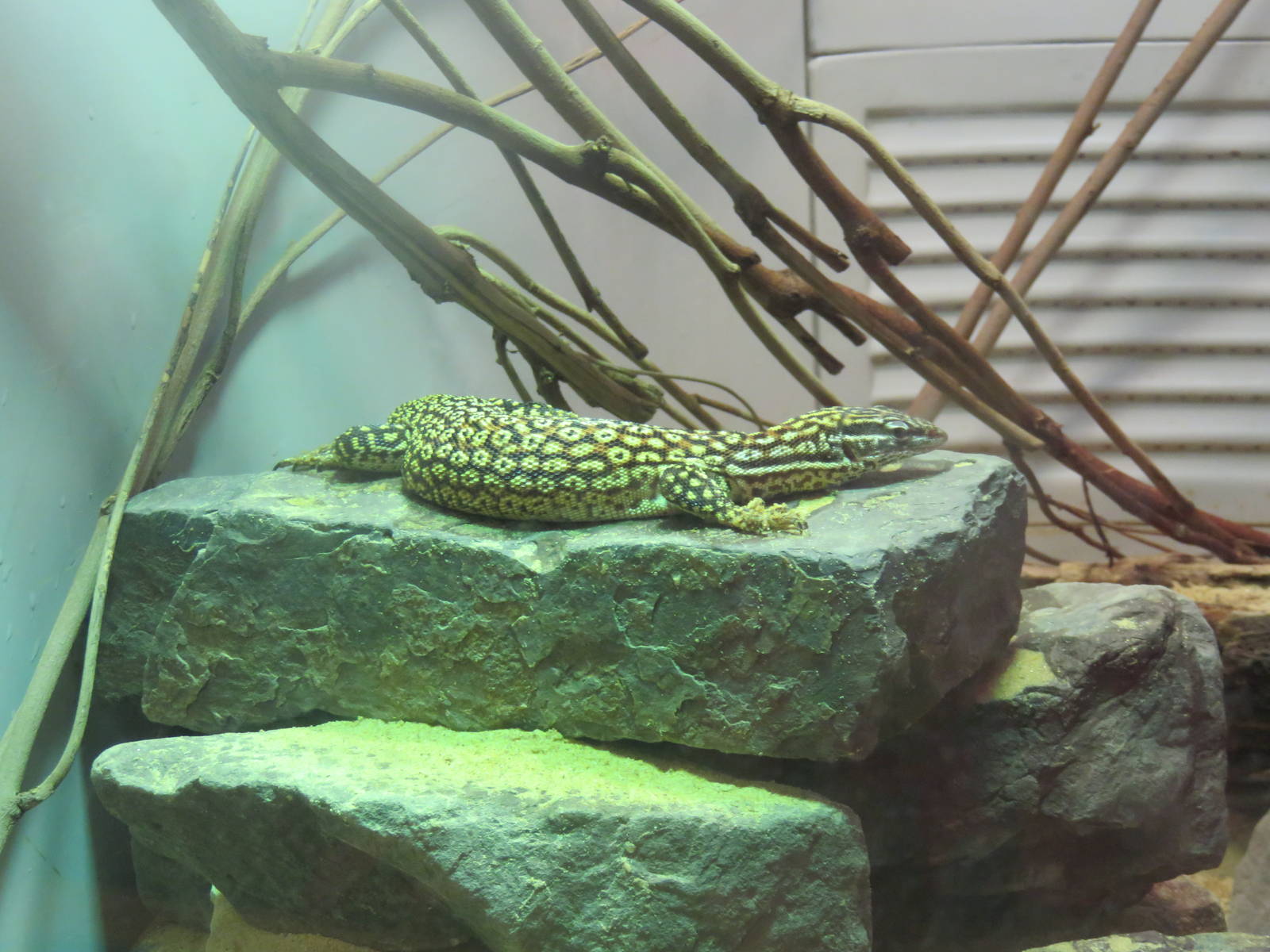
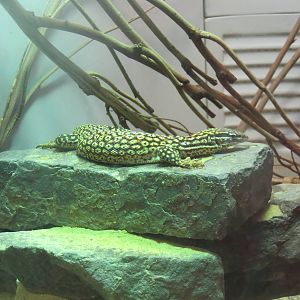
That was my original guess as well but it looks a bit off coloration-wise to be a Spiny-Tailed Monitor. I've seen this species quite a few times as they are at my home zoo and this doesn't look quite like the other animals I've seen. Could just be an oddly colored animal, however, or maybe just the fact that the animals I'm used to seeing are in a much more sandy enclosure and thus might have their coloration faded as a result.
Hix is correct on the i.d. and the lighting. MVB (Mercury Vapor Bulb) cast yellow-ish lighting due to the UV junk vs normal bulbs used for heat. If the Zoo wanted to spend money and show colour and pattern like seen outdoors in the sun, they could use LEPB (Light Emitting Plasma Bulb). Those would show them truly like out in the bush. If they were smart, they would just focus on proper heat and nutrition and not worry about the gimmicky junk of trace ultraviolet specialized lighting. But Zoos don't do that as each enclosure houses animals with different needs side-by-side and have to make up the difference in husbandry. If they were smart, they would house animals side-by-side with the same needs. Cutting down on heating, cooling costs and other husbandry needs. That's why Zoos have minimal success and their animals do not reach full potential as they hold them back as their arks can only support x amount of animals regardless of conservation value.
Another reason these are often not bred is because of their heat needs, as Gulogulo mentioned above. As these are desert dwelling lizards, it's been found they like a hot spot for basking at around 45º - 50ºC (or 113º - 122ºF).
If the Zoo wanted to spend money and show colour and pattern like seen outdoors in the sun, they could use LEPB (Light Emitting Plasma Bulb). Those would show them truly like out in the bush. If they were smart, they would just focus on proper heat and nutrition and not worry about the gimmicky junk of trace ultraviolet specialized lighting. But Zoos don't do that as each enclosure houses animals with different needs side-by-side and have to make up the difference in husbandry. If they were smart, they would house animals side-by-side with the same needs. Cutting down on heating, cooling costs and other husbandry needs. That's why Zoos have minimal success and their animals do not reach full potential as they hold them back as their arks can only support x amount of animals regardless of conservation value.
Thank you for your reference regarding LEP & reptile husbandry that I find most interesting. Would it be possible for you to direct me to further information regarding the use of this technology in terraria/vivaria lighting and studies in regard to their long-term suitability for reptile husbandry? A first quick search of mine so far has only revealed this: http://www.rtmlighting.com/pdf/ZooCaseStudy.pdf
I wouldn't denounce the benefit of proper(!) UV lighting in regard to the well-being and health of reptiles as "gimmicky junk of trace ultraviolet specialized lighting", as I have seen too many negative results of inadequate UV lighting.
I agree with your assumption that most zoos could optimize their reptile presentation and husbandry. Constructional barriers, lack of finances/ knowledge / interest and cultural differences might be contributing factors holding them back. Serious private keepers have shown again and again to be more successful on this behalf.
Unfortunately, the climate and seasonal length of adequate sunshine in Washington DC differs quite drastically from the conditions in its Australian original habitat. While it is correct that natural sunshine is the optimal light source for reptiles (and all other living creatures), its accessibility might not always be a given, making it necessary to rely on artificial means.