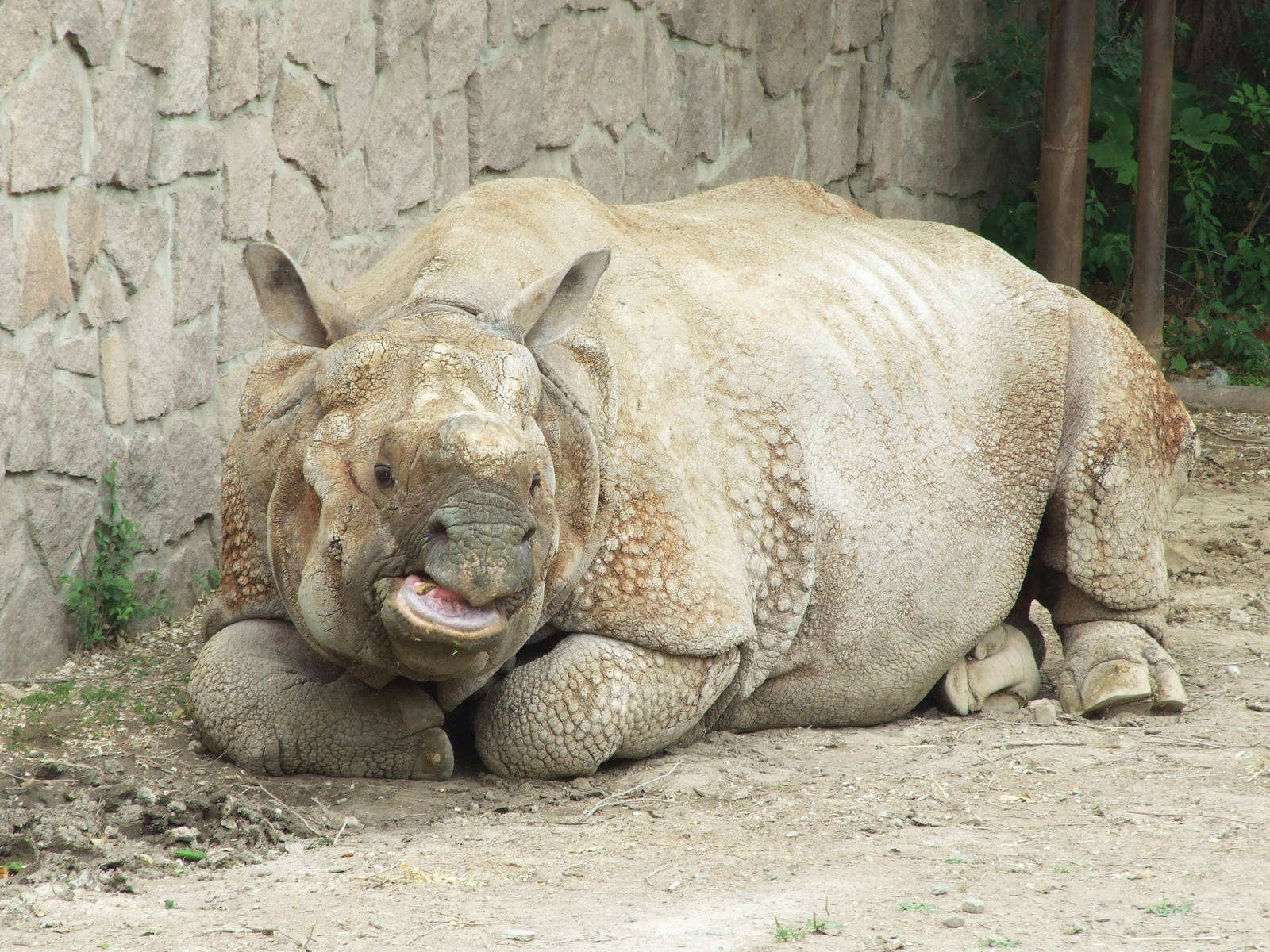
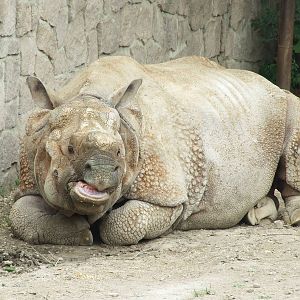
Nim was born in Dvur Kralove Zoo, Czech Republic in 1987 and transferred to Liberec in 1989. He arrived in Beijing Zoo on 20/12/2001 in an animal exchange deal.
Beijing did have a pair wild caught from Nepal at one time ...
Nim´s parents are male Dvityia (*1977 in Stuttgart) and female Numa (*1979 in Stuttgart). They are full siblings.
When Nim was born, Dvur Kralove kept its Indian rhinos in a very cramped stall that was a part of the former elephant house.
In Liberec, he lived alone in a part of their elephant house, in an enclosure originally planed for hippos. Again a very small space with a single box inside, there was no way to keep more then 1 rhino. The zoo got critized for the way he was kept.
Nim was worthless for Liberec. He was also worthless for EEP because he is from an overrepresented linie and a product of an incest on top of it.
Nim was born in Dvur Kralove Zoo, Czech Republic in 1987 and transferred to Liberec in 1989. He arrived in Beijing Zoo on 20/12/2001 in an animal exchange deal.
Beijing did have a pair wild caught from Nepal at one time ...
In fact, Beijing Zoo received four Indian rhinoceros as the gifts from Nepal.
Gifts from King Mahendra Bir Bikram Shah:
香蒂, female, came in 1958 (half year old then), died in 03/1960 (Acute Hemorrhagic Euteritis).
香卡, male, came 1959 (born in late 1950s), died in 11/1978 (Stomach trouble).
Gifts from King Bīrendra Bīr Bikram Śāh:
邦蒂, female, came 09/1980 (born in 09/1979), died on Nov.7th,2010 (Arthritis lead to can't stand up, Circulatory failure).
库玛, male, came 10/1981 (also very young), died in 12/1981.
The reason why Beijing Zoo import Nim is hoping that he can breed with 邦蒂, but this plan failed because of 邦蒂's death.
The breeding attempt failed as on import the Beijing wild born Nepali female Bang Tri was already quite old to begin with for a nulliparous female when Nim was introduced.
Here again, the fact that adult females need to breed as early as possible when reaching adulthood (at 4-5 years of age) and 10-12 years latest to avoid the onset and development of ovarian cysts. At 20+ it can no longer be realistically expected a nulliparous female will reproduce. I am not saying do not try … though, but realistically their chances are very low.
Incidentally, on arrival Bang Tri was estimated born in 1978, so in 2001 she was already 22+ at best. Further, … she died 7 Nov. 2009.
Sadly, our insight into / knowledge of rhino reproductive behavior has only recently come to this stage. So, it IS all in hindsight.
For the last male Kamat however it is a different story. He was estimated born 1981 and arrived as a suckling calf (which is not the best age / time of introduction … for a new arrival, I think). It may not have been unsurprising then … that this male died 26 Nov. 1981 (arrival: 20 Oct. 1981). Did the keeping staff really have any experience of rhino calf husbandry, I wonder …?
Here again, the fact that adult females need to breed as early as possible when reaching adulthood (at 4-5 years of age) and 10-12 years latest to avoid the onset and development of ovarian cysts. At 20+ it can no longer be realistically expected a nulliparous female will reproduce. I am not saying do not try … though, but realistically their chances are very low.
Adult females need to breed as early as possible - Is this principle only applies to Indian rhinos or to all kinds of rhinos?
The introduction of Kamat in such an unsurprising age is definitely inappropriate. It must be very difficult for him to adapt the completely different climate. The rhino was chosen by Nepal, I don't know their reasons. In fact, all the four rhinos are not very healthy from the arriving to death.
Could you please tell me where you got the database? Do you know the names of 香蒂 and 香卡? Bang Tri died in Nov 2010, not 2009. I saw two Indian rhinos in the summer 2010.
When Nim was born, Dvur Kralove kept its Indian rhinos in a very cramped stall that was a part of the former elephant house.
In Liberec, he lived alone in a part of their elephant house, in an enclosure originally planed for hippos. Again a very small space with a single box inside, there was no way to keep more then 1 rhino. The zoo got critized for the way he was kept.
Adult females need to breed as early as possible - Is this principle only applies to Indian rhinos or to all kinds of rhinos?
The introduction of Kamat in such an unsurprising age is definitely inappropriate. It must be very difficult for him to adapt the completely different climate. The rhino was chosen by Nepal, I don't know their reasons. In fact, all the four rhinos are not very healthy from the arriving to death.
Could you please tell me where you got the database? Do you know the names of 香蒂 and 香卡? Bang Tri died in Nov 2010, not 2009. I saw two Indian rhinos in the summer 2010.
This research was done primarily as an analysis of Indian rhino. However, it pretty much applies to all rhino species in captivity.
My sources: are mainly the multiple International Stud Books and data / information from other publications as well as tidbits from the Net. It is possible that individual entries may be partially incorrect, but on the whole I found this studbook to be pretty darn reliable.
Correction: Bang Tri should read Bang Ti
F 香蒂 1959 - interestingly no entry any ISB. For definite she arrived 1959 and died 2 years later (L. Rookmaker - Rhinos in Captivity). Again her young age on arrival and - perhaps - inexperience in dealing with rhino calves may have contributed to her early demise.
I would assume the ISB did not receive any / no definite info from Beijing Zoo on her, hence her being missing from the historical record.
M 香卡 Xiangka (I suppose it should BE transliterated as Xiang Ka). She was est. born 1959, arrived 15/7/1959 and died 12/11/1978. He was est. 1959 born.