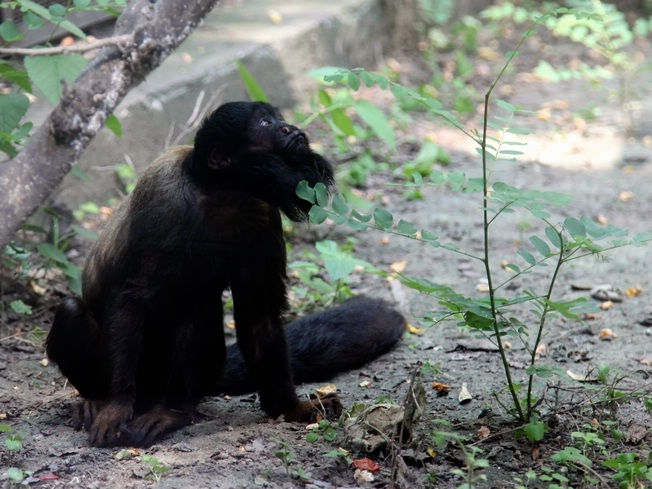
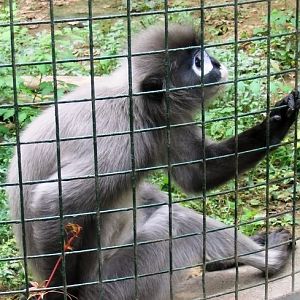
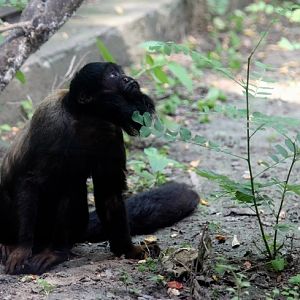
If you are referring to the species being established at Colchester and Belfast in the UK, they are not the same species. The species in Europe is the Red-Backed Bearded Saki (Chiropotes chiropotes) while I was under the impression that the animal photographed is a Black Bearded Saki (Chiropotes satanas), though Baboon will have to clarify this for us. They were considered the same species in the past so it's possible that this animal is the same as the ones in Europe, though it doesn't really look it to me. But again, Baboon will have to clarify on the scientific name listed.
While it is hard to separate the dark-nosed bearded saki species that were kept under a single species until a few years ago, I seriously doubt this is C. satanas. Because all were kept under the name C. satanas until a few years ago (e.g. "Neotropical Rainforest Mammals" was published before the split and this is the field guide used in the region), you can't trust most photos labelled as "C. satanas" on the net. Even "Handbook of the Mammals of the World" #3 got a wrong photo on p. 457!
Except in juveniles (and this evidently isn't), the real C. satanas is very dark with little or no pale on the back. There are photos of real C. satanas here and here, and a decent illustration on plate 31 in "Handbook of the Mammals of the World" #3. Considering the color of the back of the Beijing animal, it is one of the paler-backed species, probably C. utahicki or C. chiropotes. However, I've seen confirmed captive C. sagulatus (known origin: Guianas) that had surprisingly pale backs instead of their usual more reddish, possibly due to a different diet or more exposure to light than in wild specimens. As a consequence, it is very hard to separate captives of these three unless having a whole range of photos of the specimen under perfect light conditions. Of course it is even easier when knowing where the specimen originated. With the relatively small number of bearded sakis in captivity, the origin of the separate lineages is often known by the zoos that keep them. Unsurprisingly, most are kept in Brazilian zoos. Does anyone know where Beijing got theirs?
Just to be sure there are no misunderstandings: I believe Silva Jr. et al. 2002 provided firm evidence for why they were right in applying the scientific names and Bonvicino et al. 2003 was wrong. In other words:
Red-backed bearded saki (east of Rio Branco) = C. sagulatus
Brown-backed bearded saki (west of Rio Branco) = C. chiropotes
While it is hard to separate the dark-nosed bearded saki species that were kept under a single species until a few years ago, I seriously doubt this is C. satanas. In other words:
Red-backed bearded saki (east of Rio Branco) = C. sagulatus
Brown-backed bearded saki (west of Rio Branco) = C. chiropotes