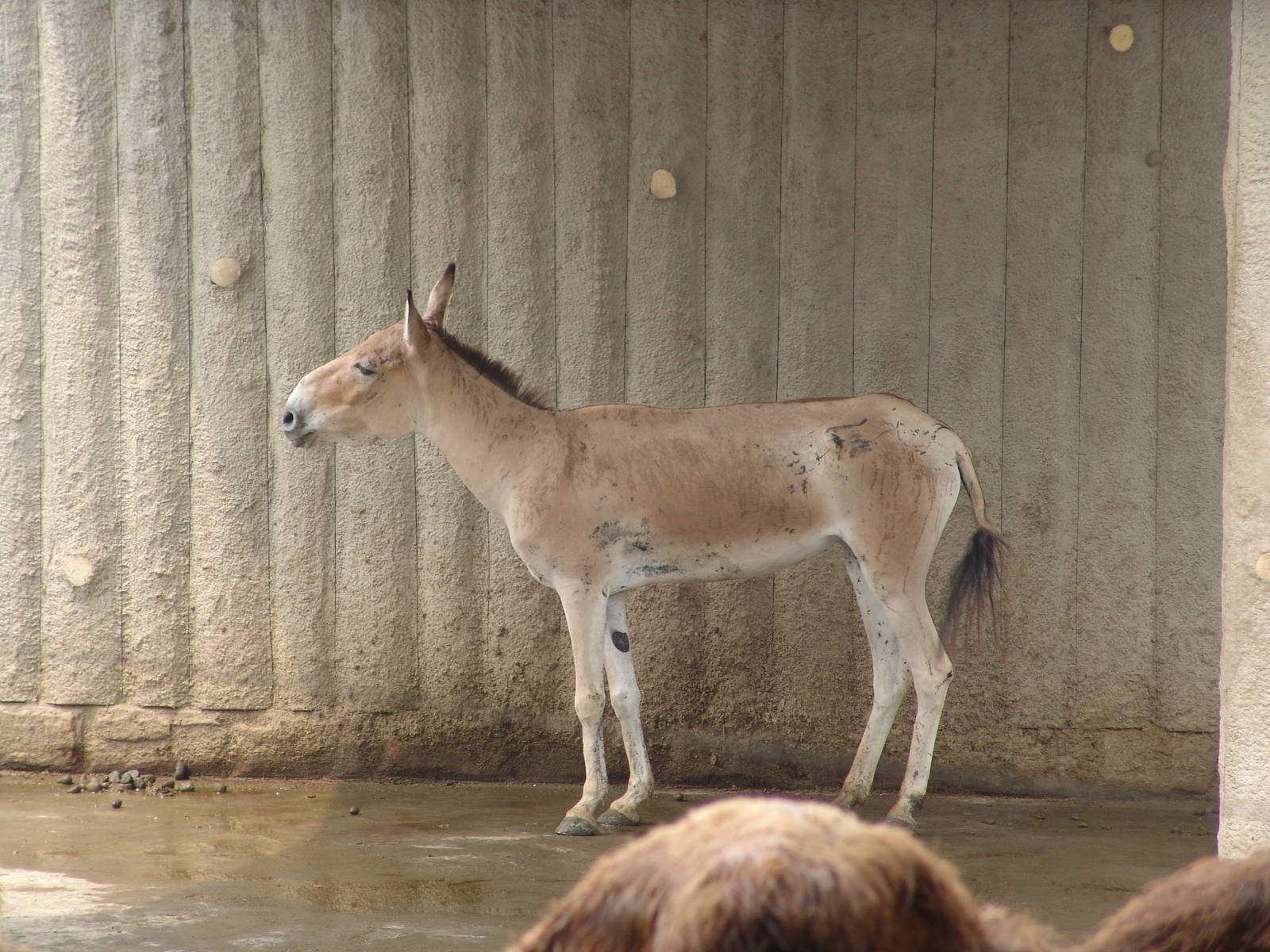
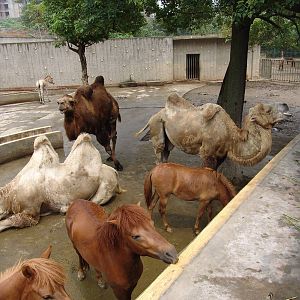
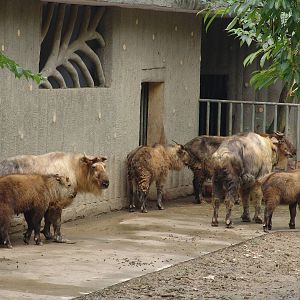
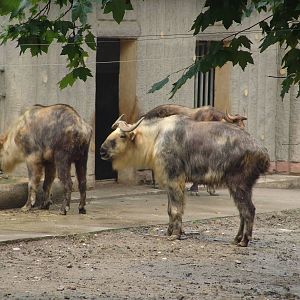
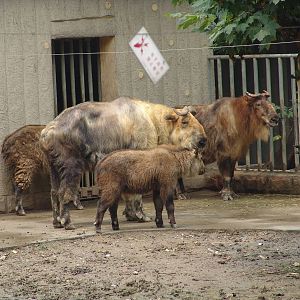
They are quite a common sight in various Chinese zoos (also Shanghai, Beijing, Urumqi).
Sadly, the latest population dat show that in this ssp. there have been significant falls in population numbers in both China and Mongolia over recent years.
I am fairly certain this is the Mongolian hemione (Equus hemionus) or dziggetai. It is considerably taller than its onager cousins. According to a Japanese researcher it stands midway between the onagers (Equus onager) of Persia, Turkmenistan and Northern India and the more common but still larger hemione (Equus kiang) of Tibet. An East German zoo had a Mongolian stallion paired with a Turkmenian mare; they looked as different as a horse and a pony! The first specimen described to modern science were a couple of dziggetais caught in northwestern Siberia where they are extinct nowadays. The stallion died but the mare had to run behind a cart to St. Petersburg. She recovered from this ordeal but the wet climate of St. Petersburg did not agree with her. In those days, late 1700s, the Russians still remembered dziggetais used to live as far west as the Ukraine. At Ascania Nova the Falz Feins kept a dziggetai with their Przewalski horses, captured in the same expedition..The dziggetai was well photographed by the Andrews fossil hunting expedition in Mongolia during the 1920s..Some researchers think there are two subspecies of the dziggetai. To finish: next to true horses both the dziggetai and the related pygmy sized hydruntine (Equus hydruntinus) are sometimes portrayed on prehistoric paintings in Europe..