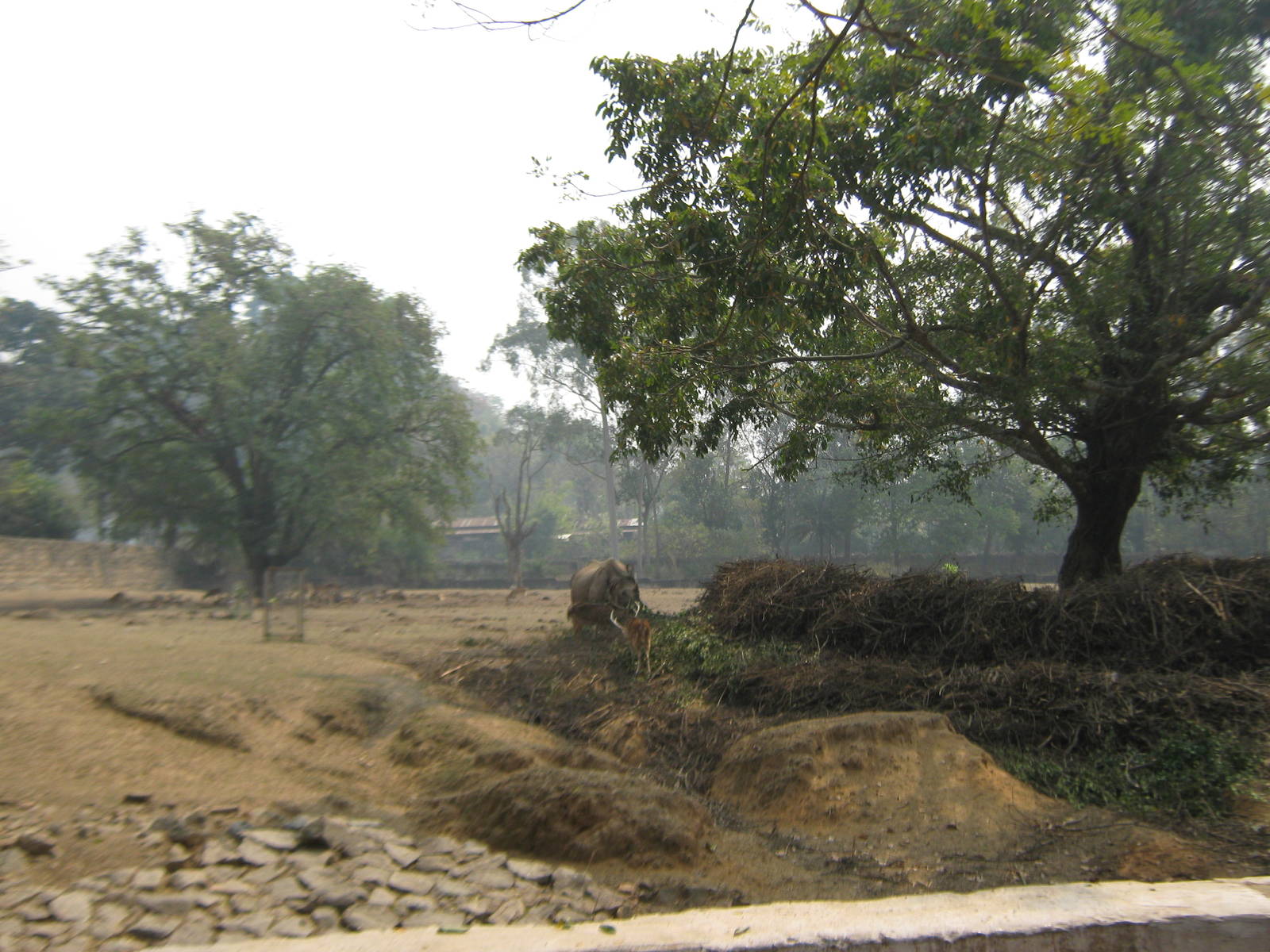
From your review and all the photo's you've posted I have to agree that this is most definitely a zoo of two halves. Some of the enclosures look fantastic but then you get to "Primate Hell" and some of the carnivore enclosures.
It's a shame as the species line-up is pretty brilliant, I also like the fact it mainly focuses on native species with the occasional exotic thrown in. Why doesn't a Western zoo help them out and maybe get some animals in return?
There was a defining conference on Conservation Biology and Breeding in 2011/2012-ish where quite a few European / US zoo staff were present to move the modernization of Indian zoos forward. A side effect of this was the entry of a huge cohort of Indian zoos in ISIS / ZIMS and more regular exchanges of individuals of rarer species.
Sadly, everything within India is top-down decision making and the bureaucratic system moves at a snail's place. New developments, exhibitry, staffing, new animals and funding is all handled by the Center and this is a major stumbling block for any swift modernization process.
I have raised myself the proposal on several occasions of a tie between zoos across continents (a bit similar to what some Western and Chinese zoos are doing that includes animal exchange, exhibit design and reciprocal study and assignment visits.
no idea sorry. I only saw one. There were signs saying that all the other rhinos are in off-display breeding areas. I don't know how many they have altogether.
no idea sorry. I only saw one. There were signs saying that all the other rhinos are in off-display breeding areas. I don't know how many they have altogether.
As I mentioned, when I went some years back there were about nine- all in groups in very small muddy yards. Maybe that area is just closed off now as I can't imagine them building new 'offshow' areas for them. Or maybe they have? Of course a few may have died as well. I have a feeling they may have received the odd 'difficult' rhino from Kaziranga.
From your review and all the photo's you've posted I have to agree that this is most definitely a zoo of two halves. Some of the enclosures look fantastic but then you get to "Primate Hell" and some of the carnivore enclosures.
I think you'll find the ungulate enclosures look good because they are large, have a lot of animals and are natural to the country so they simply look 'natural'. Whereas nearly all the species that require 'caging' such as some of the primates and carnivores have the worst type of enclosures typical of Indian zoos. Its not a good place really at all.
As I mentioned, when I went some years back there were about nine- all in groups in very small muddy yards. Maybe that area is just closed off now as I can't imagine them building new 'offshow' areas for them. Or maybe they have? Of course a few may have died as well. I have a feeling they may have received the odd 'difficult' rhino from Kaziranga.
@@Pertinax, Chlidonias, they now hold six (3.3) rhinos as of now. A male calf - the first in a decade .. - was born in late 2013. Not sure whether it is 2.2 in the off-exhibit or 1.3. It might be they still have an elderly F rhino rescued from Kaziranga some time earlier in 2012/13 (but I must admit I am not quite fully confident on that).
As to your time in ASZ - Pertinax that is - you may have visited in 2002-2003. This is the last time they held 9 rhinos. A number died in the interval (I believe the total tally was 3.1 since). Those I am certain of is a male in 2006, 2008 each and the last - the founder male - Lakshman in June 2013. They also sent off a captive-born female Rita to Thiruvananthapuram in 2003 (where they seriously ****ed up an introduction of male and female rhino and the captive-born female so carefully groomed at ASZ died from her injuries).
BTW: Lakshman's mate and co-founder Geetalaxmi / Lakhimi died in 1998. Can't find anything on a female supposedly having died in 2003/2004. This more or less put paid to any breeding at the zoo.
Some of these died with quite frankly with most disconcerting pathologies and / or diagnosis (although I really must admit the standard of veterinary science in India is somewhat ** und thus I treat some of the diagnosis as rather suspect - but this is more general than the ASZ -).
Two proven breeders in the current herd with son Mohesh and Bhagekhati.
It was earlier than that, more like the late 1990's. There were definately nine as I remember counting them probably in three groups/trios or pairs in very small muddy yards. (I don't actually remember these larger paddocks at all...)
Interesting breakdown you have provided, not a very encouraging story for a local flagship species.
It was earlier than that, more like the late 1990's. There were definately nine as I remember counting them probably in three groups/trios or pairs in very small muddy yards. (I don't actually remember these larger paddocks at all...)
Interesting breakdown you have provided, not a very encouraging story for a local flagship species.
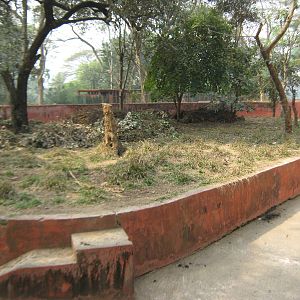
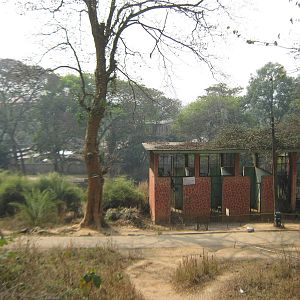
the little concrete pens are still there -- I think three or four of them? -- directly to the left of this photo's viewpoint on the other side of the side-wall (but not visible here obviously). The pens are unoccupied.