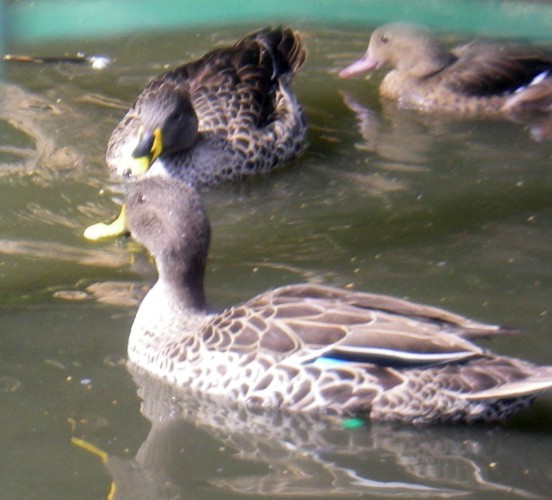
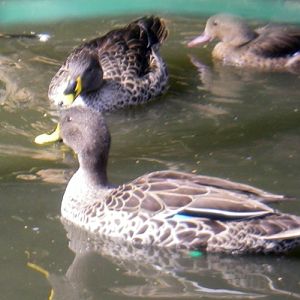
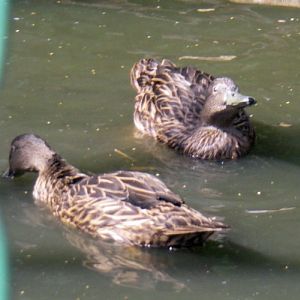
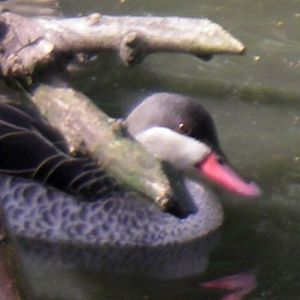
Yep, sorry, I mitaked the common name with the Yellow-billed Teal (Anas flavirostris).
This was in a mixed waterfoul exhibit for South African and Madagascan species, like the Anas bernieri in the background... also Anas melleri, A. erythrorhyncha, Dendrocygna bicolor, etc.
Sorry if I seemed picky, I really like this species, and used to breed them. I would not trust them not to hybridise with Meller's if kept in the same area.
I had hybrids from Yellowbill with Rosybill, Red-crested Pochard and Philippine. (The last one was my fault as I should not have had such closely related species together).
Actually I dislike very much hybrids :-(
It's very curious that they can hybridize with two species of Netta. Maybe is a reason for include the Netta in genus Anas.
Netta x Anas hybrids are infertile, so need to remain in different genera. I would never deliberately breed hybrids, but see my article in the Avicultural Magazine of a few years ago.
As they're infertile, they need to be different species... but no genera! Many times the production of an hybrid between two former genera was enough for change the taxonomy of them. For example the Majorcan midwife toad (Alytes muletensis, formerly Baleaphryne muletensis until they produced an hybrid with Alytes obstreticans) and the Isabelline moth (Actias isabellae, formerly named Graellsia isabellae until they produced an hybrid with Actias luna)
I don't know enough about Herps or Lepidoptera. However, if you put all waterfowl species that could hybridise, in the same genus, you would have swan and geese together, eiders, mergansers, perching ducks, shelducks and all the surface feeders together, and Mandarin on their own because of the chromosome number.
All surface feeding duck hybrids (Mallard x Pintail, Baikal x Green-winged Teal, and so on) are fertile, which puts the parent species in the same genus. Netta x Anas hybrids, while feely produced, are themselves infertile, so remain in separate genera.
Yes, is really curious how a taxonomic concept can vary so much depending on the groups of lifeforms. It's true the saying of "a species is whatever an expert says that is a species". I really could not imagine to put all the different Anas in the same species, but it's so strange that these hybrids can be fertile while in almost all animal groups this is not possible.
Thanks for make me learning something new!