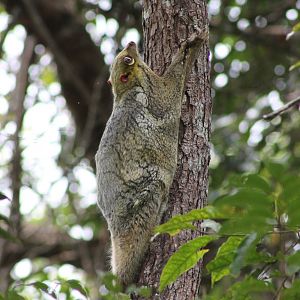
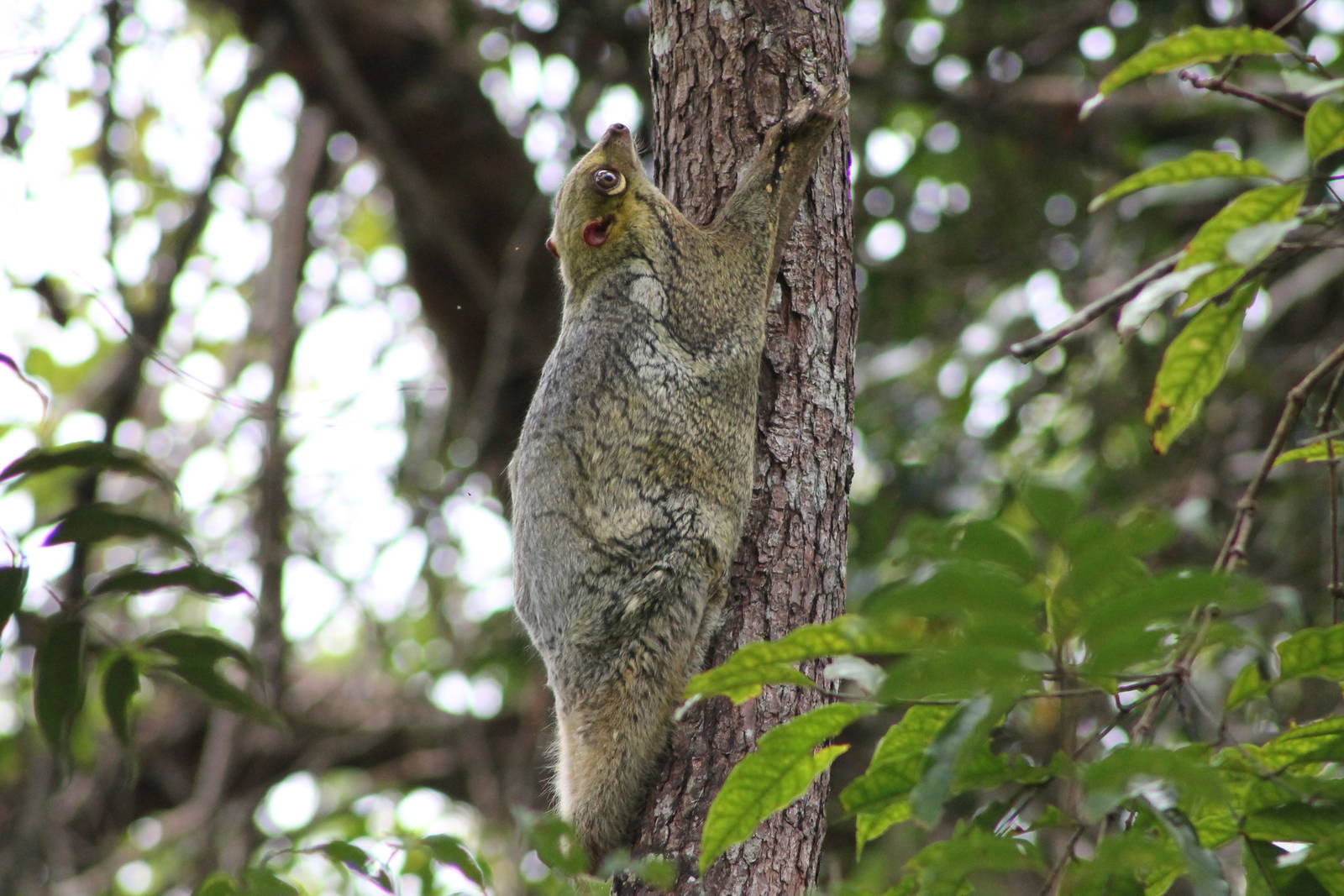
hands up who had books when they were growing up (or has those books still) which told you that colugos hang upside-down under branches like sloths, usually with a photo (always the same photo) or a picture to illustrate the posture? Well I've seen a few colugos in my travels and I have only ever seen one hanging like a sloth. Every other one I've seen has been clinging vertically to a tree trunk like the one in the above photo. The one exception was a female with a baby on her belly, and by hanging upside-down her gliding membranes formed a sort of crib around the baby.
Something I also find eternally interesting, is that their eyes are always open!! How do they sleep? Do they even have eyelids?!
I also had a book out of the library when I was a kid which had a painting of a night scene in a southeast Asian jungle, and in the bottom corner was a colugo which they had copied from the photo I had seen used continuously -- but they had inverted the animal so it was sort of "standing" on the top of the branch!
I just had a look on Google Images and there are several photos of upside-down colugos, but I do still wonder if it is mainly a female-with-young posture.
frankly I'm just lucky that it was fairly low down on the tree, on the downhill side of a slope so I could photograph straight across at it, and it was in good light. All pure luck. But I am pleased because they are by far the best photos I've ever got and the best viewing also (not that it did much -- during the day they just hang there and hope that you can't really see them!). Brilliant animals though.
Others I've seen elsewhere have been up high in the trees (so photos basically need to be taken pointing up at the sky), or at dusk, and once at night in Sumatra (at the top of a very tall tree -- took me a while to work out what the eye-shine was from!)
To my knowledge, no collection in Europe has even attempted to bring colugos into captivity, and I doubt this is likely to change - a shame, as all things being equal once I have visited Berlin and Leipzig in April the only placental mammalian order I will never have seen will be the Dermoptera.
I don't think they have ever been kept alive successfully in a captive situation, so I'm not sure I'd like to see any zoos in Europe trying to import them. Although, on the other hand, I also don't see why they should be impossible to keep?
Re mammal orders, I've never seen tenrecs, elephant shrews or pangolins. (Using the Wikipedia list for ease of reference ). Although I might have seen elephant shrews after all and forgotten. Definitely not tenrecs or pangolins though. (Actually I'm almost certain that I probably saw elephant shrews in the Grzimek House and can't remember them).
[ame=http://en.wikipedia.org/wiki/List_of_placental_mammals]List of placental mammals - Wikipedia, the free encyclopedia[/ame]
I don't think they have ever been kept alive successfully in a captive situation, so I'm not sure I'd like to see any zoos in Europe trying to import them. Although, on the other hand, I also don't see why they should be impossible to keep?
Re mammal orders, I've never seen tenrecs, elephant shrews or pangolins. (Using the Wikipedia list for ease of reference ). Although I might have seen elephant shrews after all and forgotten. Definitely not tenrecs or pangolins though. (Actually I'm almost certain that I probably saw elephant shrews in the Grzimek House and can't remember them).
I believe that the captive lifespan record is only 15 weeks; but like yourself I am somewhat puzzled as to why this is so.
The few attempts to keep them alive in captivity - all within the native range - *have* always been of rescue animals, so this could well be a factor. One wonders whether the low survival odds have merely put anyone off trying to keep a captured and presumably healthy individual alive - but as neither species is particularly threatened, being classified as Least Concern, there is no pressing need for this to be risked.
As for placental mammalian orders, at the present time I am yet to see any sirenian, elephant shrew or pangolin as well as any colugo - but as noted above I will be visiting Berlin and Leipzig in April, which should hopefully allow me to see representatives of all three (these being Caribbean Manatee, Round-eared Elephant Shrew and Chinese Pangolin).
I have seen three tenrec species at the present time - Greater and Lesser Hedgehog Tenrec, and Tailless Tenrec. If you ever return to Europe you should not have *too* much trouble seeing the Lesser, as they are increasingly common.
==Edit==
Just did a little reading on the matter of captive colugos, and found two interesting points - firstly, that there *are* unverified stories of individual animals being kept as pets within the native range for almost two decades, the key to their survival being stated as having sufficient space to exercise their gliding membrane, and secondly that the cause of death in rescue colugos is usually mould forming on the membrane.
I imagine the best chance with colugo would be to hand-rear a baby. Probably much easier than trying to adapt an adult to a cage and possibly alien diet.
I'm surprised you haven't seen elephant shrews actually -- does nowhere in the UK keep them now? Pangolins I can understand (possibly mythical beasts I believe), and also sirenians seeing there's none in the UK (but at least I've seen three species of those....ah, nothing like one-upmanship amongst zoo nerds ). I don't need to see a tenrec anyway, I've seen loads of hedgehogs instead and they just look the same
![Mountain Blackeye (Chlorocharis [Zosterops] emiliae)](/data/xfmg/thumbnail/259/259285-5dd574e9e6e6c42c6f0d901b18ee5ca4.jpg?1765329535)