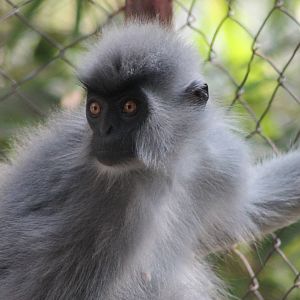
So that was the zoo done, apart for the “singing birds” which I knew I still had to see on the way out. I had a last look at the map, just to make sure, and suddenly realised that going from the gibbons to the non-existent wild boar enclosure I had completely bypassed the cage marked “langur” on the map. I could even see it from right where I was standing by the elephants! I came “this close” to missing the most exciting animals at the zoo!! Inside the cage I found a pair of what I assumed were dusky langurs with a well-grown baby. There was no sign on the cage at all, but the Yangon Zoo had dusky langurs and I guessed these came from there. After I'd left Mandalay I had a sudden realisation that they may in fact have been Phayre's langurs which are similar in appearance to duskies and much closer in natural range (dusky langurs are only found in the far south of Burma). I had never seen Phayre's langurs before and had no mammal references except the not-very-good field guide for Chinese mammals. It remained a mystery for the moment until I found internet good enough to allow me to post a couple of photos on Zoochat where they were promptly identified as Phayre's langurs. I just wish I had spent more time taking some good photos of them, but at the time I was distracted by a much more interesting langur in the same cage. I hadn't even realised the other langur was there to start with because the male Phayre's langur was extremely stressed at having to defend his wife and child, and spent almost the whole time tearing around the perimeter of his small cage in an attempt to scare off visitors getting too close, while the female and youngster stayed permanently in the very centre of the cage on a branch. The extra langur was huddled quietly up near the top of the cage right against the wire. Occasionally the male Phayre's would pause to give the other langur a telling off for being in the same cage. I really felt sorry for him. This langur I knew immediately was something exciting, I just wasn't quite sure what! He was a beautiful grey all over with a black face, hands and feet. Most striking were the startling bright orange eyes and the ridiculously long and thickened tail. Almost every mammal in a Burmese zoo is native to Burma and because I knew which species of monkeys are native here I made the assumption this had to be a Shortridge's langur. The field guide to the mammals of China didn't really help to confirm this because while it did have a painting of a Shortridge's langur it looked more like a horribly-deformed gremlin than any living animal. I tried googling some photos when I got some internet but there was almost nothing online that helped. After leaving Burma I finally got the animal identified – it was indeed a Shortridge's langur. Very exciting indeed, but also just really sad that it was being kept the way it was. Even worse was that this cage was the only place in any Burmese zoo where I saw bad visitor behaviour. A big group of local teenagers thought it astoundingly funny that the male Phayre's langur was being so defensive and they all started hammering on the wire to make him even angrier. I absolutely went off my nut at them, and because English is widely spoken in Burma they knew exactly what I was saying to them.
Also lucky enough to see on this picture so rare primate taxa, is for me a real pleasure.
And I am very glad that species Trachypithecus shortridgei is finally on zoochat added.