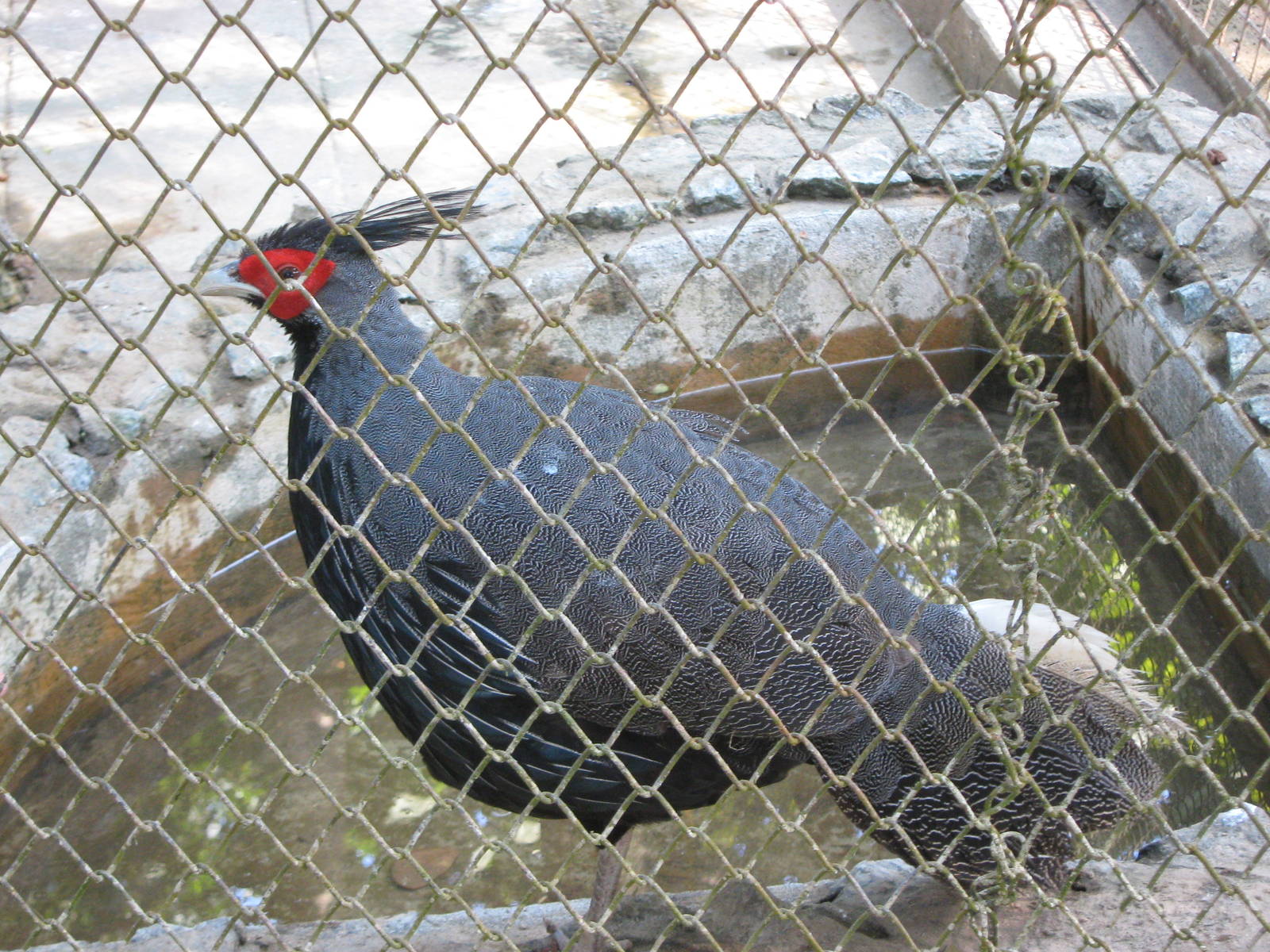
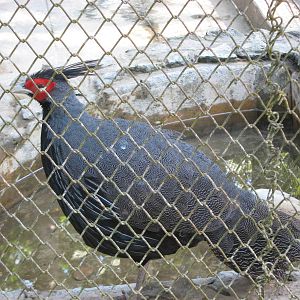
Kalij. I need to look in Beebe & Delacour before I can elaborate further.
(Sorry Israel, I wrote you a more detailed PM, then deleted it accidentally. My IT skills are even poorer than my ornithological ones).
thanks. I had the field guide to southeast Asia with me at the zoo, but neither silver nor kalij subspecies pictured matched perfectly so I wasn't sure. And apparently the Burmese silvers can approach Burmese kalij in appearance?
The general build of this bird suggests Kalij, However (and this is why I need to look in the books) I believe there is a more or less continuous gradation from Black Kalij at one end of the leucomelana/nycthemera range to Chinese Silver (the whitest of all) at the other end. I seem to remember Beebe figuring a lot of wild hybrids, which would of course be fully fertile.
The white central retrices could be an individual variation, evidence of inbreeding, or maybe hybrid ancestry.
The general build of this bird suggests Kalij, However (and this is why I need to look in the books) I believe there is a more or less continuous gradation from Black Kalij at one end of the leucomelana/nycthemera range to Chinese Silver (the whitest of all) at the other end. I seem to remember Beebe figuring a lot of wild hybrids, which would of course be fully fertile.
The white central retrices could be an individual variation, evidence of inbreeding, or maybe hybrid ancestry.
at the Yadanabon Zoo in Mandalay which I visited later there were several pairs of birds similar to this one (which were labelled as kalij and which looked sort of "more like kalij" -- they weren't exactly the same as this one, but I didn't get any photos of those ones) but all the males of those had the white tail feathers too. However the Mandalay birds may well have been bred at the Yangon Zoo or vice versa.
Both zoos also had nominate race silver pheasants (or at least a subspecies which looked like the nominate).
Oh, EDIT: I remember why the Mandalay birds looked more like kalij - they had an obviously white-scaled rump pattern and a dark back, whereas this one at Yangon has a sort of delicate lacy pattern over the whole back (which is why I was wondering if it was a silver pheasant).
The build is very Kalij like and I would expect longer tail-feathers in Silver Pheasants. Also the crest-feathers are too straight for a Silver Pheasant. I have seen Kalij with white tail-feathers so that would not be a problem. Lophura leucomelanos crawfurdii should have this typical fine lacy structure so I would even be tempted to put a subspecies label on it.
As said in my PM I rule-out Silver pheasant and would say it's one of the endemic Burma-subspecies and here I would say Oates Kalij pheasant purely on the several discriptions I've found ( throat and breast black, back and wings more blue-ish ), the other Burma-endemic being the William Kalij should be a more brown-ish bird.
A hybrid is also not to rule-out and may explain the white tail-feathers
I was just looking through my camera and I have a much better photo of a male at the Naypyitaw Zoo (I saw this type at three different zoos, but at each they looked slightly different) which I will upload when there is a gallery for that zoo. That one had a well-scaled rump (which the one pictured above appears to lack) as well as the lacy pattern on the upperparts. It also had the white tail feathers.
I'm happy with kalij as that is the 100% agreement here.
I too agree with Kalij (but the Kalij/Silver is still so debated). In particular, I'd say Lineated Kalij (Lophura leucomelanos lineata). Here's Delacour's description from "Pheasants of the World" - L. l. lineata males with very fine vermiculations of black and white on upperparts that give gray apperance with white streaked feathers on the side of the breast; the crest, chin, breast and belly is black; tail long with central feathers buffy-white. Hens are brown above with a dark brown crest, the breast and abdomen with white v-shaped streaks that are bordered with black; both sexes have brownish to gray legs.