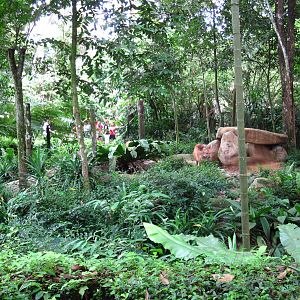
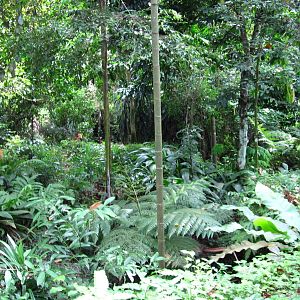
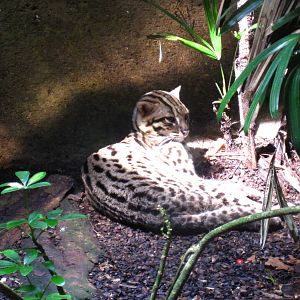
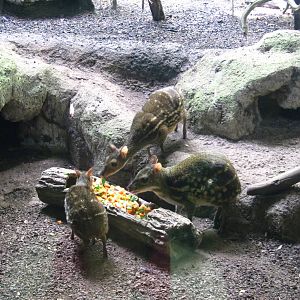
This is only about half of the exhibit. I have seen it and it stretches further out to the right. And as I noted in my comment on the other photo, this is good exhibit because it gives the Maned Wolves good shade and places to hide. They need shade and places to hide because they are shy animals.
Size is not all. Even if you would give them an exhibit the size of Singapore City, it would not nessessarily make it better. Wuppertal Zoo in Germany built a gigantic lion exhibit, only to find that the lions ever utilise a very small part of it and usually always hang out in the same place. In my three days at Singapore Zoo I found that many of the exhibits are not the biggest you will find. But they are just so cleaverly designed! Some zoos have built larger Orang-Utan exhibits in recent years but do not come even close to Singapore's one. The visiting public loves to watch the apes climb high up and about and interact with each other and even with the public during feeding sessions. Let me repeat that size is not all.
This is only about half of the exhibit. I have seen it and it stretches further out to the right. And as I noted in my comment on the other photo, this is good exhibit because it gives the Maned Wolves good shade and places to hide. They need shade and places to hide because they are shy animals.
Size is not all. Even if you would give them an exhibit the size of Singapore City, it would not nessessarily make it better. Wuppertal Zoo in Germany built a gigantic lion exhibit, only to find that the lions ever utilise a very small part of it and usually always hang out in the same place. In my three days at Singapore Zoo I found that many of the exhibits are not the biggest you will find. But they are just so cleaverly designed! Some zoos have built larger Orang-Utan exhibits in recent years but do not come even close to Singapore's one. The visiting public loves to watch the apes climb high up and about and interact with each other and even with the public during feeding sessions. Let me repeat that size is not all.
Size is not all depending one wich species, some times is better small ones but that meet all needs of the animal. Maned wolfs are very shy and difficult to see in many zoos due its large enclosures, but this is not a problem for me if it is good for the animals, in nature you will hardly finnd Maned wolf due its large territory and the fact the are most active during the night.
Of course this enclosure looks very good, but looking from this points seems small.
I was just cheking the minimum sizes of enclosures that we have to follow in Brazil and for Maned Wolfs the minimum size is 200 sqm, for me this is also far to small to them. Also this normatives states: floor need to be of soil, with grass, shrubes, planted with small to medium size trees!
Talking about Orangutans we have only to meet 60 sqm !!!! Lion,tigers, 70 sqm.
The pcitures of the Orangutans at Singapore are great, I think there is not other zoo in the world with such happy orangutans !
Due this we have around 120 sub-standard zoos in Brazil, I dont know if we one that we can say have great enclosures, its a shame that our Ibama (that owns all Lion Tamarins, Yellow Breasted Capuchins, Pied Tamarins that you have in European and US Zoos) mades such idiot laws!
The major shame is that zoos only think in fullfill this laws and not give better conditions for his animals!
I live in the southern part of Brazil and we get some strong winters, with temperatures falling aorund - 5º C, but no Zoo have indoor heating systems for example!
Today the Great Ape Project give out a press release talking about the size of enclosures:
Family of 5 Chimps, minimum size required:
Brazil: 90 sqm
Europe: 600 sqm
USA: 696 sqm.
(Correct me if this is wrong)
Im not a good photographer but I gona do some pictures of some zoos in near future for show you the Brazilain reality
I like the pic Zooish, in other hand @ eduardo_Brazil: according to WAZA minimum space for to keep these animals I found this:
How this animal should be kept
Maned wolves live solitary or in pairs and should be as breeding pairs with their offspring, with the posisbility of separating the animals as may be required.
The outdoor enclosure should have a minimum surface of 400 m² for two adults (plus eventual puppies or subadults). Separation enclosures for the temporary keeping of incompatible animals are mandatory. The enclosure should have natural, well drained soil and some sandy patches. It should be well structured allowing the animals to avoid eye contact.
Maned wolves should have shelters or dens of sufficient size (minimum 8 m² for 1-2 animals) available where a minimum temperature of 18 dgrees celsius is maintained to provide protection from inclement weather.
How this animal should be kept (Orang-Utan)
Legal requirements for the keeping of apes vary greatly from country to country. Even if lower national standards apply, it is recommended that an outdoor enclosure of 300 m² and, in cold and temperate climatic zones, an indoor enclosure of 150m² should be provided for up to 5 compatible adult animals. These enclosures should be at least 6 m high. They should be enlarged by 10% for each additional adult. During daytime, access to the outdoor enclosure should be possible whenever weather conditions permit. In- and outdoor enclosures should be connected by at least two doors. The indoor temperature should not fall below 20°C, it should be higher in places (radiators). The day phase should be around 12 hours, the light spectrum should more or less correspond to that of natural sunlight.
Vertical and horizontal climbing opportunities, horizontal benches or platforms allowing for sitting at various levels above ground, structures allowing the individuals to retire and avoid one another, and separate cages for temporary isolation should be provided as should toys, and branches, cargo nets and other material for constructing sleeping nests. The outdoor enclosure should have some natural vegetation such as a grass cover, bushes and live trees in addition to dead trees, ropes, climbing frames etc. Live trees may need to be protected by hot wires or similar.
Chimpanzees:
Legal requirements for the keeping of apes vary greatly from country to country. Even if lower national standards apply, it is recommended that an outdoor enclosure of 400 m² and, in cold and temperate climatic zones, an indoor enclosure of 200m² should be provided for up to 5 adult animals. These enclosures should be at least 6 m high. They should be enlarged by 10% for each additional adult.
During daytime, access to the outdoor enclosure should be possible whenever weather conditions permit. In- and outdoor enclosures should be connected by at least two doors. The indoor temperature should not fall below 20°C, it should be higher in places (radiators). The day phase should be around 12 hours, the light spectrum should more or less correspond to that of natural sunlight.
Vertical and horizontal climbing opportunities, horizontal benches or platforms allowing for sitting at various levels above ground, structures allowing the individuals to retire and avoid one another, and separate cages for temporary isolation should be provided as should toys, and branches and other material for constructing sleeping nests. The outdoor enclosure should have some natural vegetation such as a grass cover, bushes and live trees in addition to dead trees, ropes, climbing frames etc. Live trees may need to be protected by hot wires or similar.
Thanks for posting it, but this I know! WAZA mades only recommendations,
every country have own minimum sizes for enclosures/ exhibits. I think some countries ask more than WAZA recommneds, and is ok, no enclosure is big enough for a tiger, lion, chimp,gorilla, etc for example if we want to show a natural habitat.