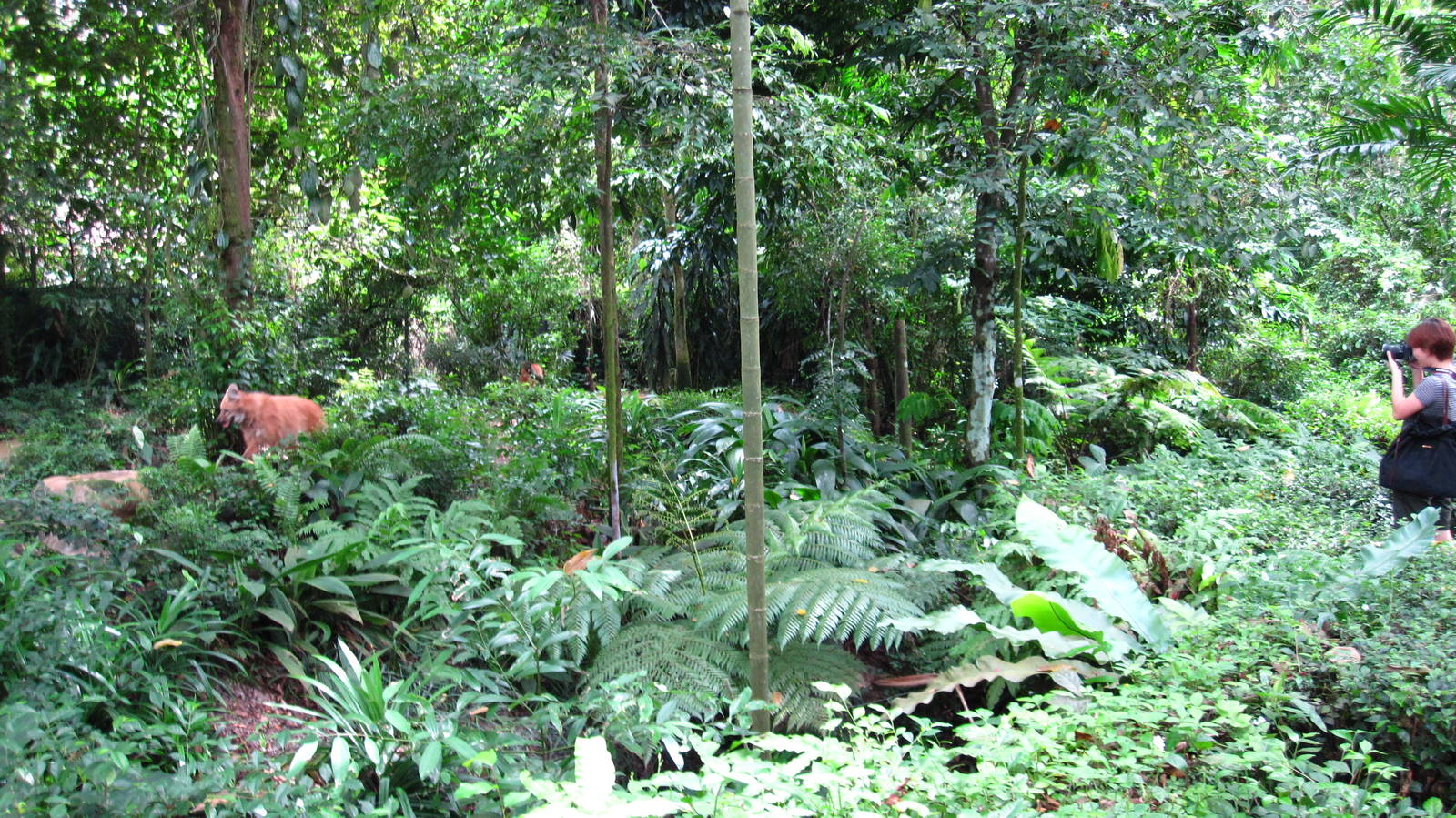
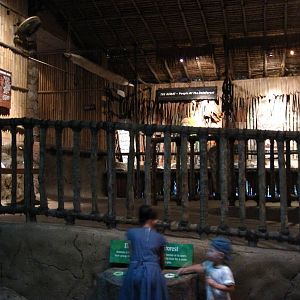
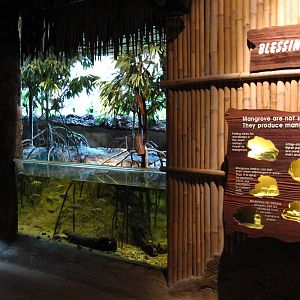
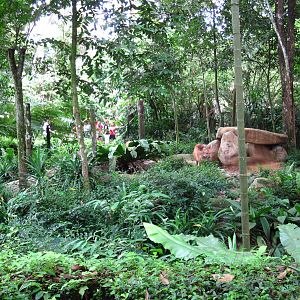
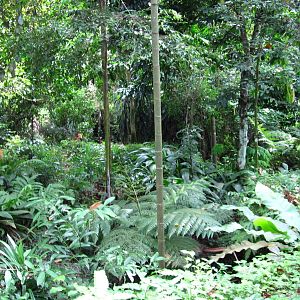
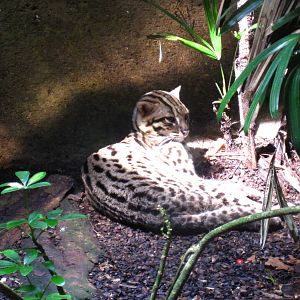
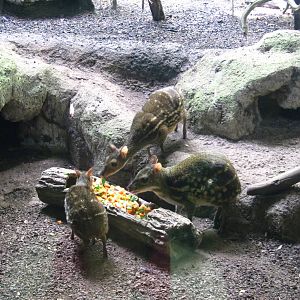
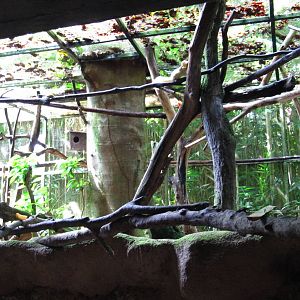
Although it looks nothing like the grassland habitat of the Maned Wolf, this exhibit is nonetheless an excellent example of habitat immersion. The barrier (dry moat) is completely hidden by vegetation.
I have to admit that I haven't been there but from what I've seen on TV and in pictures, Colchester looks like an outlet mall. Despite its large and diverse collection I don't have a great urge to go there.
I think with UK zoos their rural or semi-rural locations and natural assets (lots of fields) mean that the most cost effective way of displaying animals is in a relatively simple way.
Sometimes this works, sometimes it can be pedestrian and unimaginative. (Whipsnade's Indian rhinos spring to mind, essentially the design concept seems to be based on 'what would happen if a dairy farm kept rhinos instead of cows?') but the fact is that cultural attitudes and financial realities mean that 'striving for excellence' just doesn't take the form it does in the States for example.
Because people like different things lol. And I like mesh. If all of Bristol zoos enclosures were moated there'd be a lot of tiny exhibits. As it stands, they have mesh and they're all a good size. Also, 90% of primates benefit more from cages as there's no limit to what climbing structures you can put in like there would be with a moat with trees on the other side.
There are ways to do naturalistic, apparently barrier-free exhibits without building multi-million dollar/pound/euro themed exhibits. The maned wolf photo that started this whole discussion is a prime example. Just use the vegetation native to the area. Even the simple grass hill shown on the posted link to the Croatian maned wolf exhibit is pretty good.
Of the 70 plus zoological parks I have visited, mostly in the U.S., I would say the best I have seen is Northwest Trek. It is built in an existing forest in Washington, and they just put up fences behind the trees where they are hard to see. No extensive construction work, just the forest that was already there, but it is the most completely natural zoological park I have seen. Le Parc Des Felins in France did the same thing, except most of their viewing is through the fence still.
I am new to this thread and will not attempt to read all contributions in detail. Wiser men have contributed already so well that my contribution is not needed.
All I want to say is that it is easy to miss this exhibit. I for one almost did. Next door are llamas and then the polar bears. Close by is one of the world's best orang-utan exhibits. With these high-profile exhibits and animals close by, it is no wonder that guests seem to miss the Maned wolves a lot, and those who do pass it are unlikely to stay long in front of it.
The heavy vegetation gives the wolves places to hide, and these are shy animals, so I'd give the Singapore Zoo good grade for this exhibit, regardless of its age and how well it resembles the South American pampas.
I suppose that we all have to realize that rating exhibits in zoos is for the most part a purely subjective experience. There are individuals who declare that they like mesh (Ash), those that enjoy barrier-free enclosures (Arizona Docent) and many folks in between.
@Shirokuma: you brought up a really intriguing point when you referenced Whipsnade Zoo and its Indian rhino paddock(s). Talking specifically about UK zoos you said:
"Sometimes this works, sometimes it can be pedestrian and unimaginative. (Whipsnade's Indian rhinos spring to mind, essentially the design concept seems to be based on 'what would happen if a dairy farm kept rhinos instead of cows?') but the fact is that cultural attitudes and financial realities mean that 'striving for excellence' just doesn't take the form it does in the States for example."
You make an interesting point, and I find that I too find myself thinking of farms when I see amazing hoofstock species in utilitarian paddocks that can be found on any kind of farm. Toss in some cows instead of rhinos, wildebeest or zebras and no one would realize that you were ever in a zoo! I've seen great hoofstock exhibits with molded riverbanks, densely planted vegetation, hay-covered bomas and an attention to detail that is simply lacking when one views nothing more than a green field with a huge electric fence around it. Sure, the animal might not notice anything out of the ordinary but where is the sense of excitement? The realization, however flimsy to some individuals, of arriving in an exotic nation? The placing of an animal in the context of its environment? The exhibit does not have to be "immersive", but it also doesn't have to be a basic field that was made for loose change. There is without a doubt more than one way to skin a cat, but which is the richer zoo-going experience?
Sure, the animal might not notice anything out of the ordinary but where is the sense of excitement? The realization, however flimsy to some individuals, of arriving in an exotic nation? The placing of an animal in the context of its environment? The exhibit does not have to be "immersive", but it also doesn't have to be a basic field that was made for loose change. There is without a doubt more than one way to skin a cat, but which is the richer zoo-going experience?
The excitement comes from seeing the animals - that's my priority when I visit the zoo, as I'm sure it is for the majority of visitors. As for placing the animal in context, why is it not sufficent to landscape the interior of the exhibit? It seems a little patronising to think visitors need to be 'fooled' into thinking they have gone to the rainforest to realise the animals come from there.
(for what it's worth, I'm not saying theming or immersion are Bad Things, but just that they're not a necessity for a 'rich zoo-going experience')
And (broken record time!) remember may zoos do only have 'loose change' for exhibit construction!
But you're not. And no amount of hidden barriers change that. It's a mock Pantanal, or Ngorongoro, or wherever. Why can't we enjoy seeing the animals behaving naturally without having to be tricked into thinking it's the Western Ghats?
@Maguari: you are right in that we (as collective zoo visitors) certainly do not have to be tricked into imagining that we are in an exotic, foreign, usually unknown location. If zoos wish to remove the cows and goats from their paddocks and replace them with Indian rhinos and okapis then that is a cheap way to showcase nature. But in the 21st century surely habitat destruction and the conservation of animal environments is one of the major reasons for the existence of zoos, and thus rather than have simple graphics illustrating an animal's habitat why not take the extra step and attempt to recreate it? I know that you recently visited the Masoala Rainforest at the Zurich Zoo, and wasn't that a far more spectacular experience than strolling through a walk-through lemur exhibit that was constructed for a significantly smaller amount of cash?