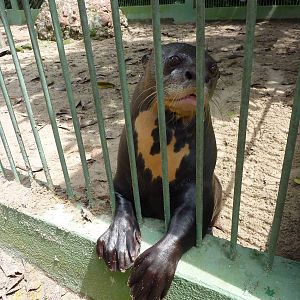
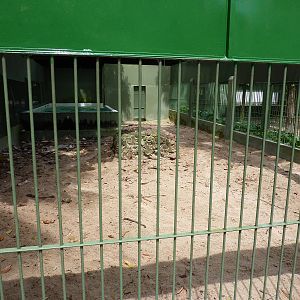
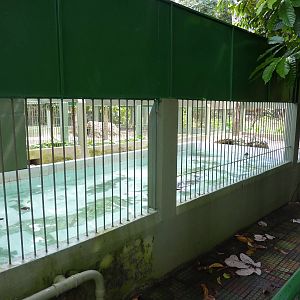
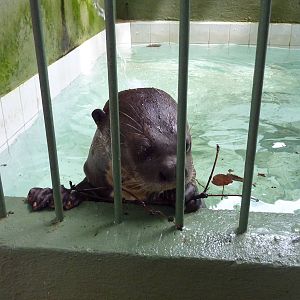
Of course not. I don't think this area was fully accessible to the public, so it was meant more to account for the viewing facilities. The size of this enclosure, for a solitary animal, seemed fair to me (you can get an idea for the scale of the pool from the other photos in the gallery.) There were at least two enclosures for at least two otters. Online photos show a pair of otters in the same enclosure, so they're probably not always separated. From what's visible in the photo, you seem right about substrate, shelter and enrichment.
INPA has kept giant otters at least since 1983, without ever breeding them. It would be fairly easy to improve their enclosures, if they would be willing to do so. Unfortunately, those enclosures have basically seen no changes since the very beginning. Zoos like Brasilia, Dortmund, Chestnut Centre or Doue La Fontaine have already proven that giant otters rear cubs really well, if they are kept in the right conditions. Regarding how rare this species still is (and how small the gene pool in zoos) it would be quite important that INPA improves their conditions and starts to breed them as well.