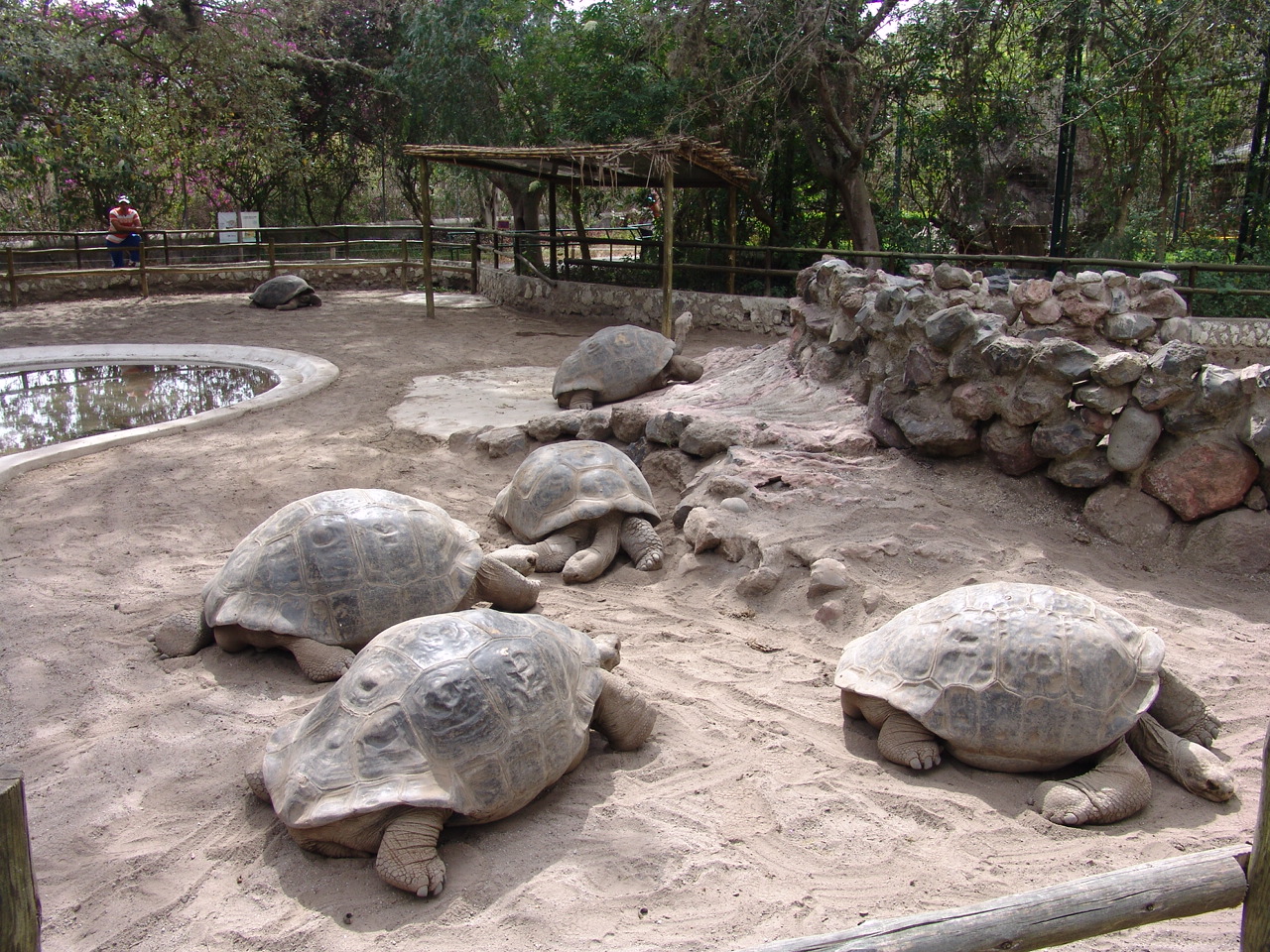
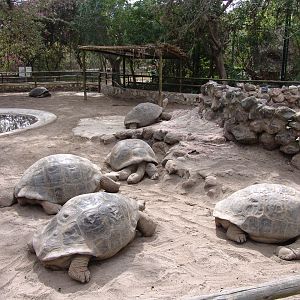
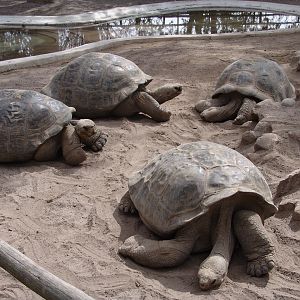
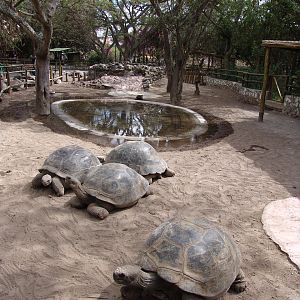
these definitely aren't abingdoni - even if Lonesome George wasn't the only one of that subspecies know to survive, these ones have entirely the wrong shell shape.
However there are tortoises back on Pinta again! As of this year 39 hybrid tortoises were released on the island, all sterilised to prevent breeding, as a fore-runner to a proper introduction in future years of pure Española tortoises (the nearest subspecies genetically to abingdoni)
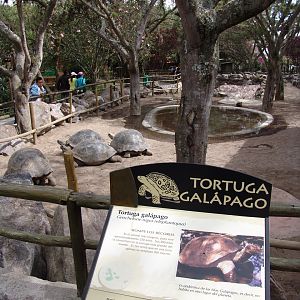
Interesting! So, which subspecies would you say this is? I must say that during my visit to this zoo, I wasn't able to find out the exact subspecies, as all the tortoises were simply named 'Galapagos tortoise'… So, I had to look it up in my book.
Interesting! So, which subspecies would you say this is? I must say that during my visit to this zoo, I wasn't able to find out the exact subspecies, as all the tortoises were simply named 'Galapagos tortoise'… So, I had to look it up in my book.
I have no idea sorry, I just know that Lonesome George is the only Pinta tortoise left and that he has a high shell. Quito has lots of tortoises from the Galapagos and its quite likely that even they don't know which types they have in their collection. How did you come up with these ones being abingdoni if they weren't labelled as such?
Quito has lots of tortoises from the Galapagos and its quite likely that even they don't know which types they have in their collection. How did you come up with these ones being abingdoni if they weren't labelled as such?
Quito has only two subspecies as you can see from the pictures. These two are kept in two separated groups. If you're a regular 'zoo goer' you'd know that the 'signs' in zoos are more often incorrect than correct. Especially when it gets to birds and reptiles. Even more so when one has to do with subspecies… As I wanted to know which subspecies these were, I 'advised' my field guide to the reptiles of the Galapagos. The issue with the Galapagos tortoise subspecies is quite complex because as of yet no one agrees upon the classification, and so no one can know for 100% certainty which subspecies this is. I thought these looked like abingdoni because they do have the elongated necks and legs, they're bigger than all the other subspecies that I've seen (also the ones on the Galapagos islands) and, although not as big as the one of lonesome George, their shell is quite big and the front opening turns upwards…
Quito has only two subspecies as you can see from the pictures. These two are kept in two separated groups. If you're a regular 'zoo goer' you'd know that the 'signs' in zoos are more often incorrect than correct. Especially when it gets to birds and reptiles. Even more so when one has to do with subspecies… As I wanted to know which subspecies these were, I 'advised' my field guide to the reptiles of the Galapagos. The issue with the Galapagos tortoise subspecies is quite complex because as of yet no one agrees upon the classification, and so no one can know for 100% certainty which subspecies this is. I thought these looked like abingdoni because they do have the elongated necks and legs, they're bigger than all the other subspecies that I've seen (also the ones on the Galapagos islands) and, although not as big as the one of lonesome George, their shell is quite big and the front opening turns upwards…
I guess I haven't been to many zoos, but you did specifically say in post #4 "that during my visit to this zoo, I wasn't able to find out the exact subspecies, as all the tortoises were simply named 'Galapagos tortoise'… So, I had to look it up in my book" -- so how do you know that the zoo only has two subspecies separated into two groups if they were all just labelled "Galapagos tortoise"? Simply assuming this to be the case and labelling your photos as such doesn't actually make it true. The fact is that Quito Zoo has been the recipient of numerous tortoises over the years from many different Galapagos Islands; whether they have had them all identified recently or not I don't know. If they did in fact have a large group of abingdoni that would be monumental news which would not have escaped attention -- but they don't.
The project to type all captive Galapagos giants in zoos is underway and is also working on the Quito Zoo stock.
I would like to see greater cooperation between zoos and the wildlife biology discipline in situ in order to make the ex situ pure-bred breeding and husbandry of Galapagos tortoise have more of an impact on in situ conservation. Would be really nice to see zoos contribute direct by conservation breeding to reestablishment in the wild (viz Praha Zoo with 1 eppiphium and SDZ with various vicinas and guntheris and vandenburghis identified amongst also the beckis and porteris
The zoo should have Western Santa Cruz (n=4), Volcan Alcedo (n=5), Volcan Darwin (n=1), Cazuela (n=1) and a Piedras Blancas (n=1). This has been the result of genetic tests done corresponding to the techniques used by Yale University and Galapagos Conservancy / Charles Darwin Research Station protocols.
It would make sense to create an in-country ex situ breeding program. ALPZA has been in the process of creating one, I think.