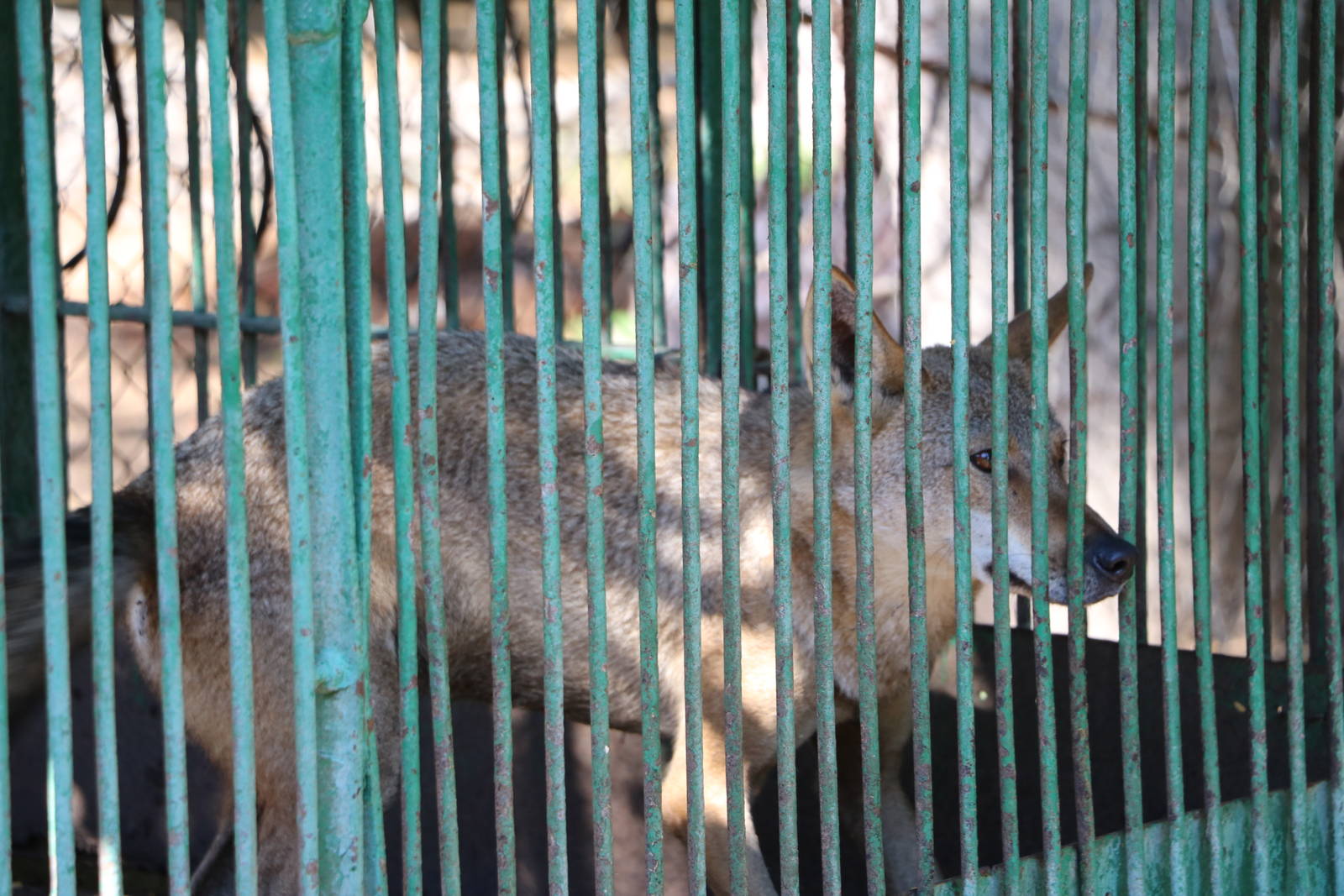
Very excitable - in this shot it's wagging its tail in anticipation of a toddler throwing a ball in front of it. The rest of the time it was pacing at great speed.
Photo taken on the 15th October 2015.
Very excitable - in this shot it\'s wagging its tail in anticipation of a toddler throwing a ball in front of it. The rest of the time it was pacing at great speed.
Photo taken on the 15th October 2015.
the Egyptian wolf isn't the same as the grey wolf. It is a different species entirely (Canis anthus), formerly treated as conspecific with the golden jackal.
the Egyptian wolf isn't the same as the grey wolf. It is a different species entirely (Canis anthus), formerly treated as conspecific with the golden jackal.
Did this paper shed any light on the difference between the African golden jackals and African wolfs, because when Canis lupus lupaster was recognised, they all said that there were 2 types of golden jackal in Africa, of which one was not recognised as a wolf before and that locals already made this distinction between lupaster and aureus....
the African wolf/golden jackal situation seems quite confusing. Back in 2011/2012 the story was that "some" golden jackals in Egypt and Ethiopia were wolves but otherwise regular golden jackals were there also (and all the ones in the rest of east Africa were golden jackals). This year's research papers seem to be specifically separating African wolves and Eurasian golden jackals (i.e. all the golden jackals in Africa are actually the wolves). Of course a lot more specimens have been sampled since 2012 so maybe that is the case.
Anyway, I found this from 2012 (?) on separating the two:
Lupaster looks like a large, blackish-yellow dog. Its tail is brushlike, with black hairs on the end. A mane of long, coarse, black-tipped fur runs from its crown to the base of its tail and onto its shoulders and hips. The golden jackal is smaller than lupaster, with soft, pale fur. Golden jackals are social animals: a breeding pair is often followed by its offspring, and the jackal sometimes forms packs when hunting. Its cry, heard just after dark or shortly before dawn, is a long, wailing howl, often followed by three yelps.
In contrast, lupaster travels alone. A nocturnal creature, it’s sometimes glimpsed as the Sun begins to set, when it emerges from caves and crevices, and from tombs. Whether it howls remains unknown.