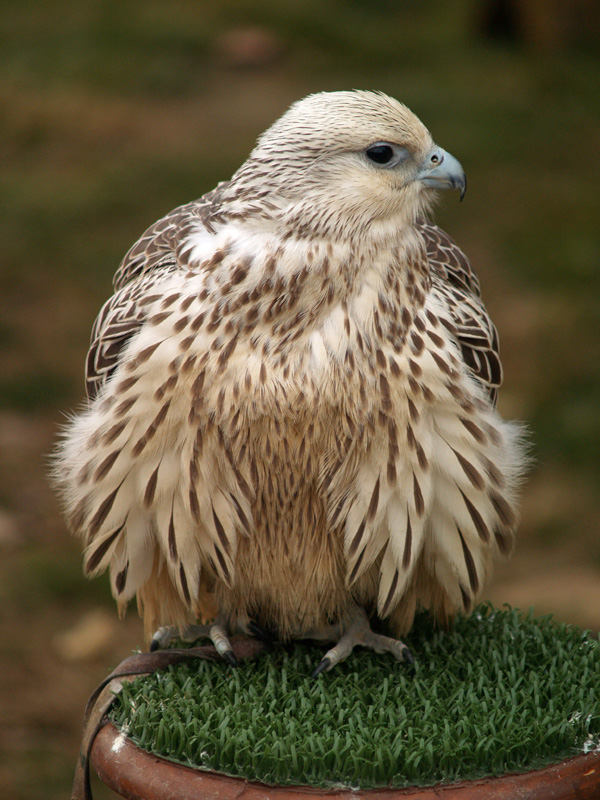
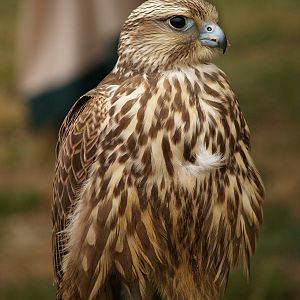
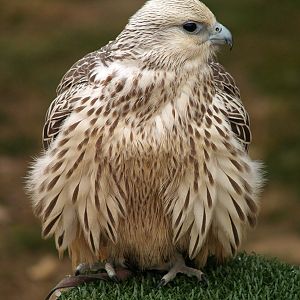
Nope, that's a Saker. I can say this with confidence because our falconry mentor has a Gyr/Saker hybrid, and he's bigger than the bird in the shot (though he has much the same coloration). Also, I've seen some recent photos of Saker falcons, and they look nearly identical to this pic.
Handsome example of the species, though, and still pretty young. Note the powder-blue color of feet and cere. They often turn bright yellow in mature birds.
You're entirely welcome. Honestly, neither am I. The only reason I spotted that one as a Saker is because I'd seen others, and because the hybrid our mentor has exhibits the same pattern on the breast feathers.
For me is a pure gyrfalcon, or as much, an hybrid with 3 parts of gyrfalcon and 1 part of saker. I cared many sakers and they're very different, although I never saw a true pure gyrfalcon (except in photos, clear).
The bird in this photograph is a juvenile gyrfalcon, light phase. The plumage is almost identicle to the photograph of a bird, in the group of plates between pages 112 and 113 in Grossman and Hamlet's Birds of Prey of the World, Copyright 1964, Bonanza Books, New York. The bill's cere and talons being blue is the diagnostic characteristic for the age of this falcon.
For me is a pure gyrfalcon, or as much, an hybrid with 3 parts of gyrfalcon and 1 part of saker. I cared many sakers and they're very different, although I never saw a true pure gyrfalcon (except in photos, clear).
i doubt its a pure gyr but likely to a hybred. Both species have a wide range of colour gyr (black to white) Saker (pale sand to reddish brown)and being closely related many domestic hybreds (to 5th of more generation) are easily produced and there is no set look for a hybred gyr x saker.