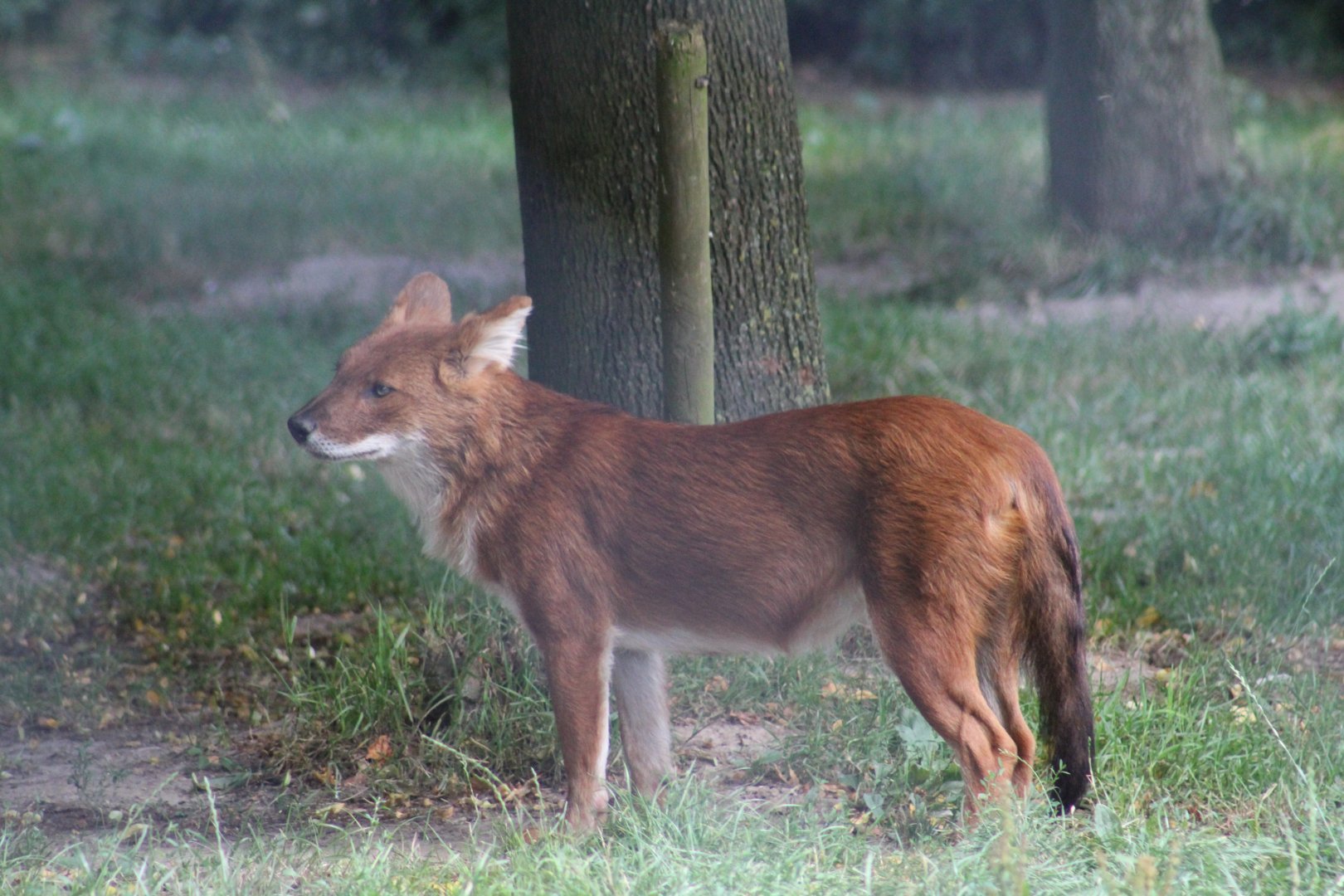
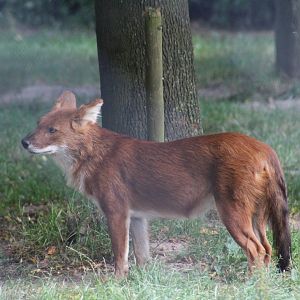
I know The Wilds (owned by Columbus) and Minnesota exhibits them in the US, and San Diego keeps a lot off-show. I think that's it for the US, though. I've always thought they'd look good in Bronx's second Amur Tiger enclosure on the monorail.
I was actually considering trying to go to The Wilds on my recent trip, but they only keep one female and it seemed they were hard to see even with an entire pack. Minnesota is a bit far away for me, as is Toronto (which also keeps just one atm). The SDZ Safari Park, meanwhile, has 29. They recently let a group of people in to see them, just normal visitors, which is a bit maddening for me because I tried every way possible (without spending $500 for a tour of whatever I wanted) to see them. Oh well.
Why Chinese dhole?
I see reference to Ussuri dhole, Indian wild dog, Eastern Asiatic dhole and of course Chinese dhole.
Is the European population sourced from China, hence the tag?
I always thought Aspinall's dholes were originally from India?
@kiang According to Zootierliste Howletts' original dholes came from Taronga and Alberta. All the European animals are listed as subspecies lepturus, i.e. Chinese Dhole, but there's no particular source for this shown so not sure how certain it is that that's all the individuals in reality.
@Maguari: the below is quoted from Kamler, J.F., Songsasen, N., Jenks, K., Srivathsa, A., Sheng, L. & Kunkel, K. 2015. Cuon alpinus. The IUCN Red List of Threatened Species 2015: e.T5953A72477893.
The origin of most captive Dholes is unclear, and their subspecific classification is probably wrong. The most numerous subspecies in captivity is listed as C. a. lepturus, which occurs in at least 20 zoos worldwide and is the most common Dhole in European zoos. Firstly, inbreeding may be an issue because captive Dholes listed as lepturus trace their origin to only three founders: a single Dhole from a game farm in North America with an unknown origin (H. Maisch pers. comm.), and Dholes from the Moscow Zoo, which originated from only two individuals captured in Qinghai Province, China in 1957 (Sosnovskii 1967). Secondly, the Dholes captured in Qinghai Province should represent either C. a. hesperius or C. a. fumosus, from the putative northern Dhole group, rather than lepturus which historically occurred only south of the Yangtze River and is part of the southern Dhole group (Durbin et al. 2004). [...] The European Endangered Species Programme (EEP) does not consider subspecies, but it does regard Dholes in European zoos as a Chinese ecotype, and prevents mixing this type with Dholes from other origins (e.g., India, Cambodia). Nevertheless, the value of any of captive Dholes for potential reintroduction efforts is uncertain, at least until genetic studies can confirm their origin and subspecific classification. Until that time, we recommend that captive Dholes from the putative northern and southern groups be managed separately, such as that done by the EEP.
I've been following the taxonomy that only considers three subspecies of Dhole as valid: alpinus, hesperius, and sumatrensis with lepturus and fumosus being synonyms of the nominate. As for the common name, I've just always heard "Chinese Dhole" used most often for the subspecies so that's naturally the one I've begun calling them by.