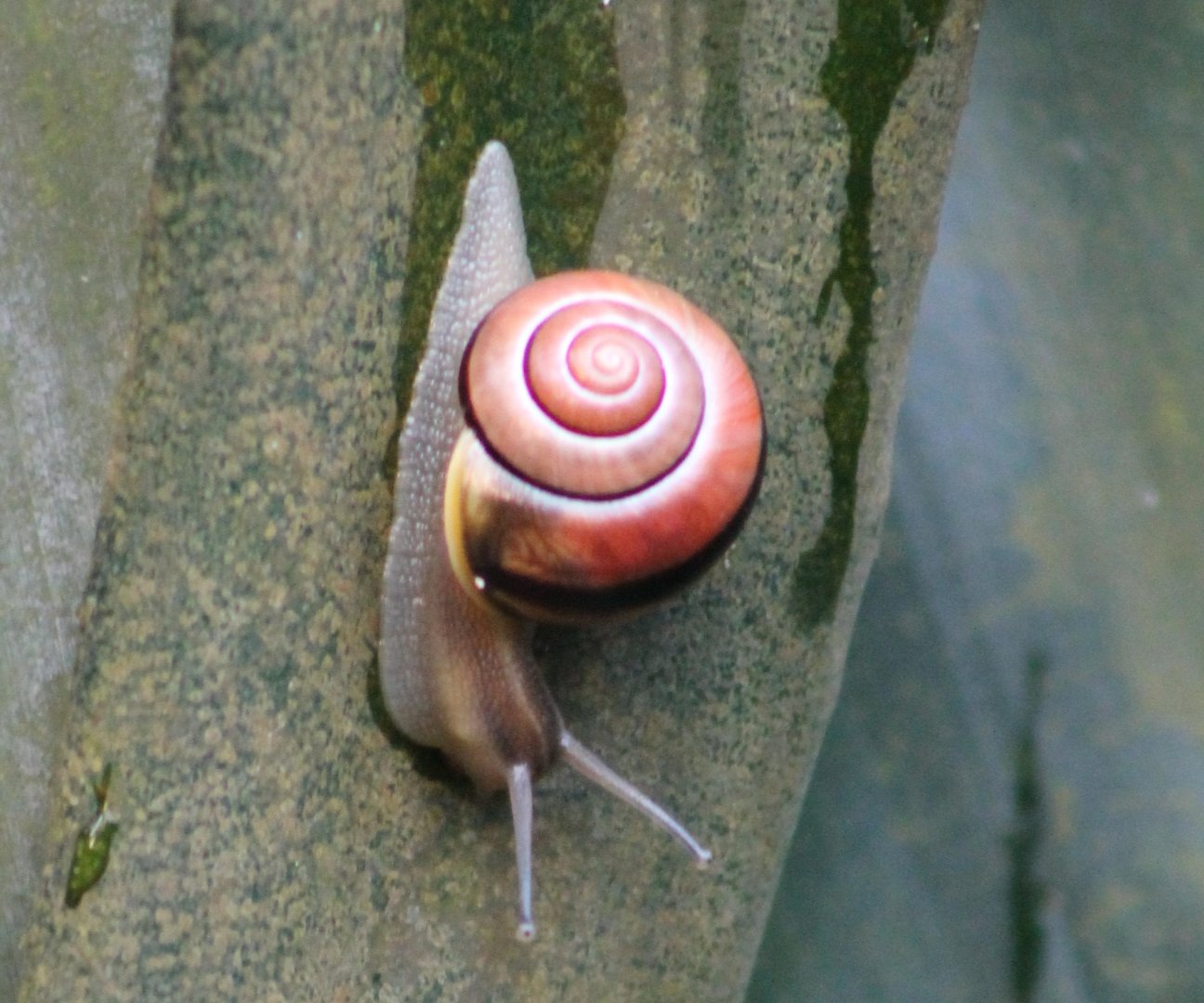
I think this is Cepaea sp., most possibly C. hortensis due to light-coloured lip of the shell. But as far as I know, this character cannot be undoubtedly diagnostic, because some specimens of C. nemoralis also may have light-coloured lip.
@Fishapod The light coloured tip of the shell considers the inside when it is about separating C. nemoralis from C. hortensis. The light tip of the shell here just indicates that it is freshly grown. Based on experience from the Bush and overall shell color, you can safely assume that this is C nemoralis.
@lintworm thanks for clarification!
I was considering the possibility that this snail is still growing, but for some reason I chose the version with C. hortensis.
In this case I have an additional question: what is the difference between these two species in the overall shell color (except for the color of the lip)? Could it be useful as a diagnostic character in the field? Because I thought that both species are very polymorphic and the only reliable diagnostic character to differintiate them is love dart shape (of course this character is hard to use in the field).
@Fishapod in my experience C. hortensis has much less variation in color and in the Netherlands they are mostly light colored with often not even the bands on the shell. C. nemoralis is however extremely variable. A relatively reliable way to separate the two is the overall shape of the shell, C. hortensis is slightly smaller larger and if seen from the front the shell is less bulbous than C. nemoralis.