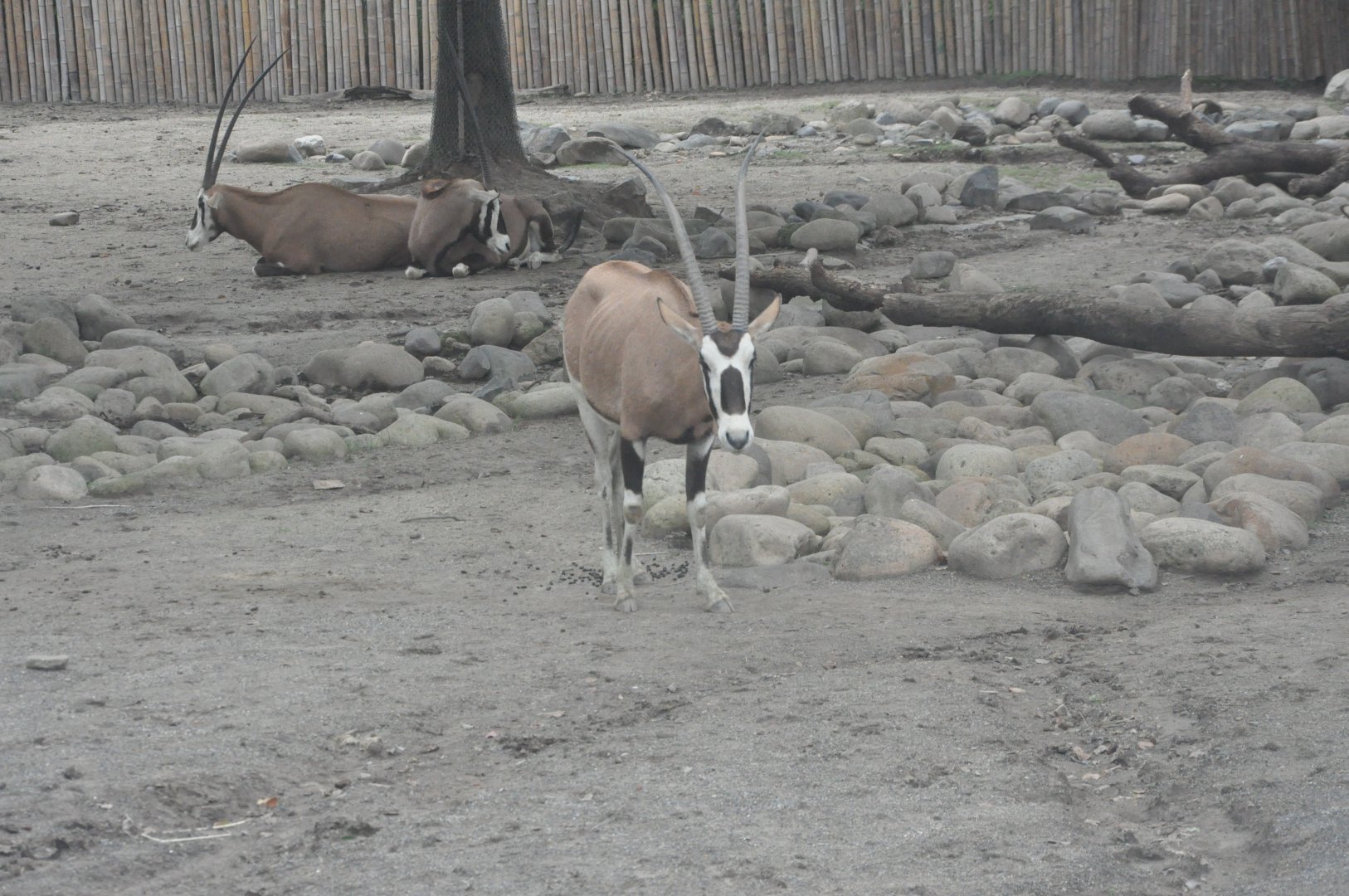
The only easy to see difference between Oryx gazella beisa and nomitate subspecies of Oryx gazella, is the presence of a black patch in the hind legs in the latter. The side of hind legs is visible only on one of the three individuals on this photo, and it have the black patch. So, supposing that all the herd is not mixed, they're not beisa.
@Kakapo@birdsandbats Gemsbok and Beisa are NOT the same species, morphological and genetical research have clearly shown that they are separate species, there are clear morphological and genetic differences and the two species have a different chromosome count. You won't find anyone respectable who lumps these species anymore....
@George_Renard The easiest identification indicators are a large black spot on the rump, which Gemsbok has, but Beisa has not and a black muzzle ring in Gemsbok. As this patch and ring are absent it is clear that they are Beisa oryx. The overall coat color and the thin black stripe between belly and flank indicate the same. Even though the animal in the middle has some more black on the thigh than expected, the muzzle ring is clearly absent.
@lintworm Oh, good to know that you find unrespectable the whole world and every scientist in the world from 1835 (the year the own Rüppell discribed this SUBspecies) to 2005, when Grubb had nothing better to do that split this species in two and wait to be followed. 170 years of knowlegdeable true science are unrespectable, I suppose... They would like a lot to know that they're unrespectable... And I suppoes that a big portion of the taxonomists from this point (2005) forwards, also will be unrespectable as they will prefair to follow the more classical and logical taxonomic school than the "split as far as you can" modern nightmare. Of course that I knew about this oryx splitting since many years ago, but why should I accept it? I don't say that I'm not open to changes, but for accept these changes I will need more exhaustive arguments... The difference in chromosome number is certainly the best argument as I don't know if it can happen between subspecies of the same species, but minor colour differences and the fact of "everybody respectable accepting it now" are not enough relevant for me. I will check about genetics tomorrow when I have time.
@Kakapo Here is the most relevant genetic paper, pairwise sequence diversion is 18-42%, which is extremely high, the two species are not even grouped as sister taxa with Beisa grouped as sister to leucoryx+dammah+gazella:
You are mistinterpreting me. with the current knowledge no respectable scientist lumps these species anymore. That is not to say that Rueppell himself was not respectable, with the available information from then it would indeed not be strange to keep them as subspecies. But the nice thing of science is that it progresses and new information is incorporated and judgements adapted.
I checked now and I have only acces to the abstract, but with your additional arguments of sequence diversion, cladogram position, added to the morphological differences, the big distance in biogeography and the fact of being originated at the Pleistocene, and after consulting a friend (that is expert in genetics) and ask his opinion, I finally decided to accept the change from Oryx gazella beisa to Oryx beisa.