Okay, here's the text explaining the bold claim in the title!
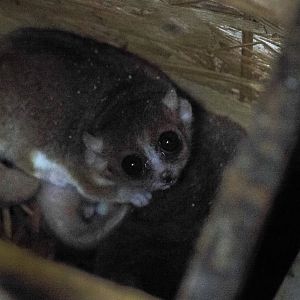
February 2017: On my visits in July 2016 and February 2017 there were three cages tucked away very far behind a few other bird cages in the off-show area, two of which labelled "1,0 Goodman's" and "0,1 Goodman's" respectively (thus referring to Microcebus lehilahytsara), and the other was labelled "1,1 Maki trpasličí "červený."
"Maki trpasličí" is the common czech name for gray mouse lemur (but literally translates to "midget lemur"), and "Maki červený" is the common name for red mouse lemur.
The fact that the "červený" (which literally translates into red) was written between quotation marks made me doubt whether they actually have M.rufus or just (very small, as they were smaller than the M.lelilahytsara right beside them) M.murinus with a slightly more reddish coloration. The keepers present were no real help, as "really small monkeys" was the only thing they knew them by.
What made me wonder the most is that in July 2016, after seeing a lemur in that cage, I added M.rufus on Zootierliste, but quite some time later it suddenly wasn't listed anymore, not in former nor current listings, with no mention of it being taken down on the notice board.
So the options I thought about in February were:
1) They are M.rufus and the zoo wants to keep it a secret that they have them (though I wouldn't know why).
2) They are M.rufus and some misinformed other person removed them from Zootierliste.
3) They're just M.murinus with a slightly more reddish coat than usual and labelled as such (thus "červený" with the quotation marks).
4) They're just incorrectly labelled M.murinus or M.lehilahytsara.
Now: The Plzen Annual Report for 2017 was released today, and in it they mentioned 2,2,0 of their Grey mouse lemurs (Microcebus murinus) turned out to belong to a different, recently described species, Ganzhorn's mouse lemur (Microcebus ganzhorni). This potentially fixes a lot of the problems in the explanation above.
M.rufus I don't think can be an option, because of the fact that the species wasn't in the annual report for either 2016 or 2017. The (silent) removal from zootierliste probably reflects this, by somebody noticing it was mentioned on zootierliste and not on the annual report, and correcting zootierliste as such.
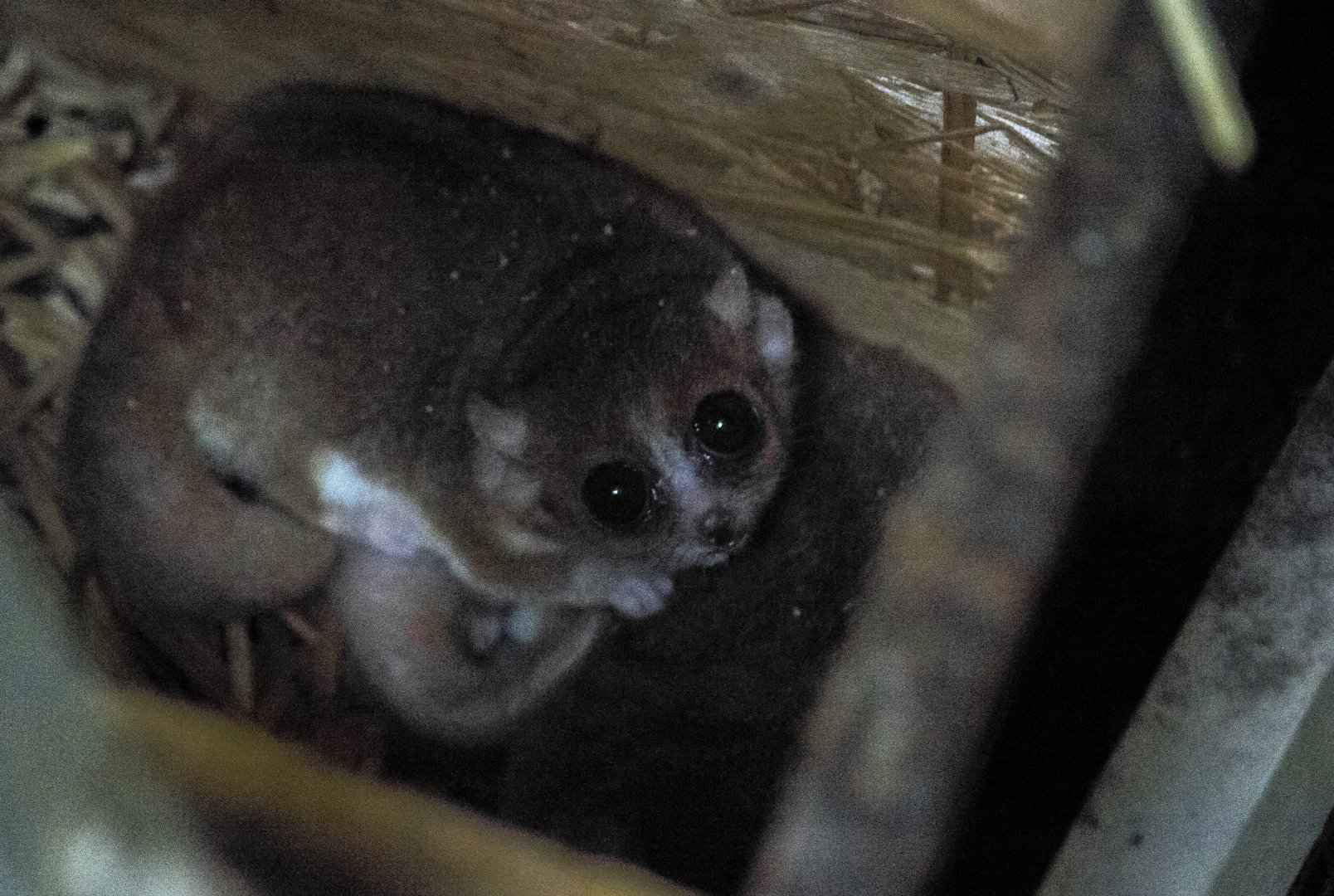
The size difference I think is the main clue; the two animals in the picture were notably smaller than the M.lelilahytsara right beside them. However, it is mentioned in many places that M.murinus is in fact the largest species of mouse lemur, so that doesn't make a lot of sense. I haven't had the time to fully read into the articles about M.ganzhorni, but since this was one of the more "cryptic" splits I assume size differences between M.ganzhorni and the rest of the very similar species will be minimal, and this species will thus generally be smaller than the biggest species, M.murinus (and potentially smaller than M.lelilahytsara).
The label "červený" also makes a lot more sense now, in that Plzen hypothetically noticed these were different, wrote down they were more "red" than the other, "normal" M.murinus they had, and then recently did more research on these "red" ones to see what species they actually belonged to.
It's hard to judge from this picture alone that these might be one species or the other (other meaning either M.murinus or M.lelilahytsara), and of course animals are often mislabelled in zoos (certainly in off-show areas I assume those are not the biggest of concerns), but the combination of the recent research, the note that these are more "red" than the others, and the fact that these were smaller than the M.lelilahytsara next doors made me draw the conclusion that these might be the M.ganzhorni mentioned in the annual report.
Reading the information published about the newly-identified species, M.ganzhorni is a split from M. berthae which is of course the smallest species of mouse lemur - so the size observations made by yourself would tend to corroborate the hypothesis.
Another interesting thing about this picture is that it shows the fat tail well, in which they store fat reserves before the dry season and hibernation. Here's a quote from Wikipedia's article about gray mouse lemurs, which I believe is true for most other species as well:
"Weight varies by season, with both sexes building fat reserves, up to 35% of their body weight, in the tail and hind legs prior to the dry season and periods of dormancy. The tail of the gray mouse lemur can increase fourfold in volume during the wet season when it is storing fat. Even in captivity when environmental limitations are not an issue, mouse lemurs have shown a seasonal dietary preference with a greater protein intake during what would be their more active season."
@ThylacineAlive honestly it's hard to say, because I have had a few extremely different experiences in that area. If the keepers/curators let you roam there alone you have to get lucky (we did see this animal very vaguely through the hole of the nest box in July 2016, but didn't see Goodman's then. The opposite was the case in August 2017, when the Goodman's showed well but these didn't). In February 2017, however, there was a keeper that joined me for most of the morning as I was photographing the mammals, and she fed or handled the animals, and opened the nest box of both species so I could take pictures of them.
Worth noting for anyone keeping track that I am now pretty certain the following image depicts the same species - possibly the same individual, actually:
Moreover, an old post by @Maguari in the following gallery thread opens up the possibility that Jihlava may also hold this species: