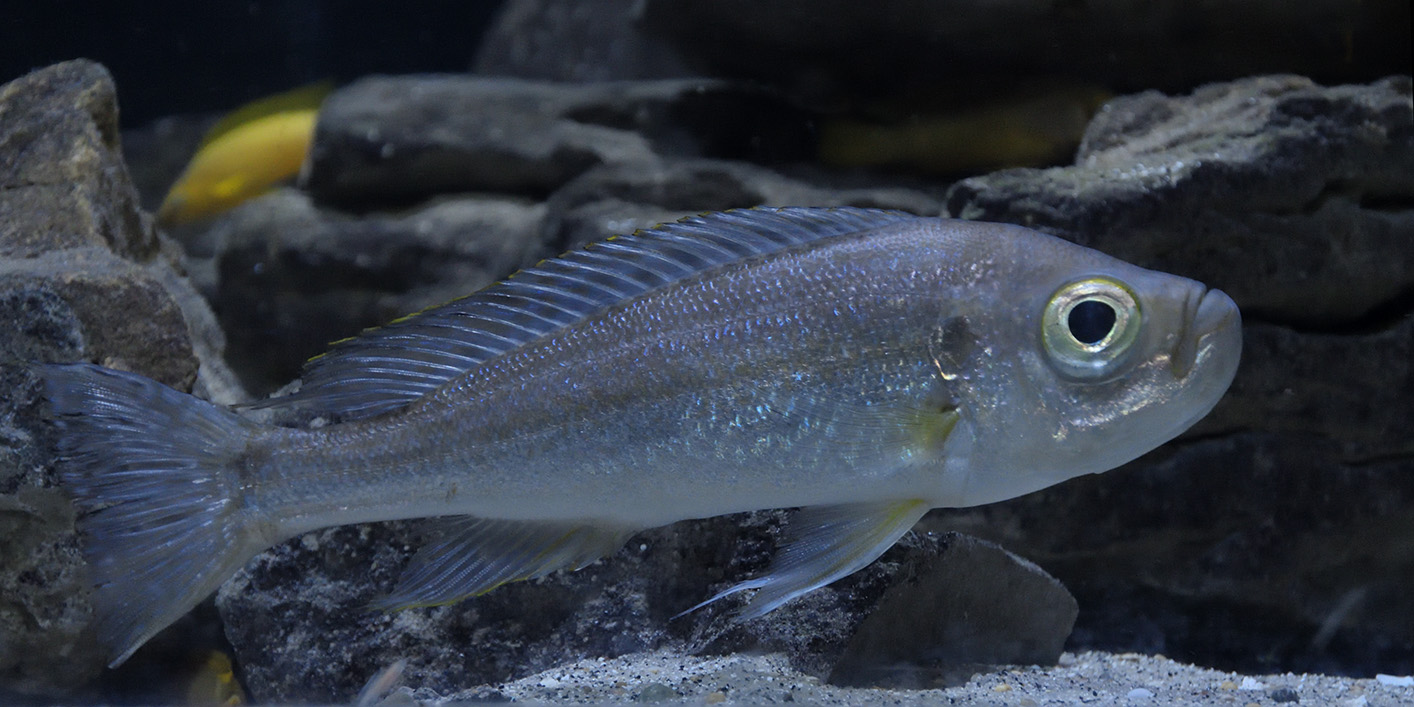
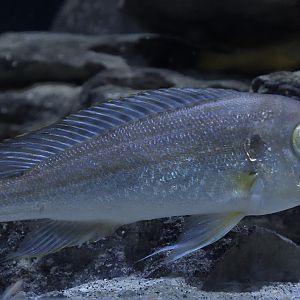
I find Tanganyikan cichlids fascinating. This species is a stealth predator which stalks small fishes from behind and below - hence the unusual shape of its mouth.
@gentle lemur Your aquarium photos are so often so good, as here. Those of us who are not so skilled can only look on in admiration. What tips would you give to achieve this level of excellence?
@sooty mangabey Thank you
The main answer is years of practice, I'm afraid. This experience helps me to observe the fish closely and to anticipate the way it is likely to move around the tank. When I kept fishes, both at home and at work, I used up a lot of film and I almost always used multiple flashguns in those days.
Modern digital cameras are so good at high sensitivities (ISO numbers) that it is often possible to get good results in public aquaria, provided the lighting is decent. I generally underexpose (-1.3 stops) to stop highlights burning out and then I can compensate with software if necessary (I use Nikon cameras, other makes may be different in this respect).
The basic rules are
1 don't bother starting if the glass and the water are not clean (but they don't have to be absolutely immaculate)
2 look for a bright area of the tank without swirling bubbles, if possible
3 always shoot at right angles to the glass of the aquarium (to avoid distortion and refraction)
4 focus on the fish's eye (when you have trained yourself to do this automatically, it is so hard to photograph blind cave fish )
5 try to shoot when the fish's body is parallel to the aquarium glass so that it is in focus from nose to tail. This also makes it easier to identify the species if the labelling is not completely reliable.
6 remember that it is not easy to take a good photo - expect a lot of failures which need to be thrown away, so always take a couple of extra shots to improve your chances a little and celebrate your successes