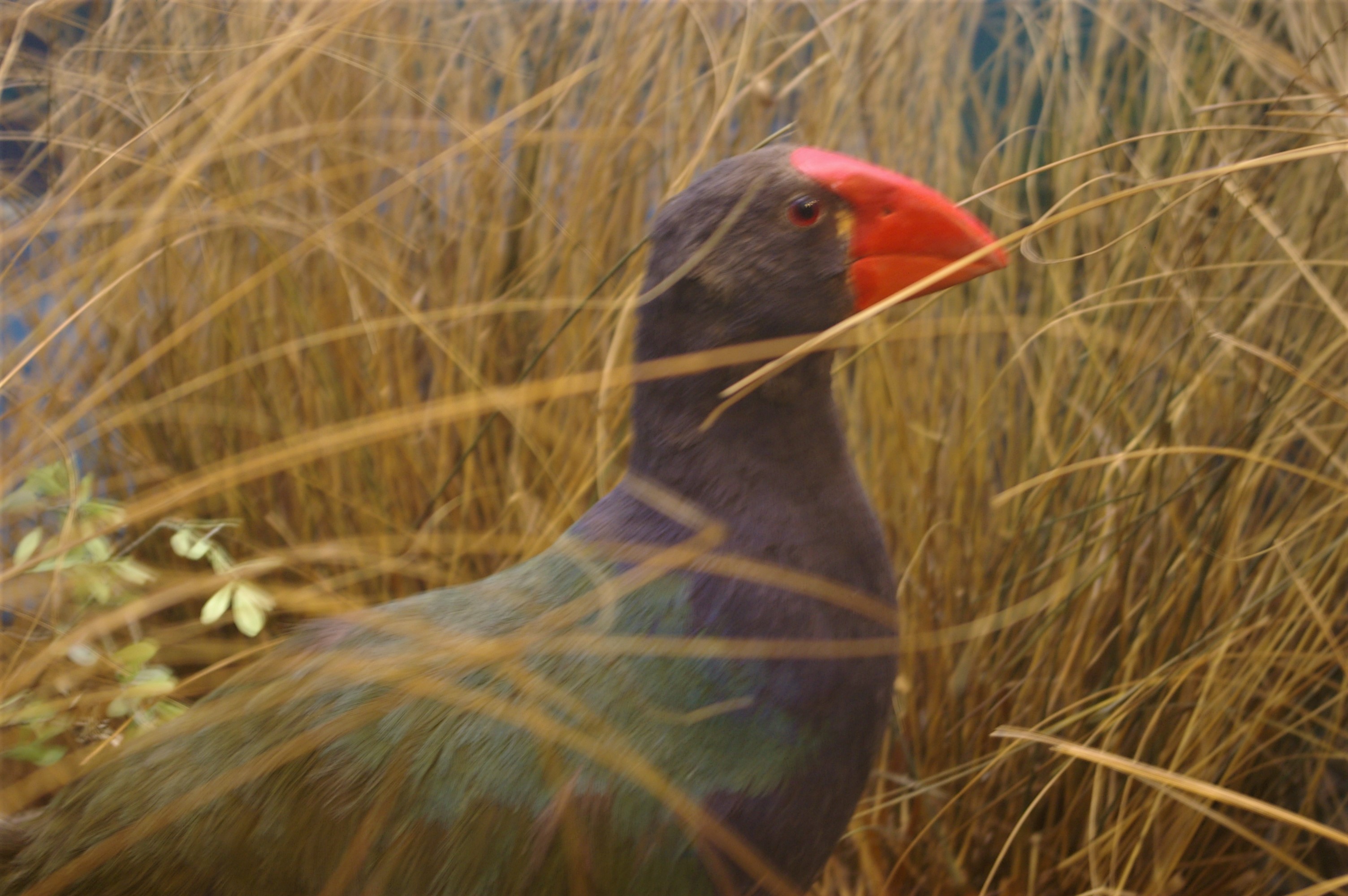
I was looking through my photos and came across this one taken at the Otago Museum in Dunedin in December 2006. It's not the best quality, but it is interesting in that this specimen is one of the four original Takahe caught between 1848 and 1898, after which the species was not recorded again in its living form until rediscovered by Geoffrey Orbell in 1948. It is also the only one of the four which has been on permanent public display (and I'm not sure if the other three specimens were ever on public display at all).
The first living Takahe was caught and eaten by a sealer party in 1848 or 1849 (sources differ) in Dusky Sound, Fiordland. The skin was presented by Mantell to the Zoological Society of London. It is currently still in the British Museum (Natural History) although presumably not on display. The museum catalogue gives the collection year as 1849.
The third specimen was caught in 1879 and purchased by Dresden's State Museum of Zoology, but was destroyed during the bombing of Dresden in World War 2.
The fourth and last known bird (until 1948) was caught in 1898, and is the one pictured in my photo above. The skin was sent to the Otago Museum after capture, where it was mounted and placed on display. I think it has been on display continuously for the last 120-odd years.